Sharp Corner Sha: The Building Edge Pointing at Your Window
Jian jiao sha (尖角煞) is the corner of a building, roof or structure aimed at your door or window — the family of complaint English-language feng shui calls the 'poison arrow'. It is the most abstract of the classical sha, and the one where it is most worth separating what the tradition claims from what is actually going on.
The idea of a pointed form
Chinese formal analysis distinguishes rounded, flowing shapes from angular, pointed ones, and treats the second as concentrating and directing. Water curving toward a site is favourable; the same curve turned outward is the reverse-bow sha. A rounded building corner is unremarkable; a sharp one aimed at a window is a complaint. The principle is consistent across the tradition and applied to natural features as well as built ones — a pointed hill in the wrong relation to a site is read the same way as a gable end. It is a formal aesthetic system before it is anything else, and internally coherent as such.
Alignment is the whole complaint
Practitioners are exact about this and it is the most useful thing to know. A neighbouring building bristling with corners is not a problem unless one of them points at an opening of yours. Assessment is done from inside, looking out — stand at the window or in the doorway and see whether the edge is aimed at you. Distance matters, and so does elevation: a corner well above or below the sight line is discounted. This precision is worth noting because it makes the diagnosis falsifiable in its own terms. A practitioner who finds sha everywhere is not doing the traditional analysis.
What is really across the street
There is an unglamorous account that covers most cases. A building corner close and square-on to a window means: a hard reflective surface bouncing sound back, a wall that blocks sky view and daylight, a form that channels wind at the angle, and — in dense settings — an oppressive outlook from the one place a person looks out from. All of these have documented effects on how people rate a dwelling. The tradition's diagnosis and a surveyor's report on outlook, daylight and acoustics converge on the same window; only the vocabulary differs.
Remedies and the mirror caveat
The physical remedies are to break the sight line: planting, a screen, an awning, a trellis, obscured glazing, or simply a heavy curtain and a rearranged room. The symbolic remedy is the bagua mirror hung outside above the opening, facing the offending corner. One caution deserves stating because it is widely got wrong: a bagua mirror is an exterior device and traditional practice does not hang one facing into a home, nor deliberately at a neighbour's door — the second is understood as an act of hostility, and is the origin of the escalating door-to-door disputes recorded as 'cursing the door'.
Fiction · Tales of the Hidden Path
The Crack
A right-angle corner of the building opposite points straight at his living room.
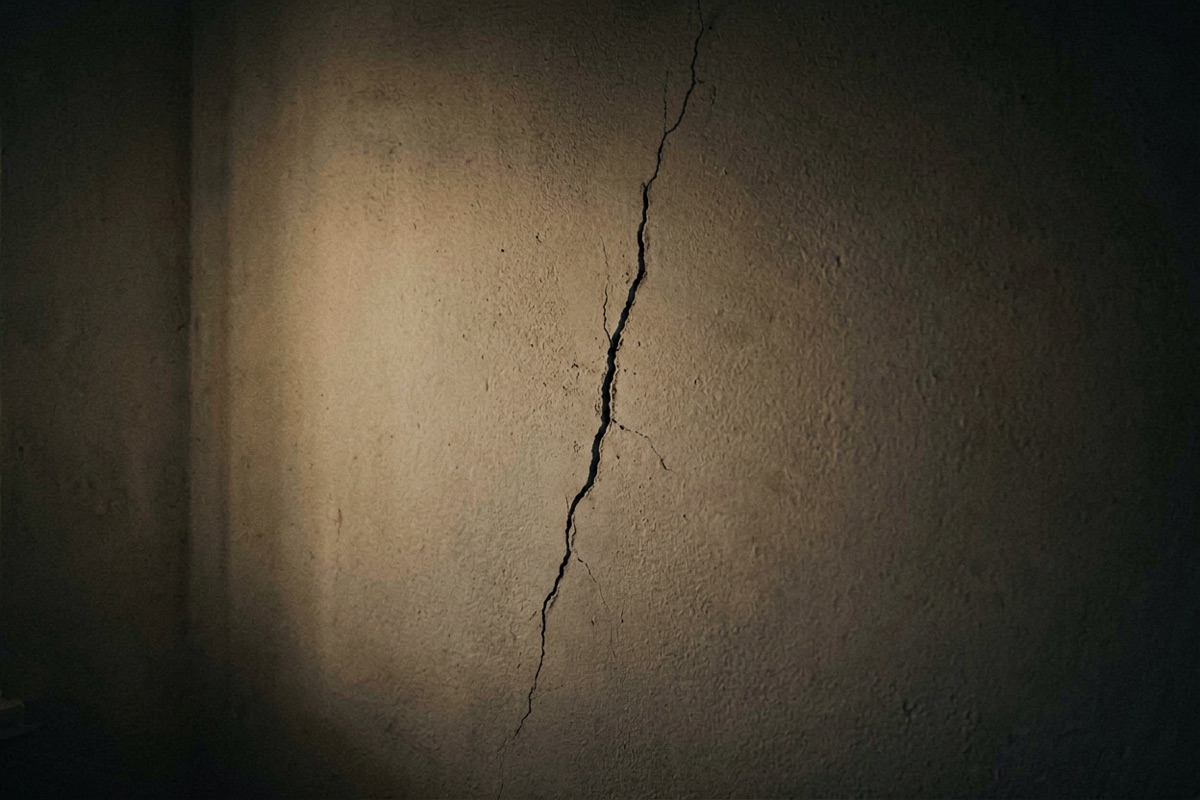
There is a crack in the living room wall, wide at the top and narrow at the bottom, the point of it downward.
He has filled it three times. Filler, sandpaper, emulsion, done carefully each time. Each time it opens again six months later in exactly the same line, not a millimetre out.
The fourth time, before filling, he photographed it and measured with a tape. Thirty-seven centimetres.
Filled it. Six months later it opened. Forty-one.
Six months after that: forty-six.
He made a table. Nine centimetres a year. He started working out how many years until it reached the floor.
Before he did the arithmetic he pulled up the photographs and looked at them one after another.
It was not growing downward.
Each new length appeared at the top. The point at the bottom had never moved. What was extending was the upper end.
The upper end was at the ceiling now, and going on into the floor above.
He went up and knocked. The woman who opened the door looked at him and said: are you here about the crack as well?
She said hers had been filled three times too. She held up a hand to show the height — from the floor upward, with the point at the bottom.
An original short story written for our folklore film series. It is fiction — invented, not a recorded case, not a claim about how any of the customs above actually work. The belief it is built on is real; everything that happens in it is not. See our honesty policy。
The door is where the tradition concentrates its attention. What front-door feng shui asks for, and the practical logic underneath it.
Protecting the Main Door →FAQ
What counts as a sharp corner sha?
A pointed architectural form — a building corner, gable, roof ridge or pylon — aimed at your door or window. Alignment is the whole complaint; a corner not pointing at an opening does not count.
How do I check?
From the inside, looking out. Stand at the window or in the doorway and see whether the edge is square-on to you. Elevation matters: corners well above or below the sight line are discounted.
What is the real effect?
A close, square-on hard surface reflects sound, blocks sky view and daylight, and channels wind at the angle. Those are documented influences on how people rate a home.
Should I hang a bagua mirror?
If used, outside, above the opening, facing the corner. Never facing into a home, and never deliberately at a neighbour's door — the latter is understood as hostile and is how door-to-door disputes start.
Related: The Beam Overhead: Why Feng Shui Moves Your Bed · Glare Sha: When the Building Opposite Throws Light Into Your Home · Free BaZi Calculator · Free I Ching Reading