The Beam Overhead: Why Feng Shui Moves Your Bed
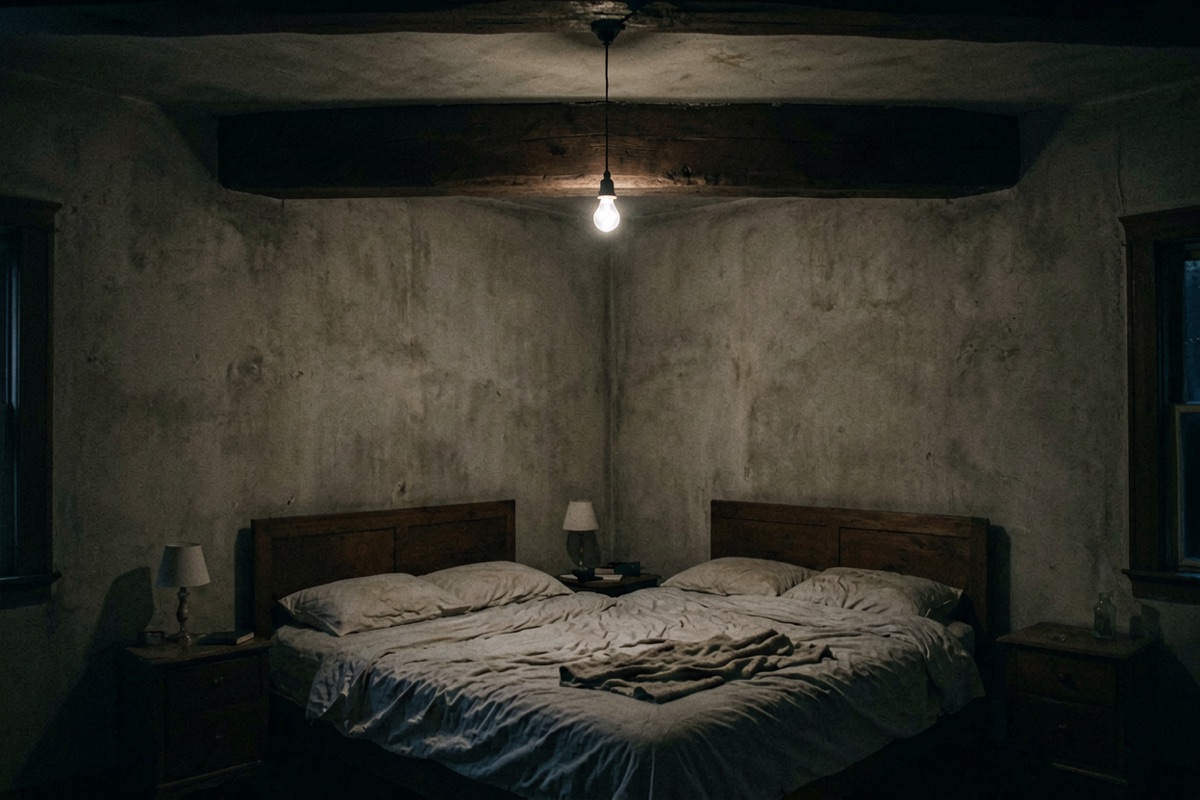
If you consult a feng shui practitioner about a bedroom, the first thing they look at is the ceiling. A beam crossing directly over the bed — heng liang ya ding (横梁压顶), 'the crossbeam presses the crown' — is the most frequently cited residential defect in the whole tradition, and the remedy is always the same: move the bed.
What the tradition says
The beam is described as producing downward pressure on whatever sits beneath it, and the reading is specific to what is underneath: a beam over the bed is read against health and sleep, over the stove against the household's finances and the cook's wellbeing, over a desk against the occupant's work and prospects, over a seat against whoever habitually sits there. Practitioners will note the beam's depth and how low it hangs — a shallow beam in a high ceiling is treated as minor, a deep beam in a low room as serious. The complaint has been in the literature for a very long time and is one of the few residential rules on which every school agrees.
The ordinary explanation
There is no need to choose between the traditional account and a physical one, because both produce the same advice. A heavy visible mass hanging low above a bed sits in the peripheral vision of someone lying down, and peripheral vision is what the nervous system uses for threat detection. Rooms with exposed low beams also concentrate warm air, and beams commonly mark where services run, which means noise. People sleep worse under them. The tradition noticed this several hundred years before anyone measured it and encoded the observation in the vocabulary available at the time.
The remedies, in order
Practitioners are unusually pragmatic here. The first remedy is to move the bed, and if the bed can be moved nothing else is needed. The second is to conceal the beam — a false ceiling, a canopy, a bed drape — on the reasoning that a beam that cannot be seen does not press. Only when neither is possible do the symbolic cures appear: a pair of bamboo flutes hung at an angle on the beam, gourds, or a length of red cord. Note the ordering. A tradition that reaches for the flutes first would be superstition; one that reaches for them last, after the two physical solutions have been ruled out, is doing something more like triage.
Beams in modern flats
Reinforced concrete has made the problem more common rather than less. Older timber-framed Chinese houses had regular beam spacing that room layout could work around; modern apartments have irregular downstands wherever the structure requires them, frequently in exactly the position a bed wants to go, and ceiling heights have come down. Practitioners working on new-build flats report that the beam complaint now accounts for a large share of residential consultations. The remedy has not changed. It is still: move the bed, and if you cannot move the bed, cover the beam.
Fiction · Tales of the Hidden Path
The Beam's Shadow
It was a rented room in a sixties block, one beam running across the ceiling directly over the bed. The landlord raised it himself at the viewing: this one is hard to let, and that beam is why.
He took it. Eight hundred and twenty a month.
Around four in the afternoon the beam's shadow fell across the bed — a band, dark, about as wide as the beam. He tore off a strip of surgical tape and stuck it at the shadow's edge, to mark it. No particular reason.
The next day at four the shadow was outside the tape, two centimetres nearer the pillow.
He put down another strip.
After that he did it daily. On overcast days too — no sun, and the shadow was still there and still moved. With the ceiling light on at night it lay in the same place.
Forty-one days, and the edge of it reached the pillow.
That night he slept on the sofa. In the morning there was a deep depression in the middle of the pillow with the buckwheat husks pushed out to either side.
He peeled up all forty-one strips and laid them out on the floor in order.
The spacing was not even. There was a stretch in the middle where they were bunched close together, with wider gaps before and after.
He counted the bunched ones: seven.
He had been away for those seven days. He had gone home for a funeral. The room was locked and the key was in his pocket.
An original short story written for our folklore film series. It is fiction — invented, not a recorded case, not a claim about how any of the customs above actually work. The belief it is built on is real; everything that happens in it is not. See our honesty policy。
The beam is one item on a longer list. The command position, the door, the mirror and the five standard bedroom fixes.
The Whole Bedroom →FAQ
Is a beam over the bed actually a problem?
Traditionally yes, and there is an ordinary reason that agrees: a low visible mass above a sleeping position sits in peripheral vision and disturbs rest. Both accounts give the same advice — move the bed.
What if I can't move the bed?
Conceal the beam: a false ceiling, a canopy or a drape. Tradition holds that a beam which cannot be seen does not press. Symbolic cures come third, after both physical options are exhausted.
Does it matter what is under the beam?
Yes. Over a bed it is read against health and sleep; over the stove against household finances; over a desk against work; over a habitual seat against whoever sits there.
Do bamboo flutes work?
They are the traditional symbolic cure, hung at an angle on the beam. Practitioners themselves treat them as a last resort — the physical remedies come first, which tells you how the tradition ranks them.
Related: Glare Sha: When the Building Opposite Throws Light Into Your Home · Sky Slice Sha: The Gap Between Two Buildings · Free BaZi Calculator · Free I Ching Reading