The Rice Measure: Borrowing Grain and the Dipper on the Altar
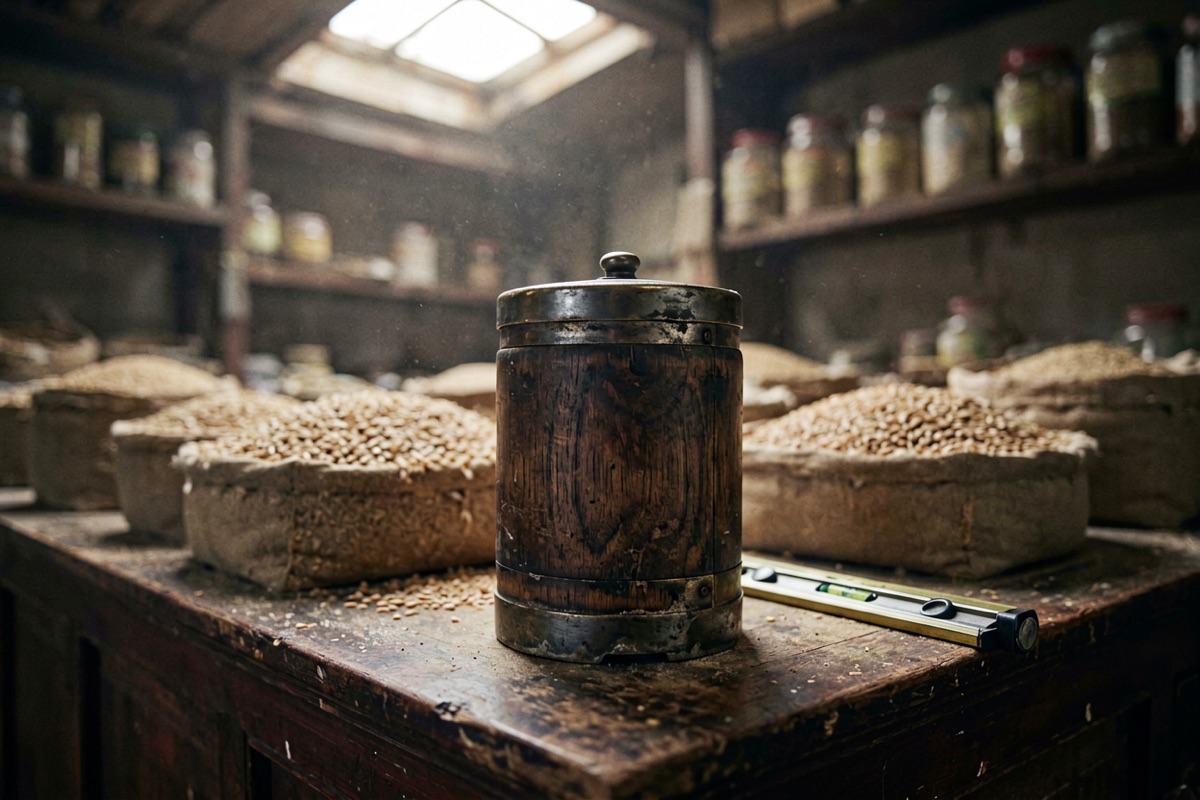
The dou (斗) is a squat wooden box, wider at the mouth than the base, used to measure grain. For most of Chinese history it was two things at once: the instrument by which a village extended credit to its poorest households, and — filled with rice and set on an altar — the central object of a Taoist rite concerning the length of a life. It is worth understanding why the same object does both jobs.
Credit in grain
Rural Chinese credit was overwhelmingly grain credit. A household short in spring borrowed a measure from a granary, a lineage store or a wealthier neighbour, and repaid at harvest with an increment — commonly steep, and in bad years compounding into arrangements that took generations to clear. The instrument of the whole system was the dou, and its handling was where the trade actually happened: whether the measure was struck level with a stick or heaped, whose dou was used, and whether the lender's dou and the borrower's were the same size. Standardising measures was accordingly a recurring imperial preoccupation, and manipulating them a recurring rural grievance.
How debts were remembered
Illiteracy made paper contracts useless for much of the population, so debts were recorded physically: notches cut into a stick or into the base of the measure itself, split tallies with each party holding a half, knots in cord. A notched record has a property paper does not — it cannot be revised without the alteration being visible, and the mark deepens and darkens with handling until an old debt looks old. Anyone who has held a worn tally understands immediately why Chinese moral vocabulary is so full of accounting metaphor. Obligation in this culture is not felt as an abstraction. It is felt as a mark somebody cut, which is still there, and which anyone can read.
The dou on the altar
The same measure, filled with uncooked rice, is the centre of one of Taoism's most widely performed rites for the living. In bai dou (拜斗), the Dipper rite, the rice-filled dou stands for the petitioner's own life-star among the Northern Dipper's seven, and is furnished with a set of implements placed into the grain — a lamp, a mirror, a sword, scissors, a ruler, a balance and an umbrella, each with an assigned meaning. A lamp is lit and tended for the named person. The rite is standard temple liturgy in Taiwan and Fujian, performed for birthdays, for illness, and at the turn of the year, and it is where the Dipper's role in recording death becomes something a family can address.
One object, two ledgers
It is not a coincidence that Chinese has the same word for the box that measures a loan and the box that stands for a lifespan. Both are ledgers. The grain measure records what a household owes and to whom; the altar dou records a person against a star that is held to keep the register of their days. The moral principle of chengfu (承负) — that consequence carries over, and that what is not settled in one generation is carried by the next — is grain credit generalised into cosmology. Anyone who has watched a village debt pass from a father to a son will recognise the model, and will understand why the Chinese afterlife has always been staffed with clerks.
Fiction · Tales of the Hidden Path
The Rice Measure
In the old days you did not borrow money. You borrowed rice. One measure out, one measure back at year's end, and the shopkeeper's stick came across the mouth of the dou to strike it level so that everyone could see what a measure was.
He borrowed three years running and paid none of them back.
The fourth spring the shopkeeper turned the measure upside down on the counter, and on the base of it were cut a row of deep lines, worn shiny from handling. One measure, one year, the shopkeeper said.
He put his hand flat on the counter and held it there a while. Then he pressed his thumb against the lines and signed for three.
He was forty-two that year. The hand that pushed the door curtain aside on his way out was already older than the hand that had come in. By the next year he looked fifty. By the year after, sixty.
In the fourth year he came back to redeem it, and the shop was darker than he remembered, and the man behind the counter was not the shopkeeper. It was a young man drawing the stick across the mouth of the measure with exactly the shopkeeper's motion.
Where's the owner, he said, in a voice that had gone thin.
The young man set the stick down. I am, he said.
The old man's hands went out to the counter and stayed there, shaking. Behind them on the counter the measure sat upside down, and there were more lines cut into its base than there had been three years ago, and the last few were very new.
An original short story written for our folklore film series. It is fiction — invented, not a recorded case, not a claim about how any of the customs above actually work. The belief it is built on is real; everything that happens in it is not. See our honesty policy。
The Dipper keeps the register of a lifespan — which is why Chinese folk belief has always asked whether the entry can be amended. What the tradition actually says.
Borrowing Years →FAQ
How big is a dou?
It varied by period and region and was a recurring target of imperial standardisation. As a unit it equals ten sheng; what mattered locally was whose dou was used and whether the grain was struck level or heaped.
What is 拜斗?
The Taoist Dipper rite, in which a dou filled with rice represents the petitioner's life-star among the seven stars of the Northern Dipper, furnished with a lamp, mirror, sword, scissors, ruler, balance and umbrella. It petitions for wellbeing and long life.
Why is the Northern Dipper associated with lifespan?
From the formula that the Southern Dipper records birth and the Northern Dipper death. It is the same cosmology that underlies the folk belief in borrowing years.
How were grain debts recorded?
Physically — notches cut into a stick or into the base of the measure, split tallies with each party holding half, or knotted cord. A cut record cannot be quietly revised, which is precisely why it was used.
Related: Foundation Sacrifice: The Bridge That Needed a Name · The Shadow: Chinese Beliefs About What Follows You · Free BaZi Calculator · Free I Ching Reading