Foundation Sacrifice: The Bridge That Needed a Name
Almost every old Chinese bridge that has been rebuilt more than twice carries the same rumour: that it only stood when something was put underneath it. Da sheng zhuang (打生桩) — 'driving the living pile' — is the belief that a great structure requires a life in its foundation. It is one of the most widespread construction legends on earth, and one of the most poorly evidenced, and both of those facts are interesting.
The legend and its distribution
The story has a fixed shape wherever it turns up. A structure will not stand; repeated collapses; a specialist declares it needs a foundation; someone is placed in it — a child, a stranger, a volunteer, the first person to pass at dawn — and afterwards the structure stands. Folklore scholarship treats this as a single international type: the Balkan ballads of the Bridge of Arta and the Building of Skadar, the Japanese hitobashira 'human pillar' tradition, South Asian and Central European versions, and the Chinese da sheng zhuang. The distribution is far too wide for cultural borrowing to account for it. What is universal is not a practice but a question — what does something this large cost — and every building culture has answered it with the same story.
The Chinese version's distinctive twist
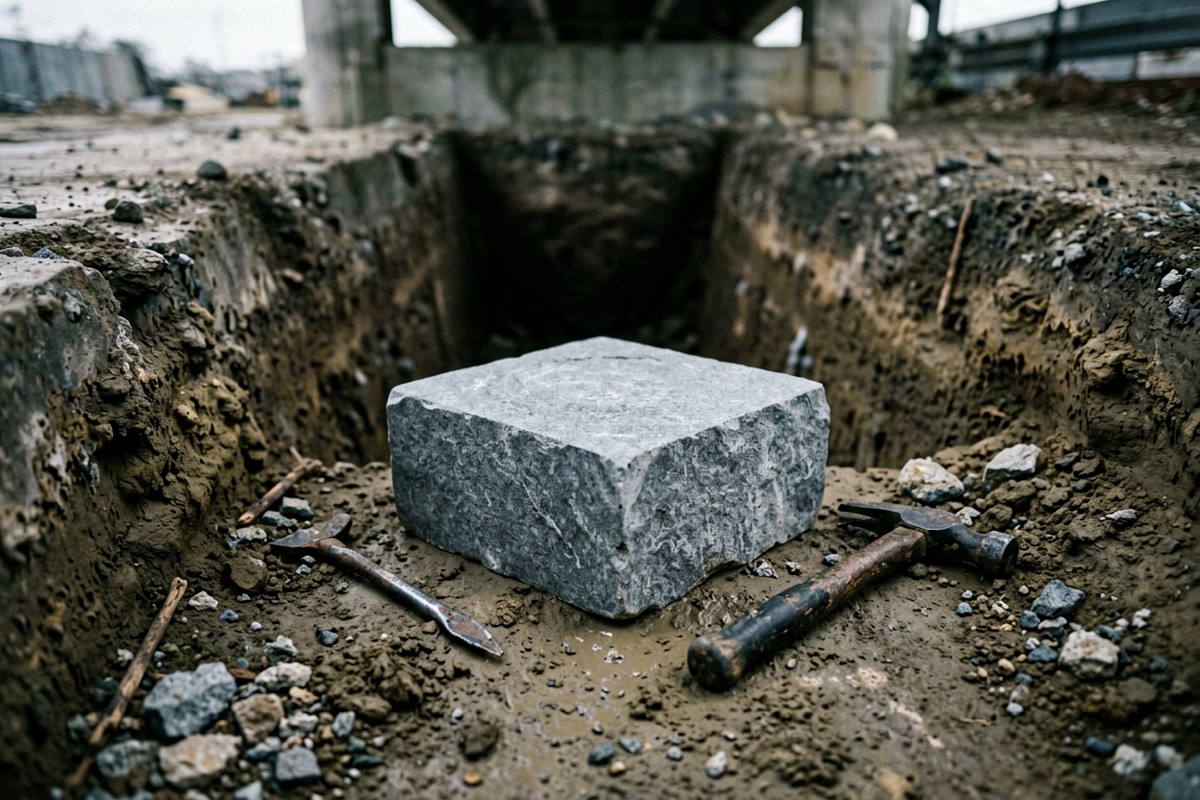
Chinese tellings differ from the Balkan ones in a way that is very characteristic. Where the European ballads bury a body — usually the master builder's wife, walled in alive — Chinese versions more often bury an inscribed stone. A block is cut, a living person's name is carved on it with their consent, and the stone goes into the foundation; the person walks away and lives. This is the same premise that runs through Chinese effigy and petition practice: the name is the person for ritual purposes. It makes the Chinese form of the legend both less gruesome and considerably more unsettling, because it leaves the donor alive and walking around with an arrangement in force under several tons of masonry.
What the evidence actually shows
There is no documentary basis for treating foundation sacrifice as a normal part of Chinese construction. Building manuals do not describe it; official records do not budget for it; the archaeology of Chinese bridges and city walls does not produce it. What the record does contain, in overwhelming quantity, is death by construction — labour conscription, cold, hunger, cave-in and collapse on the walls, canals and dams of every dynasty. The Meng Jiang Nü legend, in which a woman's weeping brings down a section of the Great Wall to reveal her husband's bones inside it, is the culture's own commentary: the wall is full of the dead, not because they were offered, but because that is what building it cost.
Why the story will not die
The legend still surfaces during modern construction. Rumours of children buried under bridge piers circulated in Hong Kong and southern China within living memory, and comparable rumours attach to large projects worldwide. Folklorists reading these note the pattern: they cluster around projects that are large, imposed from outside, and have already caused local harm — displacement, demolition, deaths on site. The story is a way of saying something true about a project in a form nobody can prosecute you for. Read that way, da sheng zhuang is not superstition about masonry. It is a rumour about power, which is why it is always about who is put into the foundation and never about the stone.
Fiction · Tales of the Hidden Path
The Foundation Stone
The bridge had been rebuilt three times: washed away, collapsed, washed away again. The old mason said what everyone in that county expected him to say — that a bridge needs a foot to stand on. Bury a stone in the foundation with the name of a living person on it. Somebody willing.
A stranger passing through said he had nobody, and stood at the edge of the pit with his bundle at his feet while the chisel went in.
They dropped the stone in the trench and filled it. The bridge did not fall again. The stranger walked away the next morning over his own foundation and was gone by noon, and the village said the method worked, and the years went by.
Thirty years later the bridge wanted work again, and the mason who came was the old man's apprentice, grown and grey at the temples himself.
The spade hit stone about four feet down. He knelt and cleared the mud off with his sleeve, meaning to cut a new name into the same block and put it back.
The characters came up out of the mud one stroke at a time and he could not read them at first, in the way that you cannot read something you are not expecting.
It was not the stranger's name.
It was his own, cut thirty years ago, when he had been nine years old and holding the old man's tools.
He knelt in the mud at the edge of the trench with it in both hands for a long time. The stone had never recorded who paid. It had recorded who would come to dig it up.
An original short story written for our folklore film series. It is fiction — invented, not a recorded case, not a claim about how any of the customs above actually work. The belief it is built on is real; everything that happens in it is not. See our honesty policy。
What Chinese tradition actually says about where and how to build — the siting logic behind feng shui's oldest branch.
Yangzhai: Siting a Building →FAQ
Did the Chinese really bury people in bridges?
There is no documentary or archaeological evidence for it as a construction practice. The belief is widespread and old; the practice is not attested. Folklorists classify it as an international migratory legend rather than a historical custom.
What is 打生桩?
Literally 'driving the living pile' — the belief that a life must go into a foundation for the structure to stand. In Chinese tellings the offering is often a name carved on a buried stone rather than a body.
Is this related to Japanese hitobashira?
It is the same tale type. Hitobashira ('human pillar') is the Japanese form; the Balkan Bridge of Arta ballads are the European form. The wide distribution is why scholars treat the story as a type, not a record.
What is the Meng Jiang Nü story?
One of China's four great folktales: a woman travels to the Great Wall to bring her conscripted husband winter clothes, learns he is dead, and weeps until a section collapses and reveals his bones. It is the tradition's own statement of what building the Wall cost.
Related: The Shadow: Chinese Beliefs About What Follows You · Borrowed Mouths: Spirit Mediums Who Speak for the Dead · Free BaZi Calculator · Free I Ching Reading