The Shadow: Chinese Beliefs About What Follows You
At a traditional Chinese burial, at the moment the coffin is lowered, the people standing at the graveside take a step back. The reason given is precise and is the same across a very large area: nobody's shadow must fall into the pit. It is one of the clearest surviving traces of an old and widespread idea — that a shadow is not merely an absence of light but a part of the person casting it.
Stepping back at the graveside
The rule is one of the most consistently reported in Chinese burial custom. As the coffin goes down, mourners move so that no one's shadow crosses the opening; in some regions the grave is deliberately dug and oriented, or the burial timed, to make this easier. The stated consequence of failure ranges by locality — illness, a wasting of vitality, being 'pulled' — but the shape of the belief never changes: what goes into that hole is not coming out, and part of you is capable of going into it. It is a rule about accidental inclusion. The interment is a transaction with a strict guest list, and a shadow is treated as capable of being counted in error.
A shadow as a part of a person
Chinese thought's plural soul makes room for this without strain. If a person consists of hun and po in several parts, and if a name, a worn garment and a birth date can all serve as handles on that person in ritual, then a shadow — which is attached, which moves with you, which cannot be given away — is an obvious candidate for the same status. Hence the smaller everyday rules: do not tread on someone's shadow, particularly a child's; do not let your shadow fall across an altar offering or a person who is ill; do not sleep where a beam's shadow crosses the bed. None of these is doctrinally systematised anywhere. They persist as habits, which is generally how the oldest beliefs travel.
Noon, and the absence of shadow
Chinese folk cosmology divides the day by the balance of yin and yang, and noon — the hour of wu (午), the peak of yang — is when shadows are shortest and the world is held to be at its most exposed. This produces a pair of opposite rules that appear side by side in different regions: some hold that noon is the safest hour because yang is at maximum, others that certain things are transacted precisely then because everything is visible and nothing can hide. What both agree on is that shadow length is meaningful information. In a culture that reads a person's shadow as part of them, the hour at which shadows nearly vanish is not going to pass without comment.
The camera and the shadow
When photography arrived in China in the nineteenth century, one of the recorded popular anxieties was that it took something from the sitter — the same reaction documented across a great many societies encountering the camera. It is easy to condescend to; it is more useful to notice that the reaction is consistent with everything above. A photograph is a fixed shadow that can be carried away by a stranger, and every prior Chinese belief about likeness, name and shadow points to that being a matter for concern. The anxiety faded within a couple of generations, but the residue is visible in modern rules — that portraits of the dead belong on the altar, that you do not photograph a funeral, that you ask before photographing an elder.
Fiction · Tales of the Hidden Path
Shadow Trade
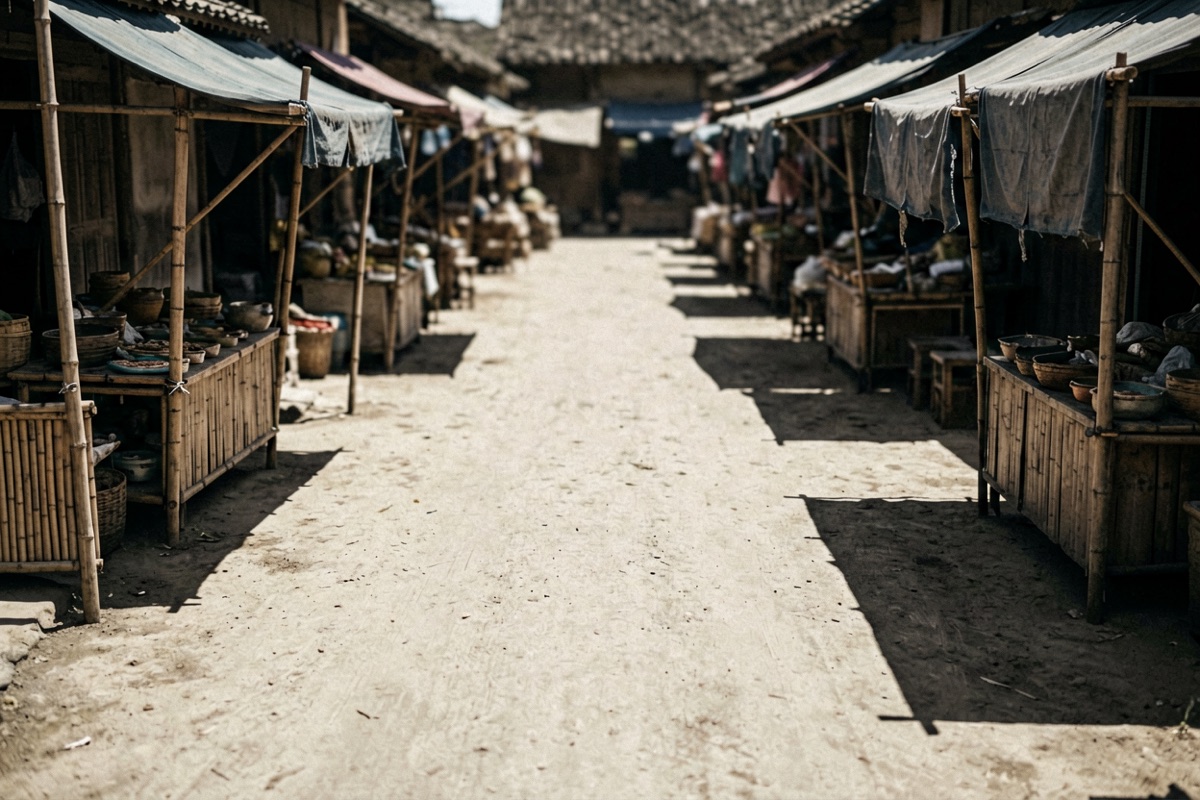
At noon everything has a shadow. That was how you found his stall — you walked the market with your eyes down and looked for the patch of ground where there wasn't one.
He bought shadows. Three silver coins each, and he did not ask where they came from. A poor man crouched at the cloth and asked what happened afterwards, and the buyer said, in a completely level voice: don't go out at noon, don't light a lamp at night. And nothing else.
The poor man took the three coins. The shadow he had been standing in went pale and then was not there.
He built a house with the money. He married. He had a son. For twenty years he stayed indoors at midday with the shutters papered over, and for twenty years there was no lamp in that house — a socket on the beam and nothing in it, and everyone in the family used to it.
The boy was seven when he brought the bulb home and held it up in both hands and said he wanted to see his father.
His father stood on a stool and screwed it in and the room came up white.
On the wall there was his wife's shadow, and his son's, and where his own should have been there was nothing at all. The boy went over and put his hand flat on the plaster and said: father, where's yours?
He opened his mouth and nothing came out of it.
On the wall, the boy's shadow raised one hand.
The boy's own hands were at his sides.
An original short story written for our folklore film series. It is fiction — invented, not a recorded case, not a claim about how any of the customs above actually work. The belief it is built on is real; everything that happens in it is not. See our honesty policy。
Chinese thought describes a person as a composite of forces rather than a single thing. The five-element model is where that idea becomes practical.
The Five Elements in a Person →FAQ
Why do mourners step back when the coffin is lowered?
So that no living person's shadow falls into the open grave. The belief is that a shadow is a part of the person, and that anything in the grave when it closes stays there.
Is stepping on someone's shadow really taboo?
It is a minor but widespread avoidance, applied most strongly to children and elders. It sits alongside the graveside rule and rests on the same idea about what a shadow is.
Is a shadow one of the hun or po?
There is no canonical assignment — the shadow is not systematised in the classical soul schemes. It functions in folk practice as one of the handles on a person, alongside the name, the birth date and worn clothing.
Do people still observe the graveside rule?
Yes. It is one of the burial customs most reliably enforced by older relatives at Chinese funerals, often without anyone present being able to explain why beyond 'you step back'.
Related: Foundation Sacrifice: The Bridge That Needed a Name · Borrowed Mouths: Spirit Mediums Who Speak for the Dead · Free BaZi Calculator · Free I Ching Reading