Borrowing Years: The Chinese Belief That Lifespan Can Be Transferred
Among the oldest ideas in Chinese folk religion is that a lifespan is a number written in a ledger — and that a written number can, in principle, be amended. Jie shou (借寿), 'borrowing years', is the belief that a healthy relative can petition to transfer some of their own allotted span to someone dying. It appears in classical anecdote, in village practice, and in a great deal of fiction. Here is where the idea comes from and what the tradition itself says about it.
The ledger behind the idea
Chinese popular religion has long imagined the afterworld as an administration rather than a landscape — offices, registers, clerks and stamped documents. Within that picture, the length of a life is data: an entry with a name and a figure beside it. The most durable expression is the pairing of the two Dipper constellations, summarised in a formula every practitioner knows: the Southern Dipper governs the record of birth, the Northern Dipper the record of death. Because a register is a made thing, it can be petitioned about. This is the structural reason 'borrowing years' feels natural inside Chinese cosmology and strange outside it — you do not bargain with fate, but you might file a request with an office.
Yan Chao and the two officials
The story that fixed the idea in Chinese literature is told of the diviner Guan Lu, and appears in the fourth-century collection Soushen Ji. Guan Lu tells a farmer that his son Yan Chao will die at nineteen, then instructs him: on a certain day, take wine and dried venison to a particular place under a mulberry tree, where two men will be absorbed in a board game. Serve them without speaking. When the game ends the officials, having eaten, are embarrassed to have taken hospitality from a petitioner. One opens a register, and the figure nineteen is amended to ninety. The tale is repeated for fifteen centuries because it is precise about the mechanism: no magic, no force — a document, an official, and an obligation created by a gift.
What village practice actually looked like
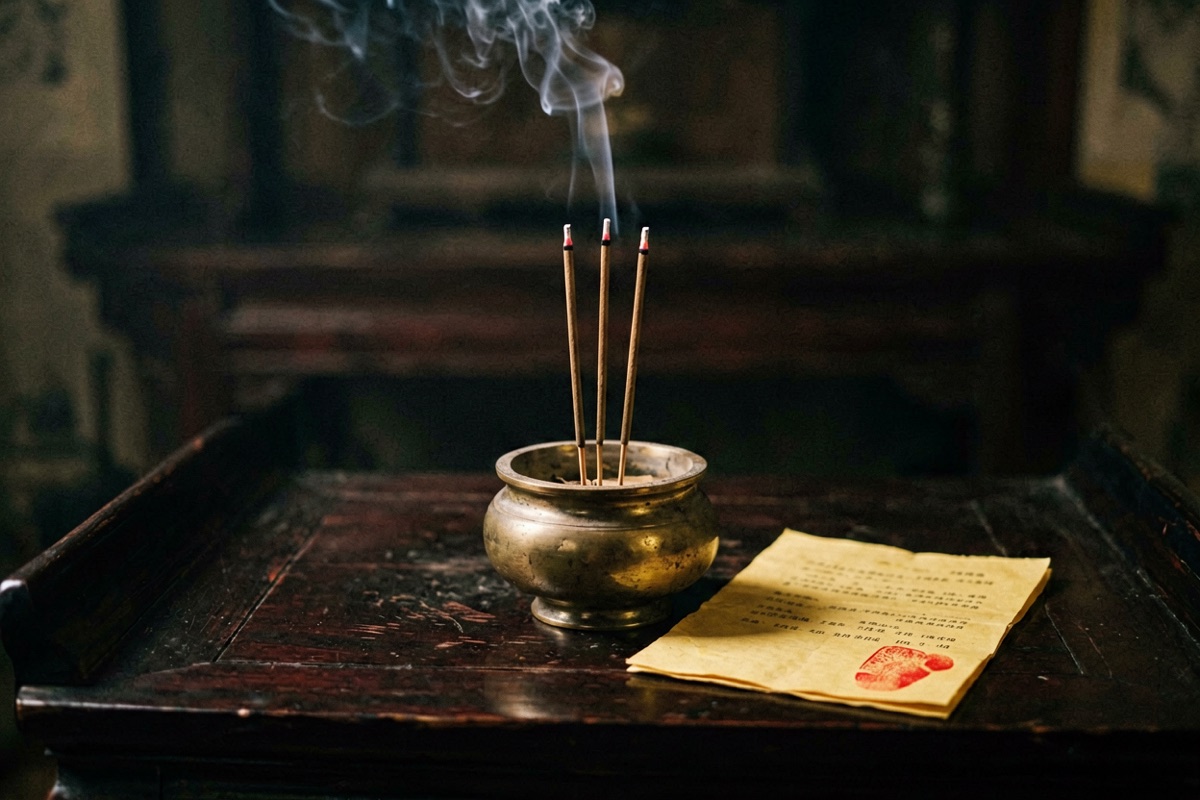
Away from the literary version, the rite as reported by ethnographers was modest and domestic: incense before an altar or a tablet, a written petition naming the sick person and the petitioner, sometimes a stated number of years offered, sometimes a red or yellow paper slip with a name and a fingerprint pressed in place of a signature. Often a Taoist or Buddhist specialist wrote and burned the document; often a family member simply spoke it. Crucially, the offering was made by the living relative on their own behalf — the tradition treats an unwilling or uninformed donor as void. The petition is a contract, and a contract requires consent.
The price the tradition insists on
No version of jie shou is free, and the moralising is not a later addition — it is the point. The years are conserved: what one person gains another loses, and the folk versions are unsparing about who ends up paying, often not the person who signed. Related beliefs run the same way: that a lifespan extended by improper means is clawed back through descendants, or that health returns to the sick while misfortune surfaces elsewhere in the family. This sits inside the wider Chinese moral principle of chengfu (承负) — the inherited carry-over of consequence across generations. Read honestly, 'borrowing years' is less a procedure than a parable about the impossibility of a gain that costs nobody anything.
Fiction · Tales of the Hidden Path
Borrowed Years
The old woman had been dying for eleven days, which everyone agreed was too long. Her son brought a specialist from two villages over, a man who wrote the petition on yellow paper with a brush worn down to a stub, and who explained the terms twice so that nobody could later say they had not understood. The years had to be given, not taken. The giver had to press a thumb to the paper themselves.
The son pressed his thumb into the red paste and then onto the paper. Beside him his wife did the same. His brother, arriving late from the city, did the same without being asked. Three prints, slightly overlapping, in the lower corner where a signature would go.
The specialist burned the paper in a tin basin in the yard and told them the answer, if there was one, would come before morning.
Before morning the old woman sat up and asked for soup. By the end of the week she was walking to the gate. By the end of the month the neighbours had stopped mentioning it, the way people stop mentioning weather that has turned fine.
It was the son's wife who noticed, in the spring, that there were four prints on the second petition — the one the specialist had left behind as a receipt, folded into the family's box of documents. Four. She counted them with her finger, then with a lamp, then with her glasses on.
The fourth print was very small. It sat a little apart from the others, at the edge of the paper, pressed cleanly and completely, the whorls quite distinct.
Their daughter had been born two months after the old woman got up. She was learning, that spring, to pull herself along the furniture toward the door. She could not yet reach the latch. She would spend a great deal of her life, her mother thought, standing under that latch and reaching for it.
An original short story written for our folklore film series. It is fiction — invented, not a recorded case, not a claim about how any of the customs above actually work. The belief it is built on is real; everything that happens in it is not. See our honesty policy。
The serious version of this question has a serious answer in Taoist thought — one that is neither fatalism nor magic. Read the tradition's own view.
Can Destiny Be Changed? →FAQ
Is borrowing years an actual Taoist rite?
Taoist liturgy has genuine longevity and star-worship rites — the Dipper lamp rite (拜斗) among them — which petition for wellbeing and extended life. 'Borrowing years' in the transfer sense is a folk-religious and literary idea rather than a standard liturgical service, and no responsible practitioner sells it as a guaranteed transaction.
Where does '南斗注生, 北斗注死' come from?
It is a formulaic saying attached to the Guan Lu / Yan Chao story and to Dipper worship generally: the Southern Dipper's office records birth and the Northern Dipper's records death. It captures the bureaucratic model of fate that the whole belief depends on.
Do people still do this?
The petition form — incense, a written plea for a sick relative, offering something of one's own — remains common in Chinese folk practice. The literal accounting of transferred years is now mostly a story people tell, not a service people buy.
Does daoism5049 perform lifespan transfers?
No. We perform petition and blessing rites and we say plainly what they are: an act of intention and dedication, with no promised outcome. Anyone selling you extra years is selling you something they cannot deliver.
Related: The Seventh Day: Why Chinese Families Leave the House Empty · The Substitute: Straw Effigies and the Chinese Idea of Standing In · Free BaZi Calculator · Free I Ching Reading