Piercing Heart Sha: When a Straight Line Runs Through the House
Chuan xin sha (穿心煞) — the 'heart-piercing sha' — is a straight unobstructed line running through a dwelling: front door directly opposite back door, or a corridor that runs the full length of the plan with an opening at each end. The tradition says the qi enters and leaves without ever circulating, and that nothing accumulates in such a house. It is the complaint that produced one of the most characteristic features of Chinese architecture.
Why circulation is the point
The organising metaphor of feng shui interiors is not blockage or flow but circulation — qi should enter, wander, gather in the rooms, and leave slowly. The two failure modes are stagnation, where nothing moves at all, and this one, where everything moves straight through. The tradition's phrasing about wealth not staying in a house with two aligned doors is memorable enough to have travelled well beyond the practice, and it is worth noticing that the underlying image is about residence time rather than quantity. A house is meant to hold onto things for a while, and one you can see straight through does not.
The screen wall
The classical solution is a piece of architecture. A yingbi (影壁) is a free-standing wall set just inside or just outside a courtyard gate so that the entrance cannot be entered or seen through in a straight line; they survive across northern China, in temples, in the Forbidden City and in ordinary siheyuan. The functions are stacked: it interrupts the straight route, it blocks sight into the courtyard from the lane, it provides a decorated surface facing anyone who comes in, and it shelters the gate from wind. A single wall solving four problems at once is a good indication that the tradition which produced it was paying attention to more than one of them.
Domestic versions today
Flats do not have courtyards, so the remedy is scaled down: a screen or room divider inside the entrance, a console table with a plant, a hanging, a curtain across a corridor, or simply furniture arranged to break the line. The advice practitioners give most often is the smallest one — do not leave both ends open at once, and put something with visual weight in the line of sight. Anyone who has lived in a flat with the front door opening onto a window at the far end recognises both the exposure and the draught, and most people solve it without being told to.
The through draught
The physical counterpart is straightforward. Two aligned openings on opposite faces of a building produce cross-ventilation, which is excellent when you want it and unpleasant when you do not: a fast local draught along the route, doors slamming, dust carried through, and heat loss in winter. Buildings are designed for cross-ventilation deliberately in hot climates, and the same feature is a nuisance in a cold one. What the tradition adds is the instruction to be able to interrupt it — which is exactly what a screen, a curtain or a closed internal door does.
Fiction · Tales of the Hidden Path
The Worn Line
One bedroom and a living room. Front door east, back door west, in a straight line.
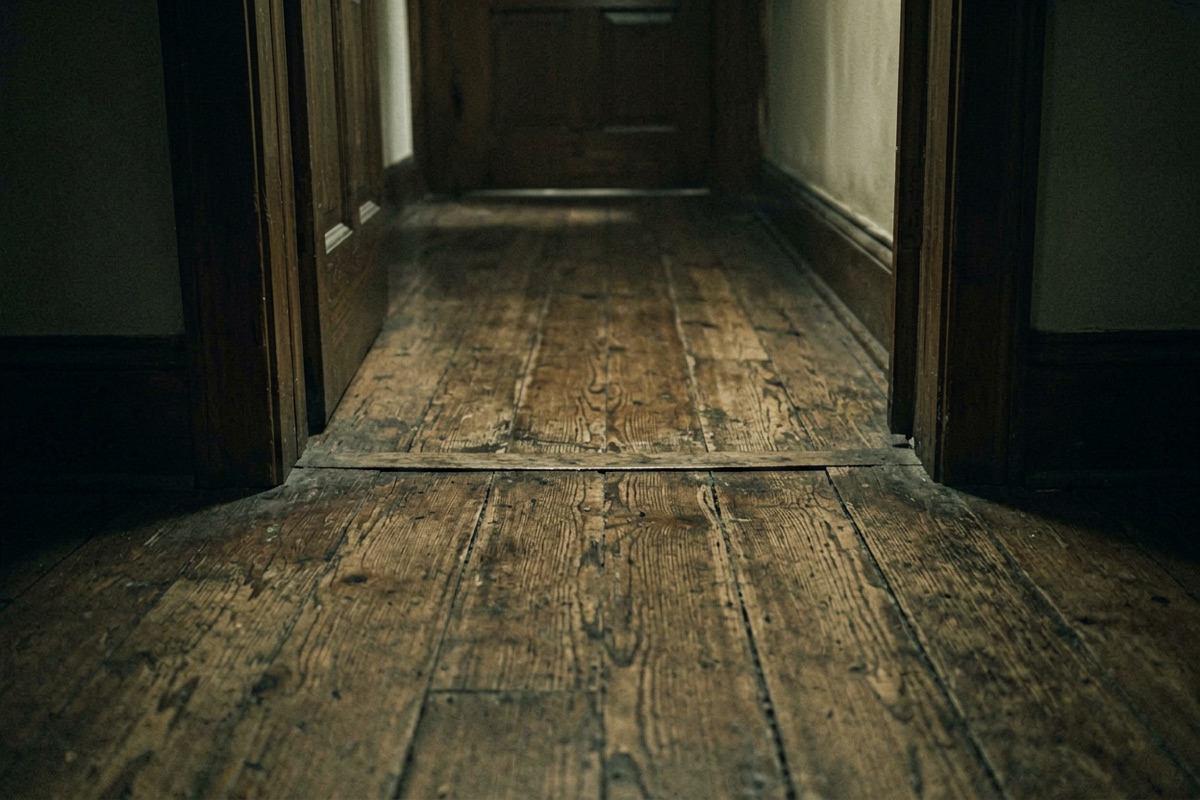
The floor is old varnished board. There is a worn strip running from the front door straight to the back one, thirty centimetres wide, the varnish gone off it down to bare timber.
He lives alone. He does not walk that line — the sofa and the coffee table sit across it and he goes round.
One day he pushed the sofa onto the line, on top of it.
The next day the sofa was off the line, against the wall, and the worn strip ran out from underneath where it had been standing, the same width, the same polish.
He measured the strip: thirty centimetres.
He measured his shoulders: forty-four. He measured the width of his own footfall: seventeen.
Thirty is not the width one person wears. It is not double one person either.
It is two people walking abreast, shoulder to shoulder, each giving a little.
He asked the management company about the flat's history.
An elderly couple had it for twenty-six years. They died the year before last, eleven days apart.
An original short story written for our folklore film series. It is fiction — invented, not a recorded case, not a claim about how any of the customs above actually work. The belief it is built on is real; everything that happens in it is not. See our honesty policy。
Everything in this article starts at the front door. What the tradition asks of an entrance, and what it warns against.
The Mouth of Qi →FAQ
What is 穿心煞?
An unobstructed straight line through a dwelling — most often the front door aligned with a back door or a large window, or a corridor open at both ends.
Why is it said money won't stay?
Because the underlying image is residence time: qi should enter, circulate and gather. A route straight through means nothing dwells. The saying is a memorable expression of that idea.
What is a 影壁?
A free-standing screen wall just inside or outside a courtyard gate. It interrupts the straight route, blocks the view in from the lane, presents a decorated surface to visitors and shelters the gate from wind.
What do I do in a flat?
Break the sight line: a screen or divider inside the entrance, a console with a plant, a curtain across the corridor, or furniture with visual weight in the line. Keeping both ends open at once is the thing to avoid.
Related: The Beam Overhead: Why Feng Shui Moves Your Bed · Glare Sha: When the Building Opposite Throws Light Into Your Home · Free BaZi Calculator · Free I Ching Reading