Door Facing Door: The Sha Between Neighbours
Men chong sha (门冲煞) covers a door directly facing another door, a stairwell, or a lift. It is the only entry in the classical sha catalogue where the problem is not a road or a building but another household, and it has an escalation pattern all of its own — one that Chinese village and estate life has recorded for centuries under the name 'cursing the door'.
Two doors, one corridor
Where two front doors face each other across a narrow landing, the tradition reads a contest: the two households' qi meets in the gap and the larger door, or the more open one, is said to draw from the other. Practitioners will note relative door size, whether one opens inward or outward, and which is better lit. Whatever one makes of the mechanism, the situation it describes is real enough — two households sharing a two-metre landing, hearing each other's doors, meeting every time either of them leaves. Chinese practice has always treated the shared threshold as a place requiring management, and this is the vocabulary in which it does the managing.
Doors onto stairs and lifts
A front door opening directly onto a descending staircase is read as qi and prosperity running downward and out; onto a lift, as the household's energy being repeatedly drawn away by movement. The practical readings are easy: a door at the head of stairs is a genuine fall hazard, particularly for children and the elderly, and a door beside a lift shaft gets the mechanical noise, the vibration, the traffic of everyone on the floor and, in older buildings, the draught the shaft acts as a chimney for. Estate agents discount such flats for the same reasons practitioners flag them.
How it escalates
The escalation is the distinctive part. One household hangs a bagua mirror; the other, finding itself reflected, hangs a larger one; scissors, a peachwood sword, a string of coins, a set of gourds follow. Chinese sources record this as a real and recurring neighbour dispute — a symbolic argument conducted entirely in objects, and one that can run for years without a word being exchanged. It is what our guide on the door war describes at length. Practitioners are consistent in advising the interruption remedies over the reflective ones for exactly this reason: a mirror aimed at a neighbour's door is not a cure, it is an opening move.
What to do instead
Everything here is about interrupting the line rather than reflecting along it. A door curtain, a screen inside the entrance, a mat, a plant, a shifted opening angle, or an offset if the plan permits. Where the door faces stairs, a gate or a rail. Where it faces a lift, a heavy curtain inside the door and attention to the door's seal, which will also address the noise. And where the neighbour has already opened with a mirror, the tradition's own advice is worth following: hang something that protects your own threshold rather than something that answers theirs.
Fiction · Tales of the Hidden Path
The Mat
Two front doors face each other across a metre-forty landing.
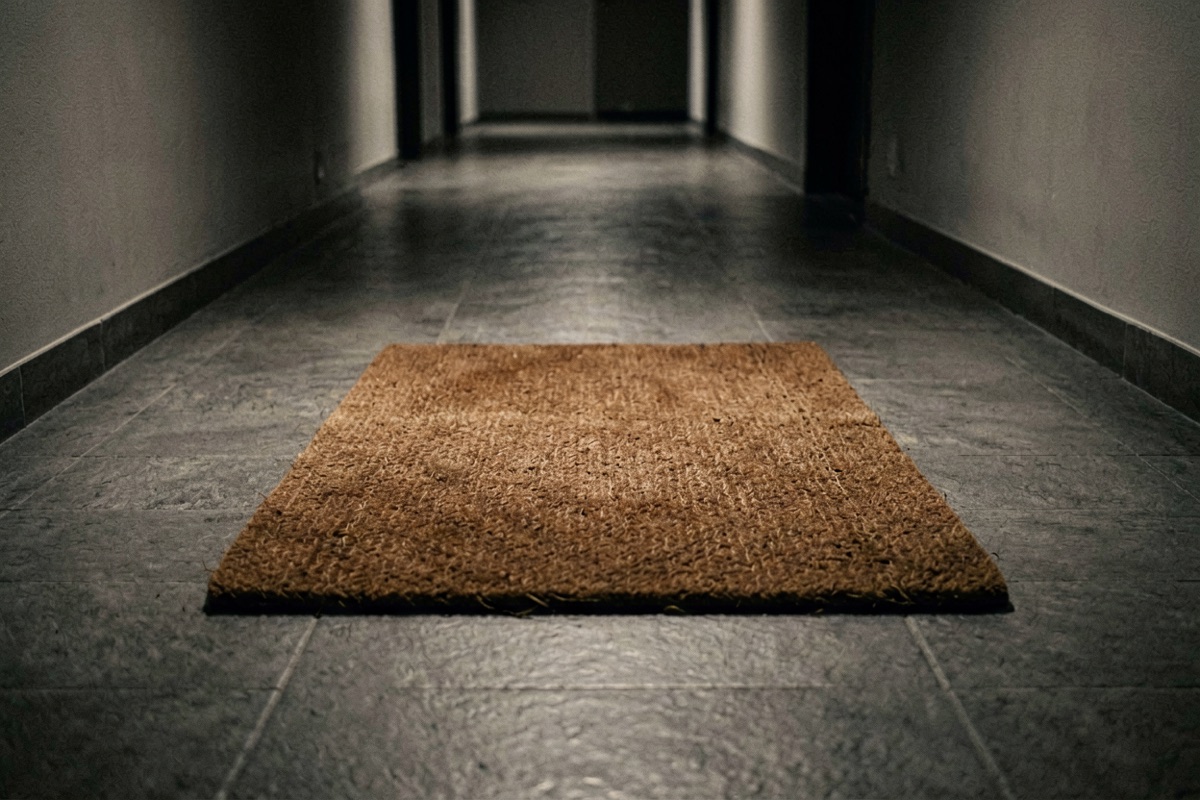
The mat outside his door has turned round by the time he leaves in the morning. Brown, rectangular, bound at the edges.
He drew an arrow on the underside with a marker, pointing at his own door.
The next day he turned it over. The arrow pointed at the door opposite.
He bought four self-tapping screws and fixed the mat down through the grouting at each corner.
The next day the screws were still there, all four. The mat had turned on them. There was a torn hole at each corner, the fibres pulled out in the same direction.
He bought a new mat and did not fix it.
The next morning the new mat faced the door opposite.
He looked up. There is no mat outside that door.
There is a rectangle on the tiles where the colour is darker, worn in over years, with a clean edge to it. He crouched down and measured it against the tiling.
Two and a half tiles. Exactly the size of his.
An original short story written for our folklore film series. It is fiction — invented, not a recorded case, not a claim about how any of the customs above actually work. The belief it is built on is real; everything that happens in it is not. See our honesty policy。
The entrance is where the tradition concentrates. What a main door is asked to do, and the practical sense underneath the rules.
Front Door Feng Shui →FAQ
Is door-facing-door really a problem?
Traditionally it is read as a contest between two households. Practically, two doors on a small landing means shared noise, shared threshold and constant proximity, which is a real thing that needs managing.
What about a door facing stairs or a lift?
Read as energy running away or being drawn off. Practically: a door at the head of stairs is a fall hazard, and a door beside a lift shaft gets noise, vibration, floor traffic and shaft draught.
Should I hang a mirror at my neighbour's door?
No. Traditional practice treats it as hostile, and it is the recognised opening move in the escalating disputes recorded as 'cursing the door'. Protect your own threshold instead of answering theirs.
What are the recommended remedies?
Interruption rather than reflection: a door curtain, an internal screen, a mat, a plant, a changed opening angle, or an offset entrance. For stairs, a gate or rail; for a lift, a heavy curtain and better door seals.
Related: The Beam Overhead: Why Feng Shui Moves Your Bed · Glare Sha: When the Building Opposite Throws Light Into Your Home · Free BaZi Calculator · Free I Ching Reading