Cutting Foot Water: When Water Reaches the Foundations
Chinese geomancy likes water near a building and dislikes water against it. Ge jiao shui (割脚水), 'cutting-foot water', is water running directly at the base of a structure with no ground between — a river against a wall, the sea at a foundation, or in the modern reading a flyover curving past like a blade, which the tradition calls the sickle sha.
Water at a distance, not at the wall
Classical siting wants water in view of a dwelling — it is one of the favourable elements, associated with wealth and with the open 'bright hall' in front of a site. What it does not want is water in contact with the building. The ideal described in the manuals is water seen across a level foreground, held off by ground the building stands on. When the water comes right up to the base, the form changes name and the reading inverts. It is a good illustration of how the tradition works: the same element is favourable or unfavourable depending entirely on its relation to the site.
What water against masonry does
The physical account requires no translation. Water at a foundation undermines it by scour, saturates the ground so that bearing capacity falls, and moves through masonry by capillary rise, bringing dissolved salts that crystallise and spall the surface. Freeze-thaw in cold regions accelerates all of it. Riverside and coastal buildings need designed protection — cut-off walls, damp-proof courses, revetments, drainage — and buildings that do not have it deteriorate from the bottom up in exactly the manner the name describes. A tradition that identified 'water cutting the feet' as the worst relation between a building and a watercourse identified the correct one.
The sickle
The modern extension is the sickle sha (镰刀煞): an elevated road or flyover curving past a building, close and at height, with the convex side toward the facade. It combines the reverse-bow reading with proximity, and practitioners rank it severely. The physical complaints from residents beside elevated roads are documented and consistent — noise at facade level rather than street level, vibration, headlight sweep at window height, particulate deposition, and loss of daylight and outlook. Property values reflect it. The tradition's picture of a blade held against the building is a reasonable summary of the experience.
What can be done
For actual water: the answer is civil engineering, and a practitioner worth consulting will say so. Revetment or a retaining structure to hold the water off, a proper damp-proof course, external tanking, land drainage to lower the local table, and repointing with the right mortar rather than a cement one that traps moisture. For a flyover: acoustic glazing, heavy curtains, planting, and reorganising rooms so that bedrooms are on the far side. Symbolic cures exist for both and are, as usual, the last item on the list rather than the first.
Fiction · Tales of the Hidden Path
The Water Line
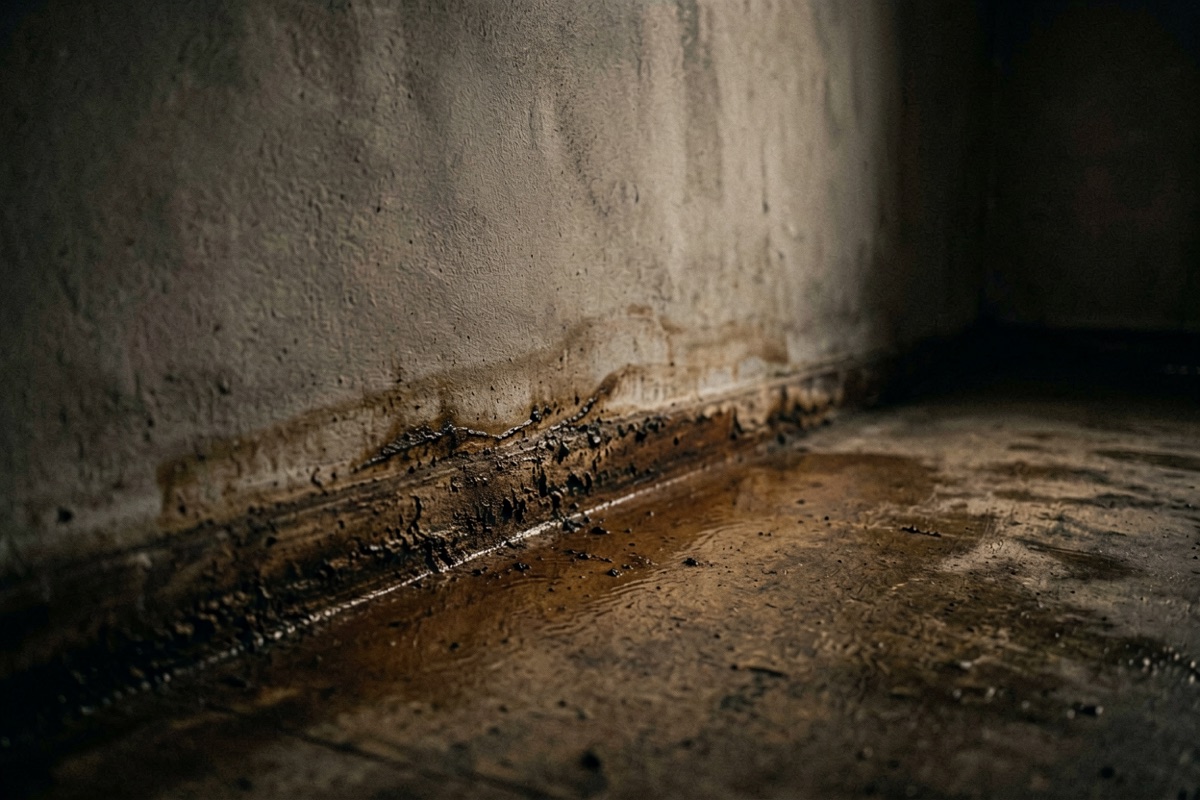
The house is about twenty metres from the river. Inside, along the base of the south wall, there is a line of damp — pale brown, dead level, as though it had been ruled.
He painted it with waterproofer, two coats. The next year it came back a finger higher.
He cut a mark into the plaster and wrote the year beside it.
By the seventh mark he went down to the river to check the level. He found a stone step to measure against and compared seven years of photographs.
The river had not changed. It rises and falls within twenty centimetres and comes back to the same place every year.
He went in and measured the spacing between his seven marks. Even. A finger a year, with very little error.
He chipped away a patch of the plaster, wanting to see how far the damp had got into the brick.
The brick was dry.
The stain was in the render only, half a millimetre of it. Behind that, dry all the way — dry enough that the lime rubbed off white on his thumb like chalk.
An original short story written for our folklore film series. It is fiction — invented, not a recorded case, not a claim about how any of the customs above actually work. The belief it is built on is real; everything that happens in it is not. See our honesty policy。
The same concern runs through burial practice, where water reaching the coffin is the gravest defect a site can have.
Water, and the Dead →FAQ
What is 割脚水?
Water reaching the base of a building with no ground between — a river, canal or sea directly against the foundation. The classical preference is water in view but held off by a level foreground.
Is water near a house good or bad in feng shui?
Both, depending on relation. Water visible across an open foreground is favourable and associated with wealth. Water in contact with the building inverts the reading entirely.
What is the sickle sha?
A curved elevated road or flyover passing close to a facade with its convex side toward the building. It combines the reverse-bow reading with proximity and is ranked severely.
What actually helps?
For water: revetment, damp-proof course, tanking, land drainage, and breathable mortar rather than cement. For a flyover: acoustic glazing, heavy curtains, planting, and moving bedrooms to the far side.
Related: The Beam Overhead: Why Feng Shui Moves Your Bed · Glare Sha: When the Building Opposite Throws Light Into Your Home · Free BaZi Calculator · Free I Ching Reading