Water in the Grave: The Worst Finding in Yinzhai
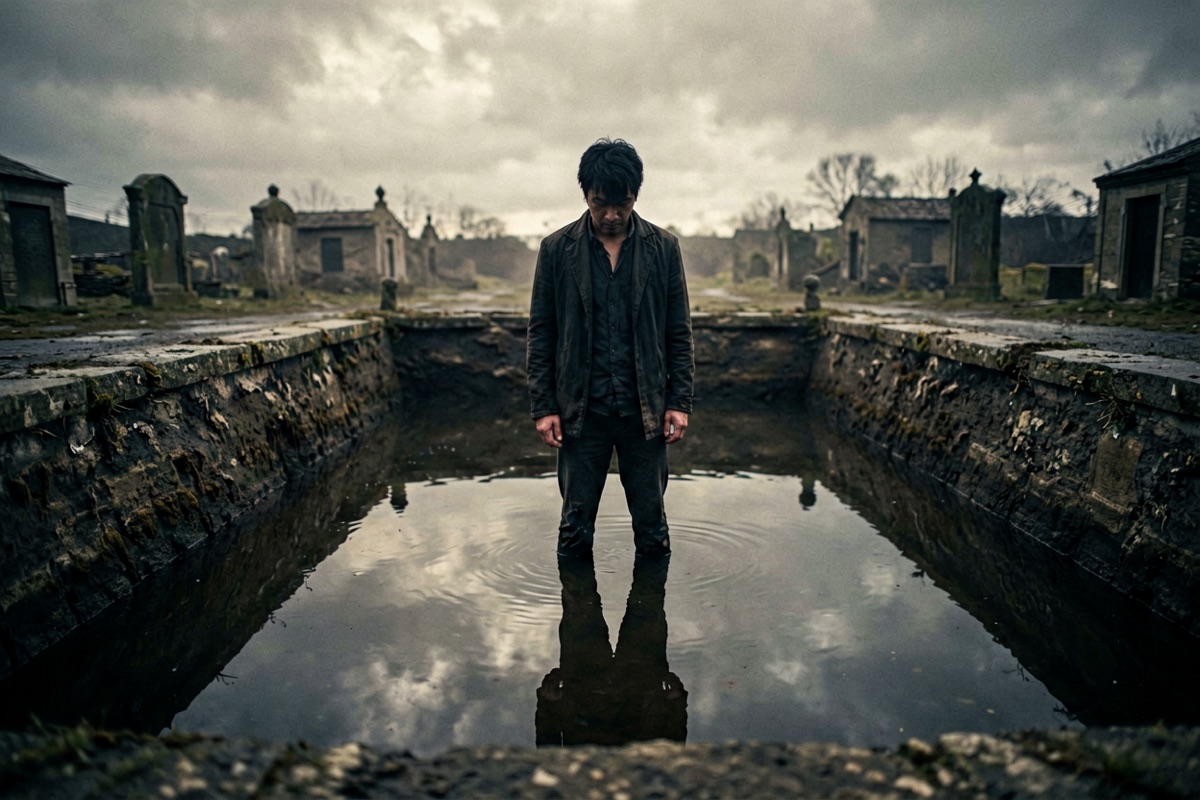
Ask a practitioner of yinzhai feng shui to name the worst thing that can be found on opening a grave and the answer is immediate and unanimous: water. Shui pao guan (水泡棺), the coffin standing in water, outranks every other defect in the tradition, and the response to it is not adjustment or remedy but relocation.
Why water is the worst finding
The tradition's stated reason is that the ancestor is in distress and that the family will show it. The physical reason needs no interpretation: a coffin in groundwater rots, collapses, and the burial is destroyed. Chinese geomancy is often described as though it were purely symbolic, and its water rules are the clearest counter-example — the entire apparatus of site selection is, among other things, a drainage assessment carried out with a compass and a vocabulary. When a practitioner says a site 'holds water' and refuses it, an engineer looking at the same slope will usually agree with the conclusion.
How a site is tested
The classical procedure is to dig a trial pit at the intended depth some days before the burial and leave it open. If water stands in it, the site is rejected. Soil is examined by hand and eye: colour, structure, whether it crumbles or smears, whether it is uniform with depth. Practitioners speak of 'live earth' and 'dead earth' and describe what they are looking for in terms a soil scientist would recognise as texture, structure and drainage class. The compass work — the sitting and facing, the mountain and the water — is layered on top of this, but the trial pit comes first and can veto everything else.
What families do about it
Finding water at a relocation or a reopening produces one outcome: the site is abandoned. The remains are lifted, dried, wrapped and moved to a new plot chosen with more care, usually higher and on a definite slope. Because relocation is expensive and heavy, a family that has to do it once will over-correct the second time, and the third site is often chosen conservatively high — which brings its own problems of exposure and access. The tradition has a good deal to say about the resulting overshoot, most of it advising that a site should be sound rather than dramatic.
The stubbornness of groundwater
One thing worth knowing, and which frustrates families repeatedly: local water tables do not respect plot boundaries. A slope that drains well at one point may sit above a perched water table fifty metres away; a site that is dry for six years may not be in the seventh, after a road is cut or a well is sunk upslope. Practitioners describe the water as following the family. Hydrologists describe it as regional groundwater responding to changes in the catchment. Both descriptions predict the same annoying fact, which is that moving the grave does not always solve it, and that the second and third sites need checking too.
Fiction · Tales of the Hidden Path
Water in the Coffin
They hit water halfway down. It came up fast, and within twenty minutes it was over the base of the coffin and the coffin was floating and rocking.
The old men said this was the worst of it and the site would have to be given up.
He wrote a number down. He had measured with a tape while the pit was open: from the water surface to the lip, three feet two.
They lifted it, pumped the hole out, and reburied on dry ground at the foot of the hill.
The next spring the earth in front of the grave was wet. The ground around it was dry — only that patch. He dug a small test hole.
Water at three feet two.
The third year they moved it up the mountain. A hundred metres higher, on rock; the drilling took three days.
The fourth year the ground in front of the grave was wet.
He had not brought a tape, so he dug with the spade and stood the handle in the hole to measure against.
Three feet two.
He went back to the old house. The well in the yard was still there, disused, with an iron cover on it. He lifted the cover and let a stone down on a string.
From the water surface to the wellhead: three feet two. His great-grandfather sank that well forty years before the grave was dug.
An original short story written for our folklore film series. It is fiction — invented, not a recorded case, not a claim about how any of the customs above actually work. The belief it is built on is real; everything that happens in it is not. See our honesty policy。
If water is found, the site is abandoned. What a relocation actually involves — the date, the early start, and the radish left in the pit.
How a Grave Is Moved →FAQ
What is 水泡棺?
Literally 'water soaking the coffin' — groundwater reaching or floating the burial. It is regarded in yinzhai practice as the most serious defect a site can have, and the response is relocation rather than remedy.
How do practitioners test a site beforehand?
By digging a trial pit at burial depth several days ahead and leaving it open. Standing water rejects the site. Soil colour, texture and structure are also examined by hand.
Can a wet grave be fixed with drainage?
Tradition says no — the site is abandoned. In practice some modern cemeteries do engineer drainage, but classical yinzhai treats water as disqualifying rather than correctable.
Why do families sometimes hit water at the new site too?
Because water tables are regional and change. A slope can be dry for years and not in the seventh, after works upslope. Tradition describes it as the water following; hydrology describes it as catchment change.
Related: Encoffining: The Cord, the Coins and the Rules of Laying Out · Moving a Grave: The Rules of Qian Fen · Free BaZi Calculator · Free I Ching Reading