The Well: Chinese Taboos About Looking Down
A well is a hole in the middle of a courtyard that is deeper than a person is tall and full of the water everyone drinks. Chinese folk practice treats it accordingly: it has its own minor god, it receives offerings at New Year, and it comes with a set of prohibitions that are observed more strictly than almost any other domestic rule. Most of them concern looking.
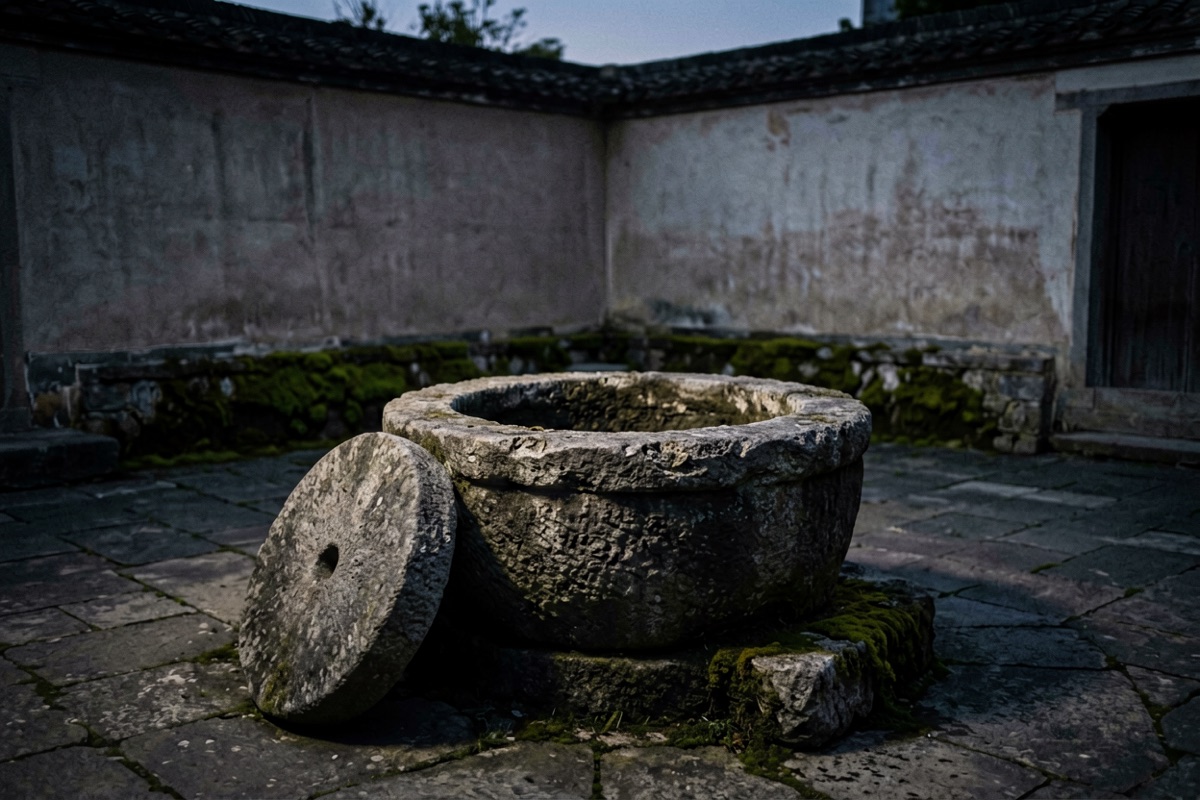
The well among the household gods
Chinese domestic religion staffs the house with minor deities at the points that matter: the stove god who reports on the family at year's end, the door gods at the boundary, the god of the bed, the god of the latrine, and the well god. The well receives incense and offerings at New Year, and in many regions is formally sealed for the first days of the year — covered with a board or a red paper, not drawn from, and reopened with a small rite. The logic is that the well too is entitled to rest, which is the same reasoning applied to the stove, the tools and the fields. It is a distinctly agricultural theology, and a fairly gracious one.
Do not look in at night
The prohibition every Chinese child is given is against leaning over a well after dark, and against calling down into one at any time. Two reasons are offered and they layer neatly. The first is the drowned: a person who dies in water is held to be unable to move on until they find a ti shen (替身), a substitute, and a well is a very small piece of water with a very specific opening. The second reason requires no belief at all — a well is a vertical drop with a slick stone rim, children lean, and a household that loses a child down a well loses both the child and its water supply on the same afternoon. The taboo is doing two jobs and does them well.
The reflection
Looking into a well produces the one thing Chinese folklore is most consistently uneasy about: a reflection, in the dark, in deep water, at the bottom of a hole. All the mirror-lore transfers directly, sharpened by depth. Folk stories built on wells almost always turn on the reflection behaving fractionally wrongly — moving a moment late, staying when the looker straightens, being of somebody else. This is a genuinely well-observed piece of psychology as well as folklore: the surface of a well is a poor mirror, disturbed by drips and by the observer's own breath, and a face seen in one at dusk does in fact seem to move independently. The tradition took an ordinary perceptual instability and made it mean something.
Sealing a well
A well in which a person has drowned is not, in traditional practice, cleaned and put back into service. It is sealed — filled, capped, or covered with a stone and abandoned — and in many regions incense is burned at the cap. The practical reasoning is obvious and would be recommended by any public health officer. The stated reasoning is the substitute belief: what is down there is waiting, the opening is how it reaches, and closing the opening is the responsible thing to do for the household and the neighbours' children. Both readings agree, and the well gets sealed, which is the outcome that matters.
Fiction · Tales of the Hidden Path
The Well
The well in that courtyard had been capped with a millstone since before he was born, and nobody had ever given him a straight answer about why. There had been a drowning. It was a long time ago. That was all anyone would say.
He levered the stone off on a hot afternoon in his thirtieth year because the house was his now and the mains had failed again, and he wanted, reasonably enough, his own water.
The shaft went down further than he expected. Down at the bottom, small and bright, was a coin of sky with his own head in the middle of it.
He raised a hand to check the depth against the rim.
The reflection raised its hand too, but late — a beat late, the way a bad line connects. He held still. It held still. He straightened up and stepped back from the edge, and for a moment, before the surface broke up, the face in the water was still looking up out of it.
He put the millstone back that evening, and it took him and a neighbour and a length of pipe to do it, and he did not sleep much afterwards.
In the morning the courtyard was wet in a track from the well head to the door of the house, the way stone is wet when something has come up out of water and walked on it.
He stood at the door with his hand on the frame and looked at the track, and then down at himself, at the water running off his own sleeves and pooling around his feet on the step.
An original short story written for our folklore film series. It is fiction — invented, not a recorded case, not a claim about how any of the customs above actually work. The belief it is built on is real; everything that happens in it is not. See our honesty policy。
Doors, windows and thresholds are the points Chinese practice pays attention to. What feng shui says about the most important one.
The Home's Other Openings →FAQ
Why shouldn't you look into a well at night?
Traditionally because the drowned are held to wait below for a substitute. Practically because a well is an unguarded vertical drop with a slippery rim and children lean. The taboo covers both.
Is there really a well god?
Yes, in the sense that the well is one of the household spirit-positions in Chinese folk religion, receiving offerings at New Year alongside the stove god and the door gods.
Why are wells covered at New Year?
Because the well, like the stove and the tools, is held to be entitled to rest during the New Year period. It is covered, not drawn from for a set number of days, and reopened with a small offering.
What happens to a well after a drowning?
Traditional practice seals it rather than returning it to use — capped, filled or abandoned, often with incense burned at the cover. Both the folk reasoning and basic public health point the same way.
Related: Foundation Sacrifice: The Bridge That Needed a Name · The Shadow: Chinese Beliefs About What Follows You · Free BaZi Calculator · Free I Ching Reading