The Seventh Day: Why Chinese Families Leave the House Empty
Chinese funerary practice counts in sevens. The forty-nine days after a death are divided into seven periods of seven, each with its own observance, and the first of them — tou qi (头七), the seventh day — carries the heaviest folklore. On that night, the tradition holds, the dead come home. What the living are supposed to do about it varies by region, but almost everywhere it involves leaving.
Counting in sevens
The seven-week structure entered Chinese practice from Buddhism, where the interval between death and rebirth — the antarābhava, in Chinese zhongyin (中阴) — lasts at most forty-nine days and is reviewed in seven-day stages. Merit generated by the living during those stages is held to benefit the deceased at each review. Chinese families absorbed the schedule and populated it with local observance: rites on each seventh day, with the first (头七), fifth (五七) and seventh (七七, the full forty-nine) treated as the major ones. Even in wholly secular families the calendar survives, which is why 'the seventh day' and 'the forty-nine days' are still spoken of by people who would not describe themselves as believers.
Why the family leaves
The folk logic of tou qi is affectionate rather than fearful, and this is often lost in retellings. The dead returns to look at the house one last time; if they see the family weeping, attachment holds them, and a soul held back cannot go on to what comes next. So the household withdraws — sleeping at a relative's, or shutting themselves in a back room and staying quiet. In many regions a light is left burning and the door left unbarred so the returning soul is not shut out; in some, a meal is set at the usual place. The instruction not to look is nearly universal, and is framed as a kindness: you are not hiding from them, you are letting them go.
Ash on the floor
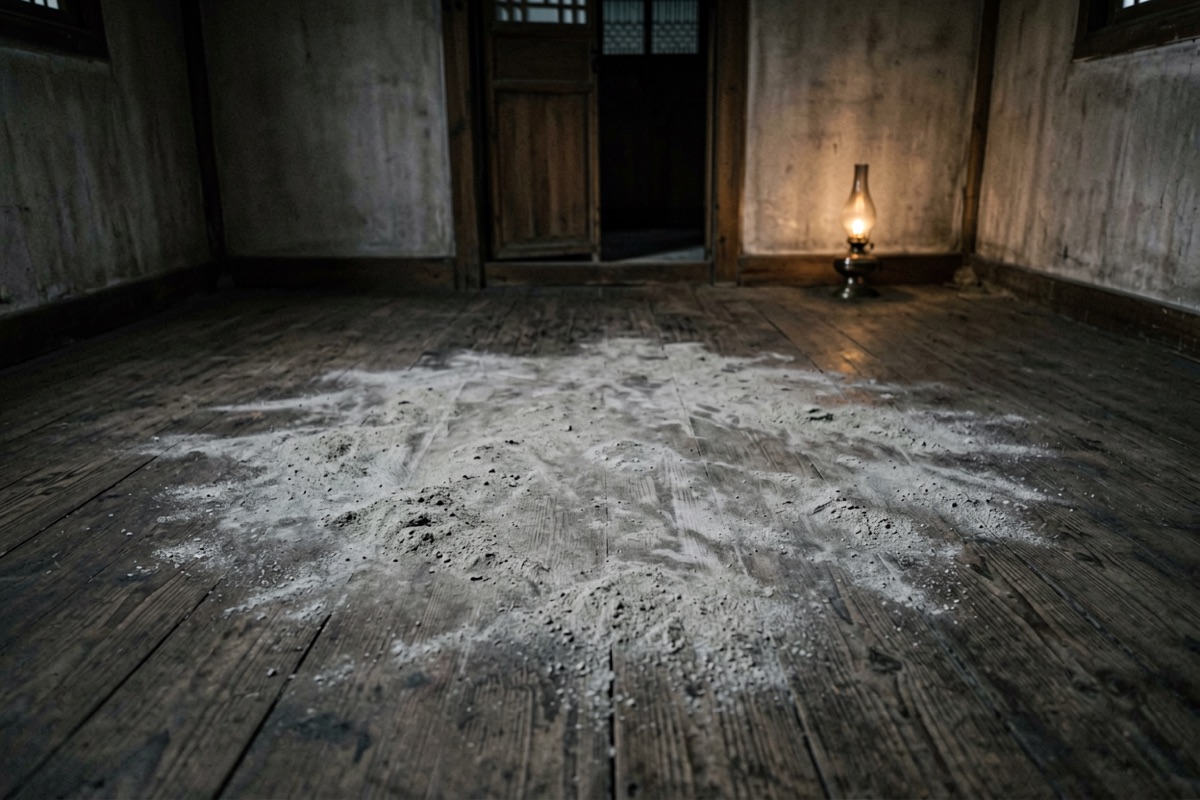
The best-known component of the custom is also the most quietly devastating: before the family leaves, someone spreads a layer of ash, flour, lime or fine sand across the floor — at the threshold, in the hallway, before the bed. In the morning they read it. Reports of what is found are exactly what folklore always reports: nothing at all, a smear, a bird's mark, or the shape of a foot. Ethnographers note the custom across a wide range of Chinese regions, and its function is legible enough — it converts an unbearable absence into something that can be looked for and looked at. Grief wants evidence. The ash gives grief a surface.
What is actually observed today
Contemporary practice has thinned but not vanished. Urban families commonly keep the seventh-day rite as a meal, an offering of fruit and incense before a photograph, and a visit to a temple or columbarium; the withdrawal from the house is often skipped, or reduced to going out for dinner. Funeral homes in Chinese-speaking regions still schedule chanting for the seven sevens as a standard package. The ash is now rare and, where it survives, is usually treated as a story about grandparents rather than a live procedure. What persists most strongly is the calendar itself — the sense that mourning has a shape and a duration, and that the seventh night is the one you do not schedule anything else on.
Fiction · Tales of the Hidden Path
The Seventh Night
His mother had done it for her mother, so he did it for his mother: a bowl of stove ash, sifted through a cloth, spread with the side of his hand across the boards from the doorway to the foot of her bed. It took a long time to get it even. He kept finding places where the layer was too thin to hold anything.
He left the lamp burning and the door unbarred, as instructed, and slept at his sister's on the other side of the village. Neither of them slept much. Around two she made tea and they sat with it going cold, not talking about it.
He came back at first light. The lamp had burned down to nothing. The door was as he had left it.
There were footprints in the ash.
They came in from the threshold and crossed to the bed and stopped there, which is where they should have stopped. He crouched over them for a long time with his hands on his knees. They were not small. His mother had been a small woman with small feet, and these were not that; these were a working man's tread, forty-three at least, the heel biting deeper than the toe the way a heavy person walks.
He measured one against his hand, then against the sole of the shoe he was holding, having taken it off to keep from spoiling the ash.
It matched. It went on matching however long he knelt there, and however many times he set his shoe down beside it and picked it up again.
An original short story written for our folklore film series. It is fiction — invented, not a recorded case, not a claim about how any of the customs above actually work. The belief it is built on is real; everything that happens in it is not. See our honesty policy。
We perform dedication rites for the deceased — a petition read, incense offered and merit dedicated in the name you give us. Plainly what it is: an act of remembrance made formally.
Memorial Blessing Services →FAQ
What exactly is 头七?
The seventh day counted from the date of death, and the observance held on it. Folk belief treats that night as the one on which the deceased returns home; Buddhist practice treats it as the first of seven judgment intervals in the forty-nine-day passage to rebirth.
Should the family really leave the house?
That is the traditional instruction in many regions, framed as letting the dead depart without being held by the family's grief. It is a custom, not an obligation, and many families today keep the rite while staying home.
Why forty-nine days?
Seven periods of seven, from the Buddhist account of the intermediate state between death and rebirth, which is said to last no longer than forty-nine days and to be reviewed at each seven-day mark.
Is spreading ash to look for footprints a real custom?
Yes, it is widely recorded in Chinese folklore across many regions, usually as ash, flour or lime spread before the family withdraws. Whether anything is ever found is exactly the question the custom is built around.
Related: Borrowing Years: The Chinese Belief That Lifespan Can Be Transferred · The Substitute: Straw Effigies and the Chinese Idea of Standing In · Free BaZi Calculator · Free I Ching Reading