The Substitute: Straw Effigies and the Chinese Idea of Standing In
If a child is predicted not to live, or a household is judged to be under something, one of the oldest Chinese responses is not to fight it but to offer it something else. A ti shen (替身) — a substitute — is a figure of straw or paper, dressed in the person's clothes and marked with their name, made to stand in their place. The craft is simple. The idea underneath it is not.
How a substitute is made
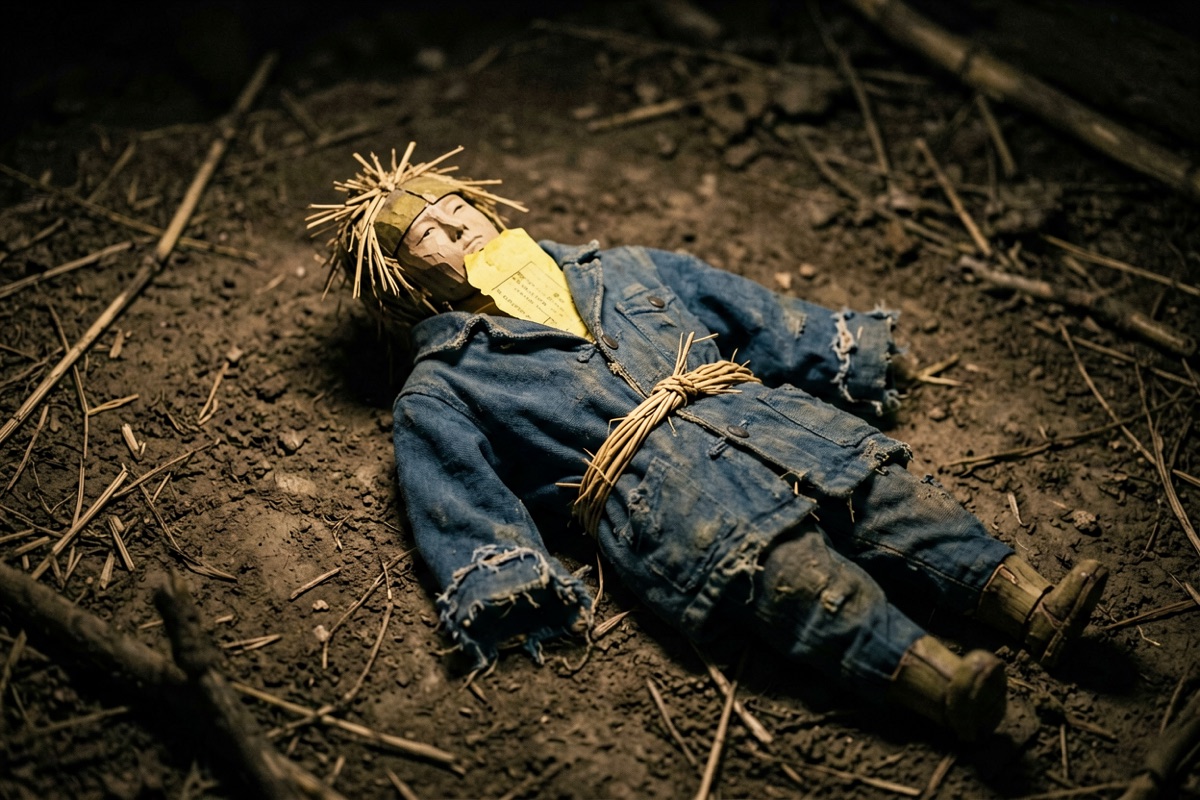
Descriptions from across the Chinese world agree on the essentials. A frame is bound from straw, reed or split bamboo — roughly human, with a trunk and limbs, rarely with a worked face. Over it goes clothing that the person has actually worn, unwashed by preference; the tradition holds that wear carries identity in a way new cloth does not. Inside the collar or the breast goes a slip of paper with the person's name, and often their birth date in the eight-character form. The finished figure is then disposed of according to the local instruction: buried where the person was born, floated on water, burned at a crossroads, or left at a boundary. What is constant is the transfer — the figure is not a charm to be kept but a stand-in to be given away.
Why the name does the work
Chinese ritual practice treats the written name as the handle by which a person can be reached. It is the same premise behind petitions that must state a name and birth date, ancestral tablets bearing a name rather than an image, and the widespread caution about giving your birth details to a stranger. In the substitute rite, this premise is turned around and used defensively: if what is coming navigates by name, then a name attached to something else will be followed to something else. This is why folk accounts insist that the effigy be named properly and named once — and why the same accounts are full of disasters caused by the wrong name, an old name, or a name written by someone who did not know whose it was.
The same logic elsewhere
Substitution is one of the load-bearing ideas of Chinese popular religion, and once you see it you find it everywhere. Paper servants, houses and money are burned at funerals so the dead receive versions rather than the originals. The drowned and the well-dead are said to seek a ti shen — someone to take their place — before they can move on, which is the engine of most Chinese water taboos. In Cantonese folk practice, da siu yan (打小人) beats a paper figure standing in for an enemy. Even the effigy burned to end an epidemic in old village practice is the same move: give the thing a body that is not a body, and let it take that instead.
Reading the custom honestly
A substitute rite is, in plain terms, a way of doing something when there is nothing to be done. A family told their child will not live to twenty is being handed an unbearable statement; the effigy converts it into a task with materials, steps and a completion. Anthropologists have long noted that such rites cluster exactly where outcomes are uncontrollable — illness, childbirth, sea voyages, examinations. That does not make the practice fraudulent; it makes it human. What deserves scepticism is not the grieving family binding straw at a kitchen table, but anyone who charges a fee while promising the substitution will work.
Fiction · Tales of the Hidden Path
The Substitute
A fortune teller told his mother he would not live past twenty, and his mother did what women in that village did: she bound a figure out of straw at the kitchen table, dressed it in the blue jacket he had outgrown, wrote a name on a strip of yellow paper and pushed it inside the collar. Then she buried it in the yard behind the house, where he had been born, and never spoke about it again in his hearing.
He lived past twenty. He lived past thirty. At forty-two he came back to the empty house with a spade, mostly out of a curiosity he could not have defended to anyone, and dug where the grass had never grown quite right.
The straw came up black and fell apart when he lifted it. The jacket had rotted, but the blue was still blue, and he could still find the place at the cuff where it had torn.
The paper was inside the collar where she had put it. It cracked along a fold when he opened it.
The name on it was not his. It was his brother's — the older brother who had died at birth, whom he had been told about perhaps four times in his whole life, always briefly, always with his mother looking at something else.
He stood in the yard with the paper in both hands and worked back through it the way you work back through an arithmetic error, and arrived where he was always going to arrive.
His mother had never once called him by his name. She had called him the second one. He had thought, for forty-two years, that this was a joke about birth order.
An original short story written for our folklore film series. It is fiction — invented, not a recorded case, not a claim about how any of the customs above actually work. The belief it is built on is real; everything that happens in it is not. See our honesty policy。
If you want to know what an honest ritual service consists of — and what it can and cannot claim — start here.
What a Blessing Rite Actually Is →FAQ
Is a ti shen the same as a voodoo doll?
No. The Western 'voodoo doll' image is about harming a person through a likeness. A ti shen is defensive and substitutive — it is offered in place of the person, to be taken instead of them. The Cantonese da siu yan rite is closer to the aggressive form, and even that is understood as venting grievance rather than causing injury.
Why does the effigy need worn clothing?
Because the tradition holds that identity attaches to things a person has used. Worn cloth is treated as carrying the wearer in a way that new cloth does not — the same reasoning behind using a child's own clothes in soul-calling rites.
What happens to the figure afterwards?
It is given away, not kept: buried, burned, floated on water or left at a boundary, depending on region. Keeping a substitute in the house defeats the entire logic of the rite.
Do you make these?
No. We perform petition and blessing rites, we tell you exactly what they consist of, and we promise no outcomes. A substitute rite sold with a guarantee is selling certainty that nobody has.
Related: Borrowing Years: The Chinese Belief That Lifespan Can Be Transferred · The Seventh Day: Why Chinese Families Leave the House Empty · Free BaZi Calculator · Free I Ching Reading