Weighing the Bones: Yuan Tiangang's Fate Scale
Of all Chinese fortune-telling methods, the simplest is cheng gu suan ming (称骨算命), 'weighing the bones'. You look up four numbers from your birth year, month, day and hour, add them, and read the total — expressed as a weight in taels and mace — against a fixed set of verses. It is attributed to the Tang astronomer Yuan Tiangang, and nothing is actually weighed.
How it works
Four tables. The first assigns a weight to the year by its sexagenary designation, the second to the lunar month, the third to the day of the lunar month, the fourth to the double-hour of birth. Each value is a small figure in taels and mace. You add the four and get a total, and each possible total has a verse attached to it. The verse is the reading. The whole procedure takes about two minutes with the tables in front of you and requires no interpretation, which is exactly why it spread as widely as it did.
Nothing is weighed
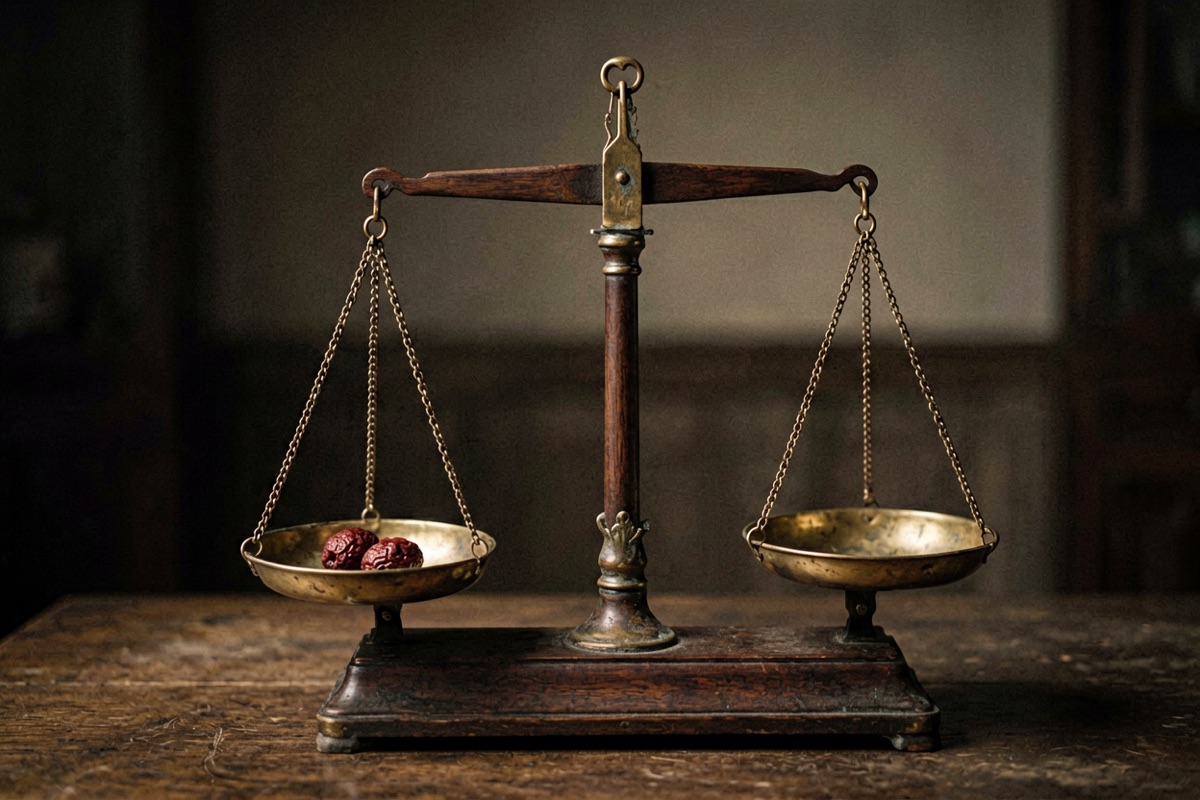
The name causes confusion in English and sometimes in Chinese. No scale is involved and no bones are measured. 'Bone weight' is a metaphor: a fate has substance, and the method assigns it a figure in the units a Chinese household used for everything else. The choice of unit is worth noticing. Weight in taels and mace is the vocabulary of the market — of grain, silver, medicine and salt — and applying it to a life produces a phrase everybody understood instantly. Chinese fortune-telling has few images as immediately legible as a life you can put on a scale.
Yuan Tiangang
The attribution is to Yuan Tiangang, a genuine historical figure: Tang court astronomer, diviner and physiognomist, associated in tradition with the Tuibei Tu prophetic text and with a famous reading of the infant Wu Zetian. Whether he had anything to do with the bone-weight tables is not established, and the attribution behaves like most such attributions — a way of lending an anonymous popular method the authority of a named expert. The tables as they circulate today are of uncertain date and appear in printed almanacs and cheap fortune pamphlets from the late imperial period onward.
What it can and cannot do
Its virtues are real: it requires no practitioner, no fee, no interpretation and no apparatus, and anybody literate can do it. Its limitation is the same thing. A single number cannot distinguish between people, and the verses are written broadly enough that most readers find something recognisable — which is a property of the verses, not evidence about the method. Serious practitioners of Chinese astrology treat bone-weighing as a folk amusement rather than a working system, and are usually direct about saying so. It is worth knowing for what it is: the most democratic fortune method China produced, and the least informative.
Fiction · Tales of the Hidden Path
The Scale
His grandfather left a steelyard. Brass pan, jujube beam, iron weight, and the graduation studs on the beam set in brass, driven in one at a time.
Weighing the bones is not supposed to involve weighing anybody. It is worked out from the birth date. But in his grandfather's notebook every generation has a figure, and there are circles drawn beside them — his grandfather actually put people on the scale.
He was lifted onto the pan once as a child. The notebook says four taels seven.
At forty he found the notebook, had the steelyard repaired, and worked it through the way his grandfather had written it out.
Four taels seven. The same as when he was a child. Bone weight is fixed; it is not supposed to change.
He did it once a year and wrote it in the back of the notebook.
Third year: four taels five.
Fourth year: four taels two.
He recalculated three times, thinking he had made an error. Then he wondered about the scale, and held the beam up against the window light.
A section of the graduation studs has been redone. The holes are new — the wood still white in them — and the studs driven into them are old and dark from handling.
He counted the studs. He knows how many there should be on a sixteen-tael beam.
Three short. The three missing are at the far end of the beam, where the heaviest of the range is marked.
He read the notebook from the first page to the last. Of all the family's recorded weights, the heaviest is five taels two.
With the beam as it now is, five taels two is as far as it will go.
An original short story written for our folklore film series. It is fiction — invented, not a recorded case, not a claim about how any of the customs above actually work. The belief it is built on is real; everything that happens in it is not. See our honesty policy。
If you want an actual chart rather than a single number: four pillars, Day Master and element balance, calculated free.
The Serious Version →FAQ
Are bones actually weighed?
No. Nothing physical is involved. 'Bone weight' is a metaphor for the substance of a fate, expressed in taels and mace — the units a Chinese household used for grain, silver and medicine.
How is it calculated?
Four tables assign a weight to your birth year, lunar month, day and double-hour. The four are added and the total is read against a fixed verse. It takes about two minutes.
Who was Yuan Tiangang?
A genuine Tang court astronomer, diviner and physiognomist, traditionally linked to the Tuibei Tu and to a famous reading of the infant Wu Zetian. Whether he devised the bone-weight tables is not established.
Is it taken seriously?
Not by serious practitioners of Chinese astrology, who treat it as a folk amusement. A single total cannot distinguish between people, and the verses are broad enough that most readers find something recognisable.
Related: Peng Zu's Hundred Prohibitions: One Rule for Every Day · Waking at the Same Hour Every Night: The Meridian Clock Reading · Free BaZi Calculator · Free I Ching Reading