The Twelve Day Officers: Jian, Chu, Man, Ping
Open a Chinese almanac at any date and among the entries you will find a single character: jian, chu, man, ping, ding, zhi, po, wei, cheng, shou, kai or bi. These are the jian chu shi er shen (建除十二神), the twelve day officers, one of the oldest continuously used date-selection systems in the world, and they rotate day by day in fixed order.
The twelve, and what each permits
Jian (建) establishes: good for beginnings and appointments, bad for groundbreaking. Chu (除) removes: good for clearing, cleaning, medical treatment and ending things. Man (满) fills: good for storing and for sacrifices, bad for medicine. Ping (平) levels: broadly neutral, good for road-making and routine. Ding (定) settles: good for contracts and installations, bad for litigation. Zhi (执) grasps: good for capture and for arrests, mixed otherwise. Po (破) breaks: inauspicious for almost everything except demolition. Wei (危) endangers: avoid heights and travel. Cheng (成) completes: broadly favourable. Shou (收) receives: good for collecting and acquiring, bad for funerals. Kai (开) opens: favourable for openings and beginnings, bad for burial. Bi (闭) closes: good for sealing and burial, bad for openings.
How the cycle is anchored
The officers do not simply cycle every twelve days through the year. They are anchored to the month: within each lunar month, jian falls on the day whose earthly branch matches the branch of that month, and the remaining eleven follow in order. When the month changes the anchor resets, which produces a doubled officer at the join — two consecutive days carrying the same one. This is the detail that surprises people who assume a clean twelve-day repeat, and it is why a given date's officer cannot be worked out by counting alone without knowing the month.
How old it is
The jian chu system is one of the best-attested pieces of ancient Chinese daily-life practice, because it turns up in excavated manuscripts. Day-books (日书) recovered from Qin and Han tombs contain jian chu tables used for exactly the purposes the modern almanac uses them for: choosing when to build, travel, marry and bury. That gives the system a documented continuous use of well over two thousand years, which makes it older than most of the metaphysical apparatus layered on top of it in modern almanacs.
Using it sensibly
The twelve officers are one column among many in a modern almanac, alongside the twenty-eight lunar mansions, the yellow and black day spirits, the clash animal and Peng Zu's daily prohibitions. Practitioners of date selection weigh them together and would not choose a date on the officer alone. For an ordinary person the useful reading is cultural rather than operative: it explains why a Chinese calendar says what it says, why certain dates fill up for weddings, and why a contractor may decline to break ground on a particular morning. That is worth understanding whether or not you organise your own diary around it.
Fiction · Tales of the Hidden Path
The Word Break
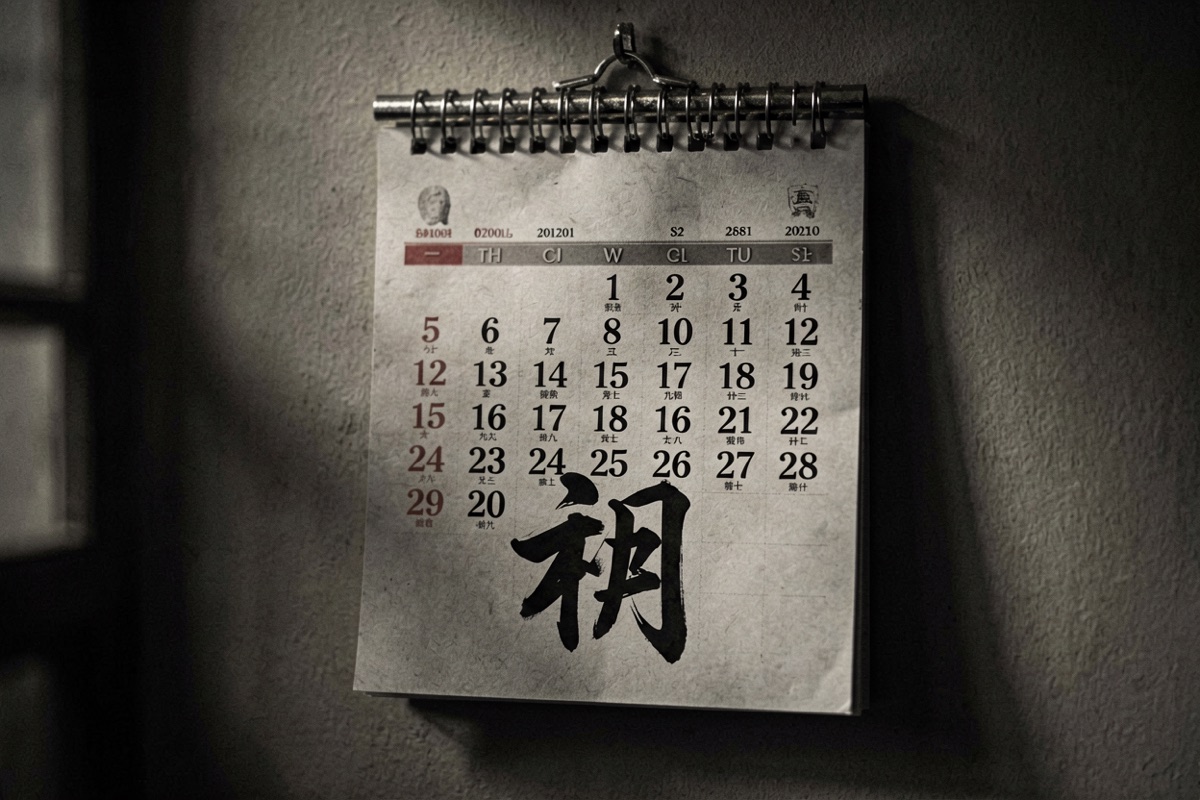
A tear-off calendar on the wall, one sheet a day, a single character printed under the date: establish, remove, full, level, settle, grasp, break, danger, complete, receive, open, close.
Round and round, twelve days to the turn.
He tore it for thirty years. It became automatic — eyes open, tear the sheet.
The year before last, in March, he forgot. He remembered the next day and tore off two at once.
The sheet underneath said break.
By the order, yesterday was break and today should be danger.
He tore another. Break.
He held the block and thumbed down through it to the end.
From that day on, all of them break.
Thirty years of used calendars were in the loft, one block a year, tied with hemp string. It took him two trips to bring them all down.
He turned every one of them to the same date.
Thirty blocks. Break on that day in every one. Twelve days to the turn, three hundred and sixty-odd turns in thirty years — it cannot land on the same date year after year.
He counted the unused sheets in the block on the wall. Three hundred and sixty-five, every one of them break. On the back of the last sheet is the printer's red stamp, and the date on it is next year's.
An original short story written for our folklore film series. It is fiction — invented, not a recorded case, not a claim about how any of the customs above actually work. The belief it is built on is real; everything that happens in it is not. See our honesty policy。
The day officer is one column. How the Tung Shing's full daily entry is put together, and which parts actually drive the recommendation.
Reading the Whole Almanac →FAQ
What are the twelve day officers?
Jian, chu, man, ping, ding, zhi, po, wei, cheng, shou, kai, bi — establish, remove, full, level, settle, grasp, break, danger, complete, receive, open, close. One per day in fixed order.
Do they just repeat every twelve days?
No. The cycle is anchored to the month: jian falls on the day whose branch matches the month's branch. When the month changes the anchor resets, producing two consecutive days with the same officer.
How old is the system?
Day-books excavated from Qin and Han tombs contain jian chu tables used for the same purposes as today's almanac. That is over two thousand years of documented continuous use.
Should I choose dates by the officer?
Practitioners never use it alone — it is one column among the lunar mansions, day spirits, clash animal and Peng Zu prohibitions. For most people its value is in understanding why the calendar says what it says.
Related: Chinese Palm Reading: The Three Main Lines · Ce Zi: Divination by Taking a Character Apart · Free BaZi Calculator · Free I Ching Reading