Calling the Soul: Jiao Hun and the Frightened Child
In Chinese folk belief a soul is not a single indivisible thing, and a fright can knock part of one loose. A child who has been badly startled and afterwards will not eat, will not speak, or will not sleep is said to have left something behind at the place where it happened. The remedy, practised across an enormous geographic range and still practised now, is to go back there and call.
Souls in the plural
Chinese thought has never treated the soul as a single unit. The classical scheme distinguishes hun (魂), the ethereal soul associated with consciousness and the heavens, from po (魄), the corporeal soul that stays with the body and the earth — commonly elaborated as three hun and seven po. The practical consequence for folk medicine is enormous: if a person is composed of parts, a part can go missing without the person dying. Soul loss through fright is therefore not a metaphor in this system but a diagnosis, and it has recognisable symptoms — a child who has stopped eating, stopped speaking, stares, sleeps badly, or has simply 'not been himself' since a specific incident that everyone in the family can name.
The rite as performed
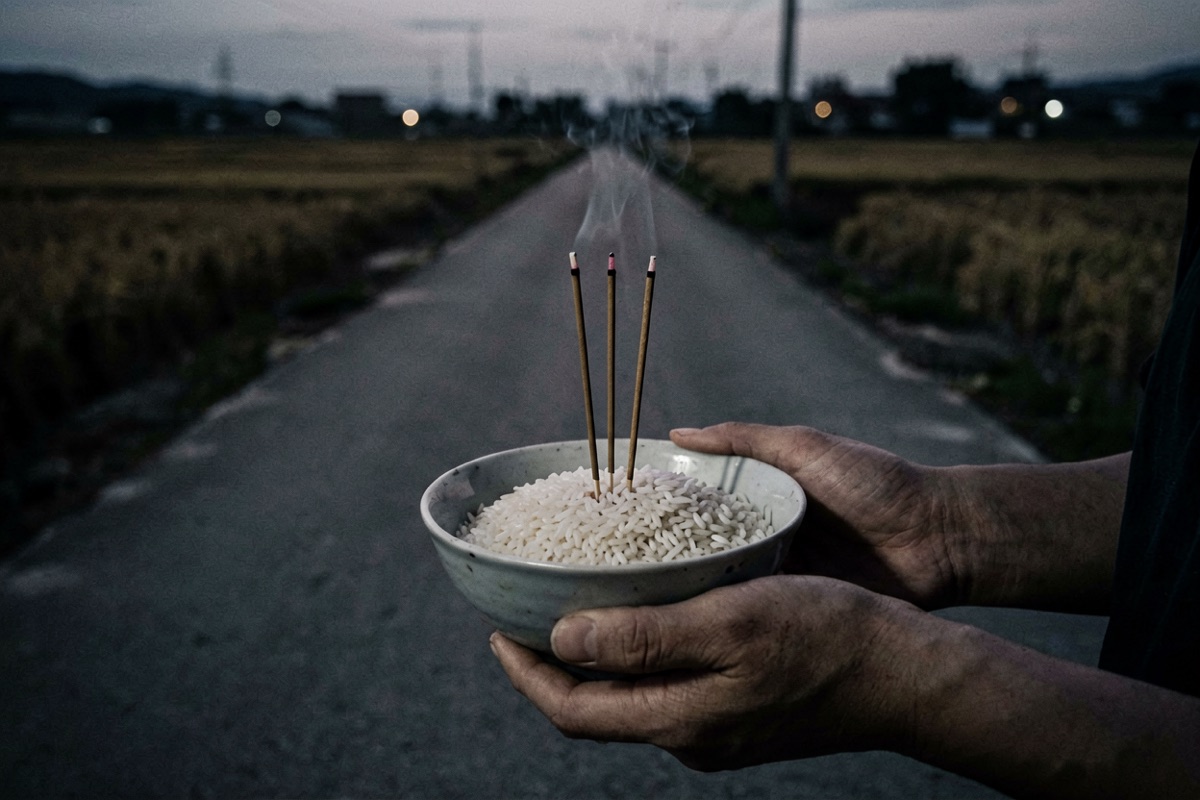
The materials are domestic. A bowl holding a little uncut rice; three sticks of incense stood upright in it; a garment the child actually wears. The caller — almost always the mother or grandmother — takes these to the exact place the fright occurred, at dusk or after dark, and calls the child's name in a long sustained cry, the standard form being some version of hui lai le (回来了) — 'come back'. A second person, either walking behind or waiting at the house, answers each call: he has come back. The pair work their way home without breaking the alternation. At the door the clothing is laid over the sleeping child, and in many versions the rice is later cooked and eaten by the child. Southern Chinese and Taiwanese shou jing has a temple version, performed by a specialist with the child's clothes and a written birth date.
The rule about looking back
Two prohibitions attach to nearly every recorded version. The caller does not look behind them, and the calling does not stop until the threshold is crossed. Both are the same instruction viewed from different angles: whatever is being led home is behind you, and the process is only complete inside. It is worth noticing how much this rule shapes the emotional experience of the rite. The mother walks home in the dark hearing an answer to every call, forbidden to turn around and check the source of it, for perhaps fifteen minutes. Whatever else is happening, that is a powerfully constructed piece of ritual theatre, and the anxiety it produces is not accidental.
The scare of 1768
The most famous appearance of jiao hun in the historical record is not a healing but a panic. In 1768 a rumour spread through the Yangzi delta and beyond that sorcerers were stealing souls by clipping the ends of men's queues, and the resulting hysteria — denunciations, lynchings, and a full-scale imperial investigation directed by the Qianlong emperor — was reconstructed by the historian Philip Kuhn in Soulstealers: The Chinese Sorcery Scare of 1768. The episode is the standard scholarly entry point to Chinese soul belief because it shows the stakes: in a society where soul-loss is a real category, the accusation of soul-stealing is a weapon, and it was used by the powerless against strangers, monks and beggars with lethal effect.
Fiction · Tales of the Hidden Path
Calling the Soul
The boy had not spoken in three days. His footprints stopped in the middle of the field road, at a place where nothing was, and did not continue — his mother had walked out at dusk to see, and that was what she found.
So she did it the way her own mother had. Half a bowl of rice, three sticks of incense pushed upright into it, his jacket over her arm. She went out through the gate after dark and walked to the place where the footprints ended and called with the long drawn note the calling takes.
Come back.
And out of the dark, faint, from somewhere ahead of her: he's come back.
She turned and walked home calling, and each time she called, the answer came, and each time it came it was closer. She did not look behind her. At the gate the voice answering her was near enough to have been at her shoulder, and she did not look behind her then either. On the threshold, set neatly side by side, was a pair of his shoes.
She put the bowl on the table. The incense had burned down to stubs. In the bed the quilt was higher than it had been when she left.
Mother, the boy said, from under it. He had not spoken in three days.
She had her hand on the corner of the quilt when he said the rest of it: Mother, why did you call two of us back?
On the threshold there were two pairs of shoes. Identical. One pair older than the other.
An original short story written for our folklore film series. It is fiction — invented, not a recorded case, not a claim about how any of the customs above actually work. The belief it is built on is real; everything that happens in it is not. See our honesty policy。
Charms for children — the lock pendant, the peach-wood token, the red cord — belong to the same protective tradition. What they are and what they mean.
Chinese Protective Amulets →FAQ
Is soul-calling still practised?
Yes. In rural mainland China, Taiwan and Southeast Asian Chinese communities the domestic form survives, and temple shou jing services for startled children are openly advertised in Taiwan and Fujian.
What are hun and po?
The two classes of soul in Chinese thought: hun is the ethereal, consciousness-associated soul that departs at death, po the corporeal soul that remains with the body. Conventionally three hun and seven po. Soul-loss beliefs depend on this plurality.
Why does a second person have to answer?
Because the rite is a call and response: the caller calls the name, the answerer confirms the return. Most accounts treat the answering voice as essential — a call with nothing answering it is considered incomplete.
Is this a substitute for medical care?
No, and it should never be treated as one. A child who has stopped eating or speaking needs a doctor. The rite is a cultural practice about fright and family attention; presenting it as treatment for illness is where folk custom turns into harm.
Related: Borrowing Years: The Chinese Belief That Lifespan Can Be Transferred · The Seventh Day: Why Chinese Families Leave the House Empty · Free BaZi Calculator · Free I Ching Reading