Road Rushing Sha: When a Street Points at Your Door
A house at the end of a straight road, with the carriageway aimed at its front door, is the classical external sha — lu chong sha (路冲煞), 'road rushing'. It is the first thing a practitioner looks for on approaching a property and the complaint most likely to result in advice to buy somewhere else. It is also, of all the sha, the one with the least need of explanation.
The complaint
The geometry is simple: a road runs straight and terminates at, or points directly into, a building. The classical case is the property at the head of a T-junction; modern equivalents include a house at the end of a cul-de-sac approach, a flat at the end of a long straight corridor, and a shop directly facing an off-ramp. Severity is judged by how directly the alignment falls on the entrance, how long and straight the approach is, how fast traffic moves on it, and how far back the building sits. A road that curves before reaching you, or that passes across your frontage rather than into it, is not the complaint.
What is actually happening
Terminal T-junction properties are hit by vehicles. Not often, but at rates measurably above surrounding plots, because a vehicle that fails to stop or turn continues into the property at the stem — this is why highway authorities place barriers, bollards and chevron boards at such junctions as standard practice. Below that threshold, the same properties receive headlights sweeping the facade every night, engine and braking noise concentrated at the frontage, and a larger share of road dust. The tradition's account of a force arriving repeatedly at the door describes something that arrives repeatedly at the door.
The stone lion and the shi gan dang
The classical protective responses at such a site are physical objects with symbolic weight. Paired stone lions flank an entrance. A shi gan dang (石敢当) — a stone slab or pillar carved with the characters and often set at a T-junction or the end of a lane — is a genuine and widespread practice, listed in China as intangible cultural heritage, and is placed precisely where a road meets a wall. It is worth appreciating what these objects are doing at the level of physics as well as belief: a substantial stone mass at the point where a road terminates is a bollard. The tradition arrived at street furniture by another route.
Remedies for an ordinary house
A boundary wall or solid fence across the frontage; planting, particularly a dense hedge or a group of trees on the line; bollards or a raised kerb where permitted; moving the entrance off the axis, which is the most complete solution where it is possible; and internally, keeping beds and the main seating out of the aligned room. Commercial properties in this position routinely install crash protection as a matter of insurance. A family that consults a practitioner, is told about lu chong sha, and puts in a wall and a hedge has taken the correct action, whatever they believe about why.
Fiction · Tales of the Hidden Path
The Threshold
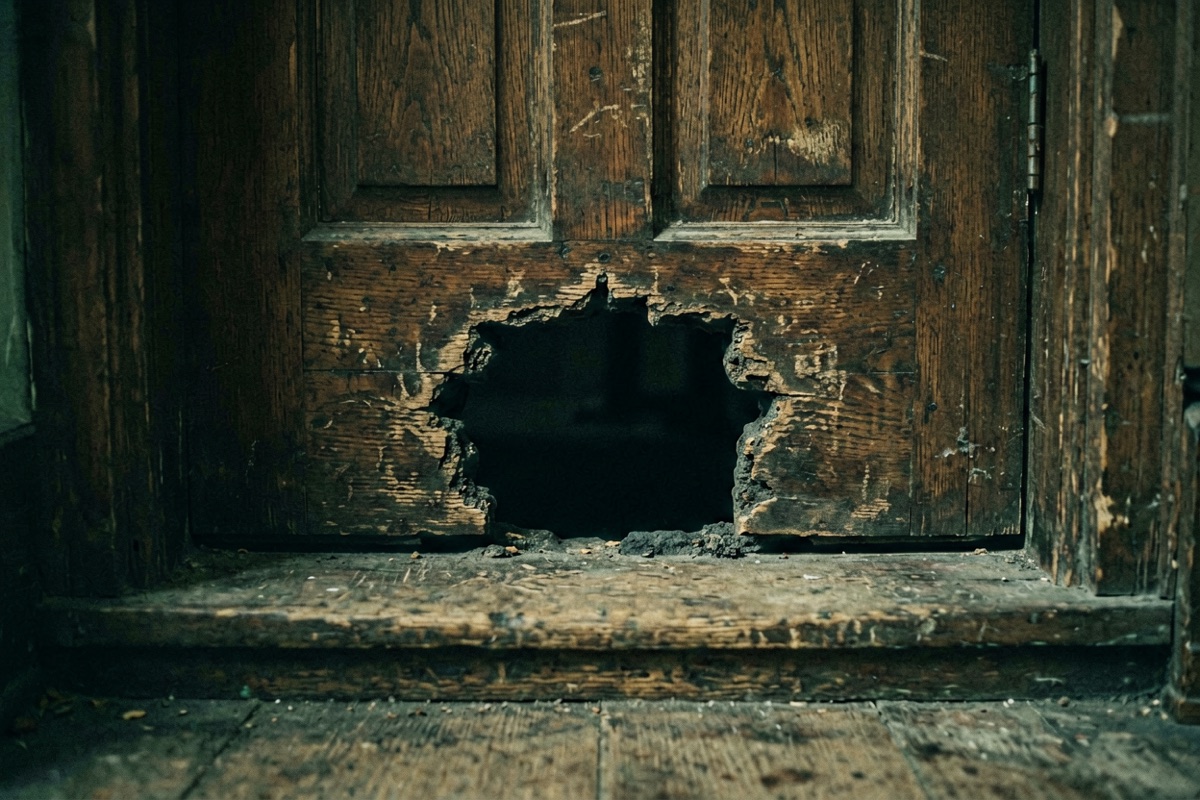
The old house has a beech threshold with a hollow worn into the middle of it.
He has lived there alone for ten years.
Once a year he measures the depth with a vernier caliper and writes it on the inside of the door frame. First year to tenth: about a millimetre a year, very even.
He has done joinery and knows what that means. Beech is hard. To take that much off it you need tens of thousands of crossings.
He worked his own out: out and back twice a day, four crossings, about fifteen hundred a year. Ten years, fifteen thousand.
The depth of that hollow corresponds to something nearer sixty thousand.
He spread a thin layer of stove ash across the threshold, level, edge to edge.
In the morning he opened the door and looked.
There were prints in the ash. All of them going out. Not one of them coming back.
An original short story written for our folklore film series. It is fiction — invented, not a recorded case, not a claim about how any of the customs above actually work. The belief it is built on is real; everything that happens in it is not. See our honesty policy。
Road rushing is one of thirteen classical forms. How each is identified, and the tradition's own ranking of the cures.
The Full Sha Catalogue →FAQ
What exactly is 路冲煞?
A straight road, lane or driveway aimed directly at a building's entrance — classically the property at the head of a T-junction. Severity depends on directness, straight approach length, traffic speed and setback.
Is there evidence for it?
Terminal T-junction properties are struck by vehicles at rates above surrounding plots, which is why highway authorities place barriers and chevron boards there as standard. They also get sweeping headlights, concentrated noise and more road dust.
What is a 石敢当?
A carved stone slab or pillar set where a road meets a wall or at the end of a lane, to absorb or turn the force. It is a widespread practice and recognised in China as intangible cultural heritage — and it is also, physically, a bollard.
What should I actually do?
A solid boundary wall or dense planting on the line, bollards or a raised kerb where allowed, and moving the entrance off the axis if possible. Inside, keep beds and main seating out of the aligned room.
Related: The Beam Overhead: Why Feng Shui Moves Your Bed · Glare Sha: When the Building Opposite Throws Light Into Your Home · Free BaZi Calculator · Free I Ching Reading