Reverse Bow Sha: The Road That Curves Away
Chinese geomancy reads a curve. Where a road or river bends around a site so that the inside of the curve embraces it, the form is favourable and has a name of its own — the jade belt. Where the same curve is turned the other way, so that the outside of the bend faces the building like the back of a drawn bow, it is fan gong sha (反弓煞), and the reading reverses completely.
Which side of the bend
The whole doctrine turns on one distinction. Stand at the building and look at the curve: if the road or river wraps toward you, holding the site in its arc, the form is embracing and favourable. If the arc bulges away from you so that you are on the outside of it, the form is the reverse bow. Practitioners are precise about this and will walk a site to establish which case applies, because the two readings are not merely different in degree but opposite in kind. The favourable case has the more evocative name: the jade belt around the waist, from the belt of a court official.
Rivers, where the doctrine comes from
The distinction originates with water, and with water it is straightforwardly correct. On the outside of a river bend the flow is fastest and the bank erodes; on the inside the flow is slow and material is deposited. Any hydrologist would site a building on the inside of a meander and keep it off the outside, and any farmer knows which bank loses land each year. Chinese siting doctrine encoded the observation in the language of embrace and rejection, and then — as the tradition consistently does — extended the formal principle from watercourses to roads, walls and any other curving feature.
Roads, where the extension holds up
The extension to roads turns out to work, for a different reason. A vehicle that loses control on a bend departs tangentially, which means it leaves on the outside of the curve. Properties on the outside of bends receive run-off incidents, headlight sweep through the arc, and the noise of braking and acceleration; properties on the inside receive far less of all three. Highway engineering treats the outside of a curve as the hazard side and protects it accordingly with barriers. A tradition that says the outside of a bend is where the force goes is describing a tangent.
Flyovers and modern forms
The form recurs in modern infrastructure and practitioners have extended the reading without difficulty: an elevated road curving past a tower block, a rail viaduct, a slip road, even the curved edge of a large building. Where the concave side faces the property the reading is embracing; where the convex side faces it, reverse bow. Severity is judged by proximity, height and how tight the curve is. The remedies are the familiar physical set — screening, planting, a solid boundary on the exposed side — plus, in the tradition's symbolic layer, the same protective objects used for the road-rushing sha.
Fiction · Tales of the Hidden Path
The Arc on the Floor
The house sits on the outside of a bend. The road comes past the front of it with its back turned.
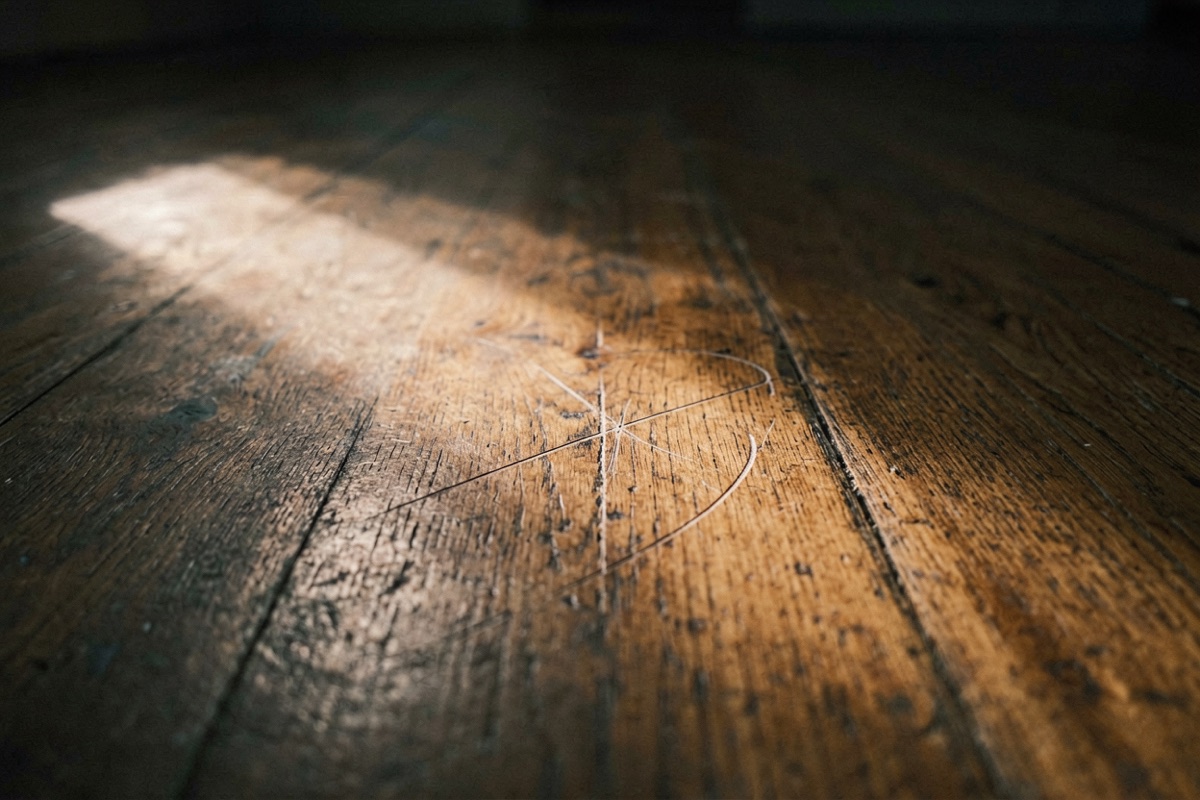
There is a curved scratch in the living room floorboards, very shallow. You only see it if the light rakes across.
He had always assumed the previous tenants dragged furniture over it.
One day he lay on the floor with a tape and a piece of chalk and took three points off the arc, and worked out the radius. Two metres thirty.
He went up onto the roof and looked at the road. The bend out there has a radius of about thirty metres.
The scale does not match, but the curvature runs the same way — the back of the bow toward the house, both of them.
He traced the floor arc onto tracing paper, enlarged it to scale, and laid it over the bend on the map.
It fitted. The same arc, thirteen times the size.
He extended both ends of the floor arc outward and kept drawing until he had closed the circle. It took a whole sheet.
The centre was not in the living room. He measured the coordinates twice. It fell in the bedroom, on the bed.
The bed came with the flat from the furniture shop. It has stood in that spot for three years.
An original short story written for our folklore film series. It is fiction — invented, not a recorded case, not a claim about how any of the customs above actually work. The belief it is built on is real; everything that happens in it is not. See our honesty policy。
Curves, slopes, water and support — the full set of criteria the tradition applies when judging where a house should stand.
Siting a Home →FAQ
How do I tell which case I have?
Stand at the building and look at the curve. If the arc wraps toward you, holding the site, it is the favourable jade belt. If the arc bulges away so you are on the outside, it is the reverse bow.
Why does the tradition care?
It comes from rivers, where it is simply true: the outside of a bend erodes and the inside deposits. The formal principle was then extended to roads and other curving features.
Does it hold up for roads?
Yes, for a different reason. A vehicle leaving a bend departs tangentially — that is, to the outside. Highway engineering treats the outside of a curve as the hazard side and barriers it.
What about flyovers and viaducts?
Read the same way: concave side facing you is embracing, convex side facing you is reverse bow. Severity depends on proximity, height and how tight the curve is.
Related: The Beam Overhead: Why Feng Shui Moves Your Bed · Glare Sha: When the Building Opposite Throws Light Into Your Home · Free BaZi Calculator · Free I Ching Reading