The Outer Response: Divination That Uses the Room
Most divination systems draw a boundary around the procedure: coins, sticks, cards, and everything else in the room is irrelevant. Mei hua yi shu (梅花易数), plum blossom numerology, does the opposite. Its doctrine of wai ying (外应), the external response, holds that whatever happens around you at the moment of casting is part of the answer.
Casting from anything
Plum blossom numerology is distinguished by not requiring apparatus. A hexagram can be raised from the current time converted to numbers, from a number a person says, from the strokes in a written character, from a sound heard, from a direction something came from, or from any quantity available. The tradition attributes the method to Shao Yong, the Song philosopher and numerologist, and the founding anecdote has him casting from plum blossoms falling — hence the name. The absence of dedicated equipment is the method's practical selling point and also its philosophical position.
Why the boundary disappears
The consequence follows immediately. If a hexagram can be raised from any circumstance, then no circumstance is outside the system, and the events surrounding a casting are not interference but material. A bird striking the window, a bowl breaking next door, a dog barking three times, someone arriving at the door — the practitioner records these and reads them alongside the hexagram, giving weight to direction, timing, number and the nature of the thing. A cracked bowl and a bird are read differently. This is genuinely distinctive: most divinatory traditions work hard to isolate the procedure, and this one dissolves the isolation on principle.
Body and function
The interpretive core of the method is the ti-yong (体用) relation. One trigram of the derived hexagram is the 'body', standing for the querent or the matter's subject; the other is the 'function', standing for the circumstances acting on it. The reading turns on the productive and controlling relations between their five elements: whether the function generates the body, drains it, controls it or is controlled by it. It is a compact system, learnable quickly, and the external response is read into the same frame — an event is assigned an element and evaluated the same way.
How to hold it
Two things can be said honestly. The doctrine is a formalisation of something everyone does: at moments of decision people notice coincidences and weight them, and the plum blossom method gives that tendency a structure and a vocabulary rather than pretending it away. And the obvious objection is also correct — with no limit on what counts, something always happens, and a practitioner alert for a response will find one. The tradition's own answer is that the skill lies in knowing what to disregard, which is an honest response but not a testable one. Recorded properly over years, a practitioner's own log is the most interesting thing here, and it is worth keeping.
Fiction · Tales of the Hidden Path
The Outer Response
He was three years into studying plum blossom before he would read for anyone. The method takes the external response: whatever happens at the moment of casting counts.
First reading. He had just raised the hexagram when a bird hit the window. He wrote it in the notebook: bird, struck window, roughly a quarter of an hour after casting. The reading came out right.
Second: a bowl broke next door. Noted. Right again.
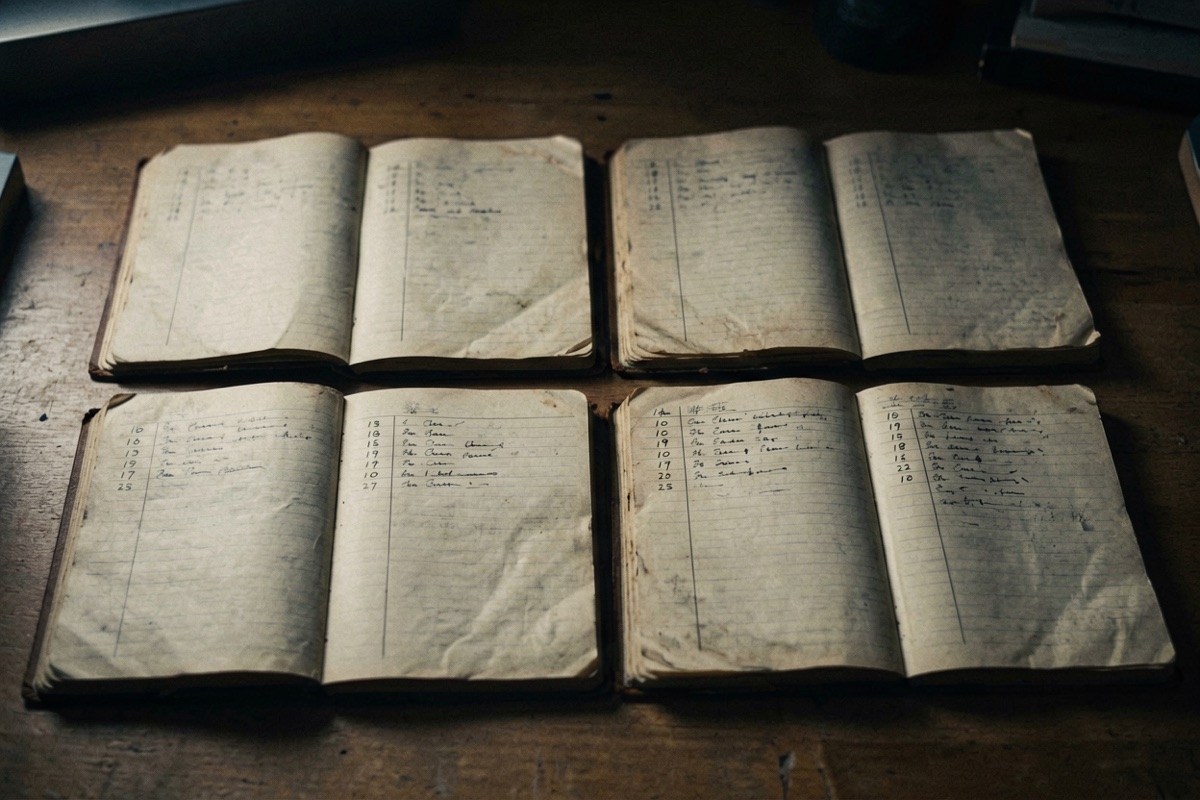
He kept the log for three years. Four notebooks. Each entry gives the date, the hour, the hexagram, what the response was, and how long after the casting it came.
In the second year he noticed something.
The responses were arriving earlier.
First year, the average was about the burning time of a stick of incense. Second year it was down to a few minutes. Third year, several of them came at the same moment as the casting.
Once he had not decided whether to cast at all — he had only taken the coins out — and the response came first. The dog at the gate barked three times, and it matched the hexagram he raised afterwards.
He laid the four notebooks out on the desk and sorted every response by the interval. First year positive, second year near zero, third year negative and getting steadily more so.
He drew the line and extended it back.
It reaches March, twenty-nine years ago. He was born that March.
An original short story written for our folklore film series. It is fiction — invented, not a recorded case, not a claim about how any of the customs above actually work. The belief it is built on is real; everything that happens in it is not. See our honesty policy。
Whatever the method, the reading is decided by the question. The craft of asking — the half that is entirely under your control.
Asking a Question Well →FAQ
What is 外应?
The plum blossom doctrine that whatever happens around you at the moment of casting forms part of the reading — a sound, an arrival, a breakage, a bird — read for direction, number, timing and nature.
What makes plum blossom numerology different?
It requires no apparatus. A hexagram is raised from whatever is at hand: the time, a number, the strokes of a character, a sound, a direction. That is also why nothing counts as outside the system.
What is ti-yong?
Body and function. One trigram stands for the querent or subject, the other for the circumstances acting on it, and the reading turns on the five-element relations between them — generating, draining, controlling or being controlled.
Isn't something always happening?
Yes, and that is the standard objection. The tradition answers that the skill is knowing what to disregard, which is honest but not testable. A practitioner's own long-run log is the most interesting evidence available.
Related: Chinese Palm Reading: The Three Main Lines · Ce Zi: Divination by Taking a Character Apart · Free BaZi Calculator · Free I Ching Reading