Paper Offerings: Why the Chinese Burn Houses, Servants and Money
Walk through an old Chinese neighbourhood before Qingming and you will pass shopfronts stacked with paper houses, paper cars, paper servants and bricks of banknotes drawn on the Bank of Hell. Zhi zha (纸扎) — bamboo-framed paper goods made to be burned — is one of the most visible and least understood parts of Chinese practice. It is a craft with real rules, and craftsmen who observe them.
Where the custom comes from
Behind the paper Mercedes is a very old and rather humane story. Early Chinese elite burial included human and animal interment; the shift to grave figures — the mingqi (明器) of which the Terracotta Army is the spectacular extreme — was already established by the Zhou, and Confucius is recorded discussing the ethics of burial figures directly. Paper, cheap and universally available after the Tang, democratised the same logic: any family could now send a house, a horse, a servant. The premise never changed across three thousand years and two materials. What the dead need can be sent in effigy, and sending the effigy is not a pretence — it is the accepted mechanism.
How the figures are made
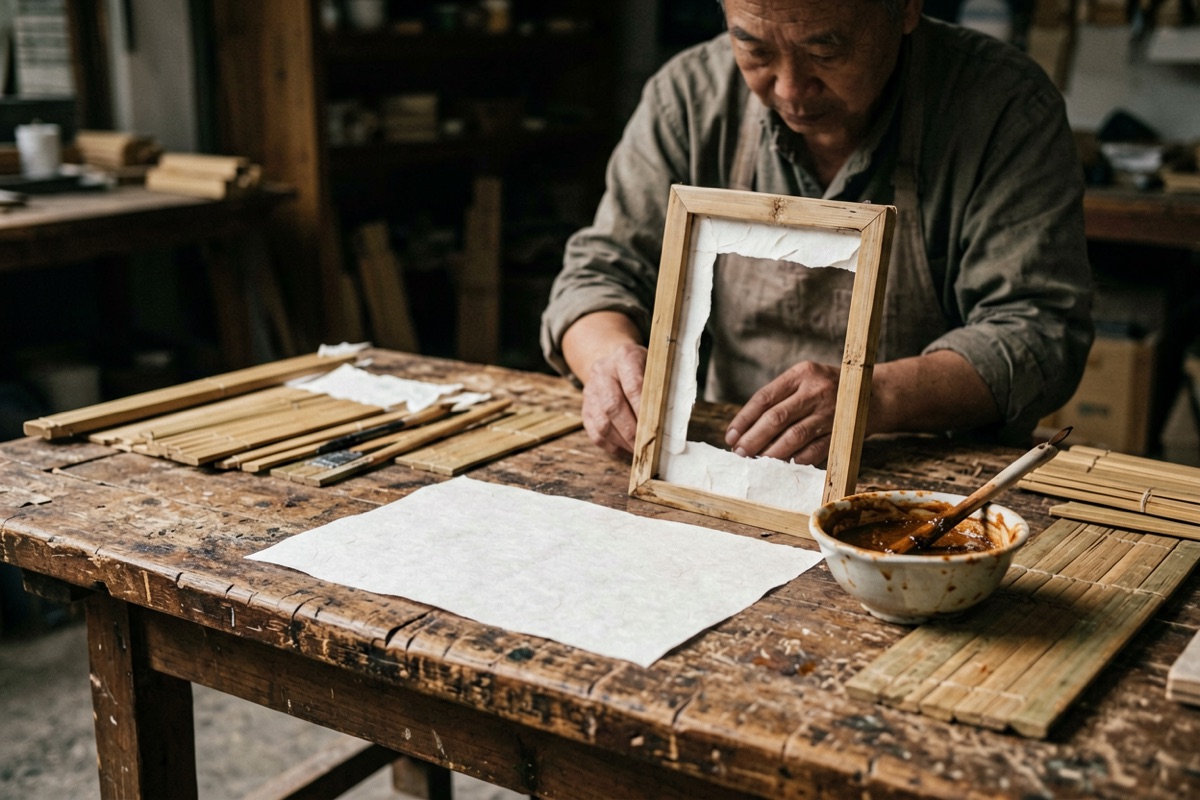
The armature is split bamboo or reed, bent and lashed at the joints with fine cord or paper twine, built up limb by limb into a rough human frame. White or coloured paper is pasted over it and worked smooth with a brush and thin paste. Details — a collar, a sash, a hairline — go on in cut coloured paper or pigment. A traditional workshop can build a life-sized attendant in a morning. The finish is deliberately unfussy: these are objects with a working life of a few hours, and the craft's aesthetic — flat colour, blunt line, a certain fixed cheerfulness — comes directly from that. Contemporary shops in Hong Kong, Taiwan and Malaysia now produce smartphones, air conditioners and branded handbags to the same standard.
The rule about the eyes
Paper craftsmen across regions describe the eyes as a separate operation, done last or not at all. The reasoning given is the same one behind the idiom hua long dian jing (画龙点睛) — 'painting the dragon, dotting the eyes', from the tale of a painter whose dragons flew off the wall once he added their pupils. Finishing the eyes is understood as finishing the thing. Craftsmen also commonly avoid writing a living person's name anywhere on a figure, and many will not leave a completed effigy standing in the shop overnight. It is easy to file this as superstition; it is more interesting to notice that the rules cluster precisely around the moment an object stops being materials and starts being a likeness of somebody.
What is actually being done
The honest account of paper burning is that it is a way of continuing to give. Chinese funerary practice does not end the relationship at death — it converts it into a schedule of obligations, and the obligations are material because that is how care is expressed between the living too. A daughter who burns a paper coat in November is doing the recognisable thing of worrying about whether her mother is warm. Read that way, the paper Mercedes is not absurd and not a joke about consumerism; it is the exact same gesture as the paper coat, made by a family whose expression of care happens to include cars. The burning is the point at which something can still be handed over.
Fiction · Tales of the Hidden Path
Paper Bride
He had made paper figures for forty years and kept three rules the whole time. Do not paint the eyes. Do not write a name. Do not let one stay in the shop overnight.
The knock came at night, three times. A slip of paper came under the door with a name on it and a date, and a voice on the other side of the boards said: I want one that can stay overnight. Then a cloth bag hit the ground and the footsteps went away, and when he unbarred the door there was nobody, only the money — enough that he could have stopped working for three years.
He counted it twice. Then he flattened the slip of paper on the workbench and weighted the corner.
Bamboo. Paper. Colour. And then the last step, which he had not taken in forty years: he painted the eyes, and he wrote the name.
It stood by the bench when he was done. The lamp threw its shadow up the wall, and the shadow was taller than the figure was.
The first night it did not fall over. The second morning it had turned a little. The third morning it was facing the door, and by the fourth it was gone, and the gate of the yard stood unbarred with a mark across the dirt like a paper edge dragged over it.
On the seventh night he opened the shop and there was a new figure standing on his bench. The bamboo was lashed exactly as he lashed it. Inside the collar, in the corner where nobody would look, was the small private mark he had put inside every figure he had ever built.
Written across the breast of it was a name, and the name was his own.
An original short story written for our folklore film series. It is fiction — invented, not a recorded case, not a claim about how any of the customs above actually work. The belief it is built on is real; everything that happens in it is not. See our honesty policy。
Paper is the material offering; incense is the one that opens the rite. What the three sticks mean and how they are properly offered.
Incense: The Other Offering →FAQ
Is burning paper offerings a Taoist or Buddhist practice?
Neither exclusively — it is Chinese folk practice, used at funerals conducted under Taoist, Buddhist and purely secular auspices. Both clergies accommodate it; some Buddhist reformers discourage it in favour of merit-dedication.
What is 'hell money'?
Joss paper printed as banknotes, usually drawn on the 'Bank of Hell' — 'hell' here being a nineteenth-century English mistranslation of diyu, the underworld bureaucracy, which is a place of processing rather than eternal damnation.
Why are the eyes painted last?
Craft lore holds that completing the eyes completes the figure — the same idea as the classical 'dotting the dragon's eyes'. Many craftsmen leave funerary figures' eyes blank for exactly this reason.
When are paper goods burned?
At the funeral itself, on the seven seventh-day observances, at Qingming in spring, at the Ghost Festival in the seventh lunar month, and on death anniversaries.
Related: The Soul-Guiding Lantern: Light at the Head of a Chinese Funeral · The Ghost Market: China's Pre-Dawn Trade and Its Legend · Free BaZi Calculator · Free I Ching Reading