The Ghost Market: China's Pre-Dawn Trade and Its Legend
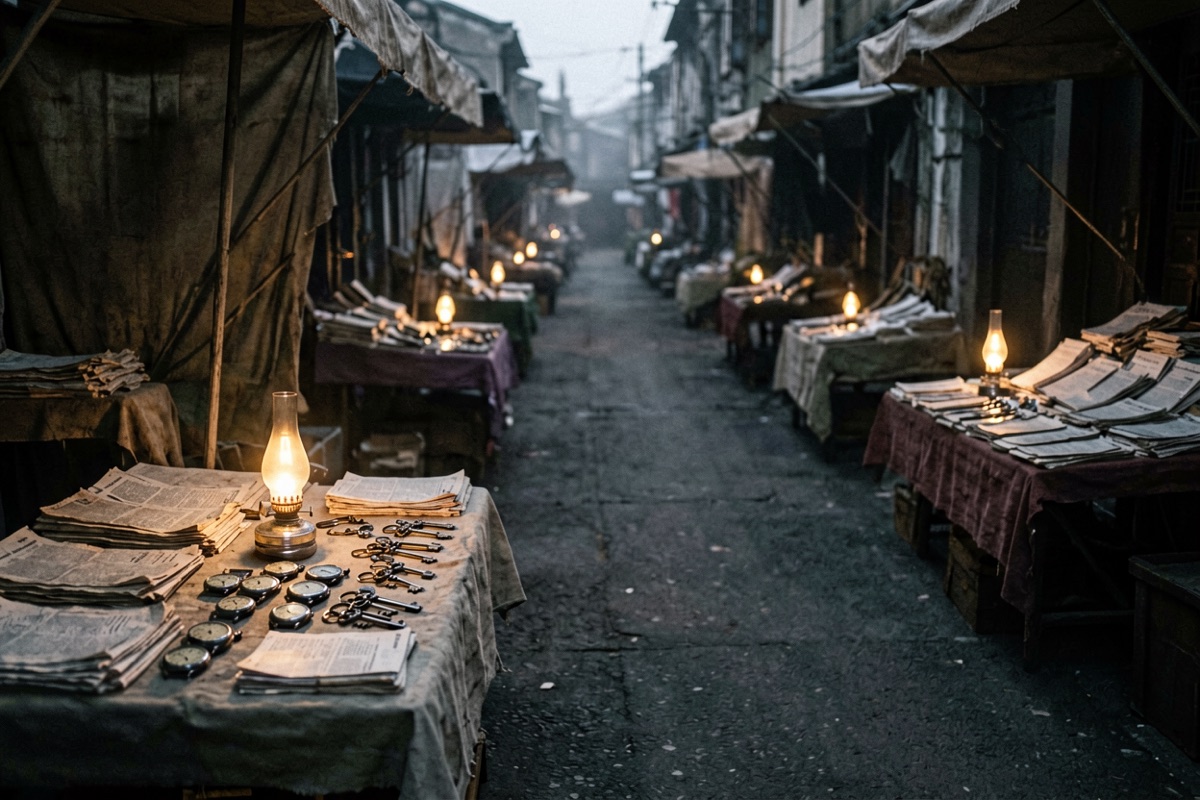
A gui shi (鬼市) — 'ghost market' — is a real and specific institution: a market that opens hours before dawn and dissolves at sunrise, lit by hand-torches, where goods change hands in the dark and nobody asks where anything came from. Beijing, Tianjin and a dozen other cities have had one. The name is not decoration, and there is an older story underneath it.
The real institution
The historical ghost market was a solution to a problem: how to sell things that could not be sold in daylight. Impoverished families disposing of heirlooms they did not wish to be seen disposing of; goods of doubtful origin; objects whose sellers preferred not to answer questions. Trading in the two or three hours before dawn, by the light of a torch held close to the object, solved all of it at once. Buyers inspected by feel and by a moment's flare of light; sellers squatted behind a cloth laid on the ground; nobody used names. The market's own etiquette forbade asking where something came from, which is the single feature that generated most of the legend attached to it.
Why it is called a ghost market
Chinese sources give the obvious explanations and then a better one. The obvious: the hours are the hours of ghosts, and the traders materialise in the dark and are gone by sunrise. The better one is about the transaction itself. In a market where you cannot see the goods properly, cannot ask their history, and will never find the seller again, every purchase is an act of faith with a stranger who does not exist by daylight. Old Beijing writing about the gui shi returns constantly to this quality — that you might buy a treasure or a fake, from a scholar or a thief, and the market's structure guarantees you will never know which. That is a genuinely uncanny commercial form, and it earned its name honestly.
The market of the dead
Alongside the real institution runs a folkloric one, and Chinese classical fiction is full of it: a traveller stumbles on a lively night market in a place where no market should be, buys something at a strangely good price, and finds in the morning that the money he paid with has become paper ash, or that the lane he walked down is a graveyard. The motif is old, widely distributed, and structurally identical to fairy-market stories across Eurasia. Its Chinese versions have one characteristic emphasis: the transaction is real and binding. What you bought, you have. What you paid, you paid. The horror is never that the market was an illusion — it is that it was not.
Going now
Ghost markets still operate. Panjiayuan in Beijing has an early-weekend trade that begins in the dark and is well known to collectors; similar pre-dawn markets run in Tianjin, Shenyang, Xi'an and elsewhere, and the format has been widely commercialised for tourists. What survives from the old institution is the atmosphere and the caution: experienced buyers still say that anything genuinely valuable at a ghost market is either a mistake or a trap, and that the correct posture is to enjoy the hour and expect nothing. That is not bad advice about a great many things one might be tempted to buy in the dark.
Fiction · Tales of the Hidden Path
The Night Market
There is an alley that only connects on certain nights. On the other side of it is a market, and the market does not take money. It takes years.
The first time, he bought back his brother's watch. The stallholder held out an open palm; he laid his own hand on it; that was the transaction, and it cost a year. The second time it was a letter that had never been sent. Two years.
The third time he walked the whole length of the stalls and found nothing of his, and a seller reached out and put a bronze coin into his hand — square-holed, worn smooth at the rim — and said, in a voice with nothing in it: it's on order. Bring this next time and collect.
The fourth time he came, most of the lamps were out. The stalls stood empty on both sides all the way down, and only the one at the far end was still lit.
There were three things laid out on it. His brother's watch. The letter. And a pair of shoes.
He looked down at his feet. They were the same shoes.
The stallholder was crouched with his back to him, threading a bronze coin onto a cord that already carried a great many. He said, hey. The hands stopped. The stallholder turned — only far enough to be a shape against the lamp — and held out an open palm to be paid.
Every trader in that market had once been a customer. The ones who ran out of years stayed on to collect them.
An original short story written for our folklore film series. It is fiction — invented, not a recorded case, not a claim about how any of the customs above actually work. The belief it is built on is real; everything that happens in it is not. See our honesty policy。
Coins, cords, peach wood, mirrors — what Chinese tradition actually considers protective, and what it says such objects can and cannot do.
Protective Objects Explained →FAQ
Is the ghost market a real place or a legend?
Both, and the two are related. Pre-dawn markets called gui shi genuinely operate in Chinese cities. A separate body of folklore describes markets where the dead trade — and the real markets' anonymity and darkness are exactly what kept that folklore alive.
Why do they trade before sunrise?
Historically, so that goods of uncertain origin could change hands without scrutiny, and so that sellers disposing of family property would not be recognised. The market's etiquette forbids asking where anything came from.
Where can I visit one?
The best-known is the early-morning trade at Panjiayuan in Beijing, which begins before dawn on weekends. Similar markets run in Tianjin, Xi'an and other cities, though most are now substantially oriented to tourists.
What do the folkloric ghost markets sell?
In the stories, ordinary things — and objects that belonged to the buyer or their family. The recurring twist is that the price is not paid in money at the time of purchase.
Related: Paper Offerings: Why the Chinese Burn Houses, Servants and Money · The Soul-Guiding Lantern: Light at the Head of a Chinese Funeral · Free BaZi Calculator · Free I Ching Reading