Keeping Vigil: The Rules of the Chinese Wake
Between a death and a burial, Chinese custom does not leave the body alone. Shou ling (守灵) — keeping vigil — means family members sitting with the coffin in shifts through every night until interment, feeding a lamp, burning paper, and observing a short list of prohibitions that are remarkably consistent across a very large country. The rules are worth taking seriously, whatever you believe, because each one turns out to be about something.
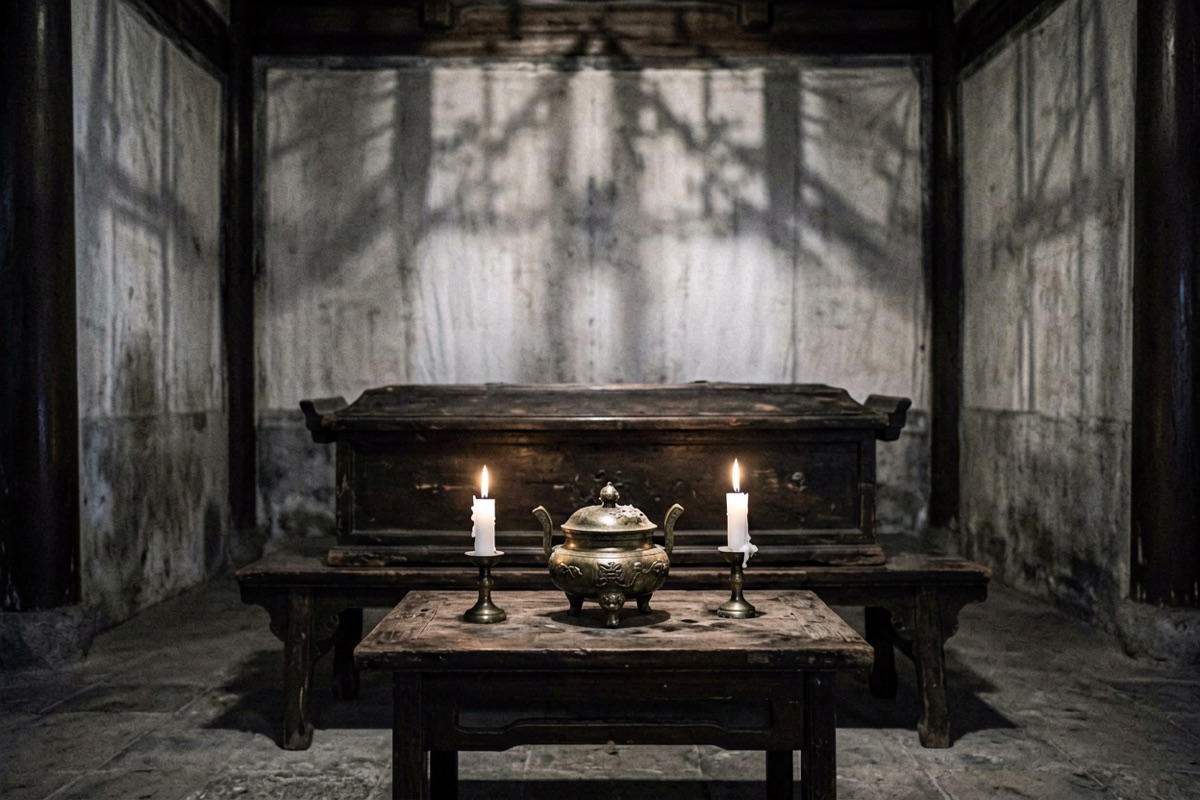
The lamp that does not go out
A lamp burns at the head of the coffin for the whole vigil and, in older practice, for the whole forty-nine days before the tablet. It is called the chang ming deng (长明灯), the ever-bright lamp, and the same term is used for the perpetual lamps placed in tombs, of which archaeology has turned up a great many. Its stated purpose is to light the road: the newly dead are held to be disoriented, and the lamp marks where they are and which way out lies. Letting it fail is the gravest of the small failures available to someone keeping vigil. In practice this converts the night into a job — oil to be added, a wick to be trimmed, a thing that will go wrong if you stop attending to it, which is precisely what a person in the first days of grief can hold on to.
Nothing living crosses the body
The most widely known Chinese funeral taboo is that a cat must not jump over a corpse. The stated consequence, in the folklore, is that the body will rise — the origin of the jiangshi (僵尸), the stiff corpse of Chinese ghost story and, later, of a whole film genre. The prohibition is usually extended to dogs and sometimes to any animal, and in strict households to people leaning across the coffin. Explanations offered by folklorists range from static electricity and muscle contraction in the pre-refrigeration period, to the simpler observation that an animal disturbing a laid-out body in a hot room is a disaster in ways that require no metaphysics. The taboo has outlived every explanation for it, which is generally the sign of a good taboo.
Why someone must stay awake
The third rule is the hardest and the least negotiable: the vigil must be kept by someone conscious. Falling asleep beside the coffin is treated across regions as both a discourtesy and a risk, and the folk accounts of what happens to those who do are numerous and unpleasant. The functional reading is straightforward — the lamp, the incense and the paper burning in an open basin all require a person, and an unattended flame beside a wooden coffin is exactly the accident it sounds like. The ritual reading is that the dead are not to be left alone at the one moment when being alone matters. Both readings produce the same instruction, which may be why it survives so well.
The vigil today
In Chinese-speaking regions the vigil now usually takes place in a funeral home rather than a front room, compressed into one or two nights and attended by a smaller circle. Chanting may be arranged by the hour; the lamp is often electric. What has proved most durable is the social core rather than the ritual detail: the room stays occupied, relatives arrive through the evening, food appears, and people who have not spoken in years sit on the same bench for six hours. Anyone who has kept a vigil will recognise that the rules about lamps and cats are, in the end, scaffolding for the thing that actually happens, which is that nobody is left alone with it.
Fiction · Tales of the Hidden Path
The Wake
By two in the morning the others had gone home and he was alone with it: the coffin on its two benches, the two white candles, the tin basin of paper ash, and his own shadow thrown up the wall and across half the ceiling by light coming from below his knees.
He knew the rules. Feed the candles. Nothing living over the coffin. Nobody sleeps.
A cat cried in the yard, once, and he got up and went to the door to see about it, and there was nothing there, and when he came back one of the candle flames was leaning as though something had walked past it.
He sat down again and folded his hands and told himself he would only close his eyes.
When he woke, everything was where he had left it. Both candles burning. The incense down to its last quarter inch, as it should have been. The ash in the basin at the same level. He sat up straight and let his breath out and felt the specific, undignified relief of a man who has got away with something.
Then he looked at the wall.
There were two shadows on it. One sitting. One standing beside the sitting one. He turned around and there was nobody in the room, and he turned back and there were still two, and the standing one was beginning, without hurry, to face him.
The rule had never been about staying awake. The rule was about being the only one sitting there when you woke up.
An original short story written for our folklore film series. It is fiction — invented, not a recorded case, not a claim about how any of the customs above actually work. The belief it is built on is real; everything that happens in it is not. See our honesty policy。
Incense is the through-line of every rite in this article. Our guide covers what the three sticks mean and how they are properly offered.
How Incense Is Offered →FAQ
Why can't a cat go near the coffin?
Folk belief holds that an animal passing over a corpse causes it to rise as a jiangshi. Practical explanations have been offered for centuries; the taboo is observed regardless, and is one of the most consistent funeral rules across Chinese regions.
What is the 长明灯?
The 'ever-bright lamp' kept burning at the head of the coffin and before the memorial tablet. It is said to light the road for the newly dead, and the same term is used for the perpetual lamps found in ancient tombs.
How long does a Chinese wake last?
Traditionally from death until burial, which could be several days or considerably longer for a family awaiting a chosen date. Modern practice usually compresses it to one or two nights at a funeral home.
Is it disrespectful to fall asleep during a vigil?
Traditionally yes, and it is treated as more than a discourtesy — the requirement that someone remain awake is one of the three core rules. In practice families keep watch in shifts precisely so that no one has to.
Related: Borrowing Years: The Chinese Belief That Lifespan Can Be Transferred · The Seventh Day: Why Chinese Families Leave the House Empty · Free BaZi Calculator · Free I Ching Reading