Sitting and Facing: How a Chinese Grave Is Oriented
Every Chinese grave has a zuo xiang (坐向) — a sitting and a facing, the direction the back of the burial rests against and the direction it looks out toward. Getting it right is the central act of yinzhai practice, and the instrument for it is the luopan, the geomantic compass. A practitioner will check the reading two or three times before the stone is set, and the family will check the stone every year afterwards.
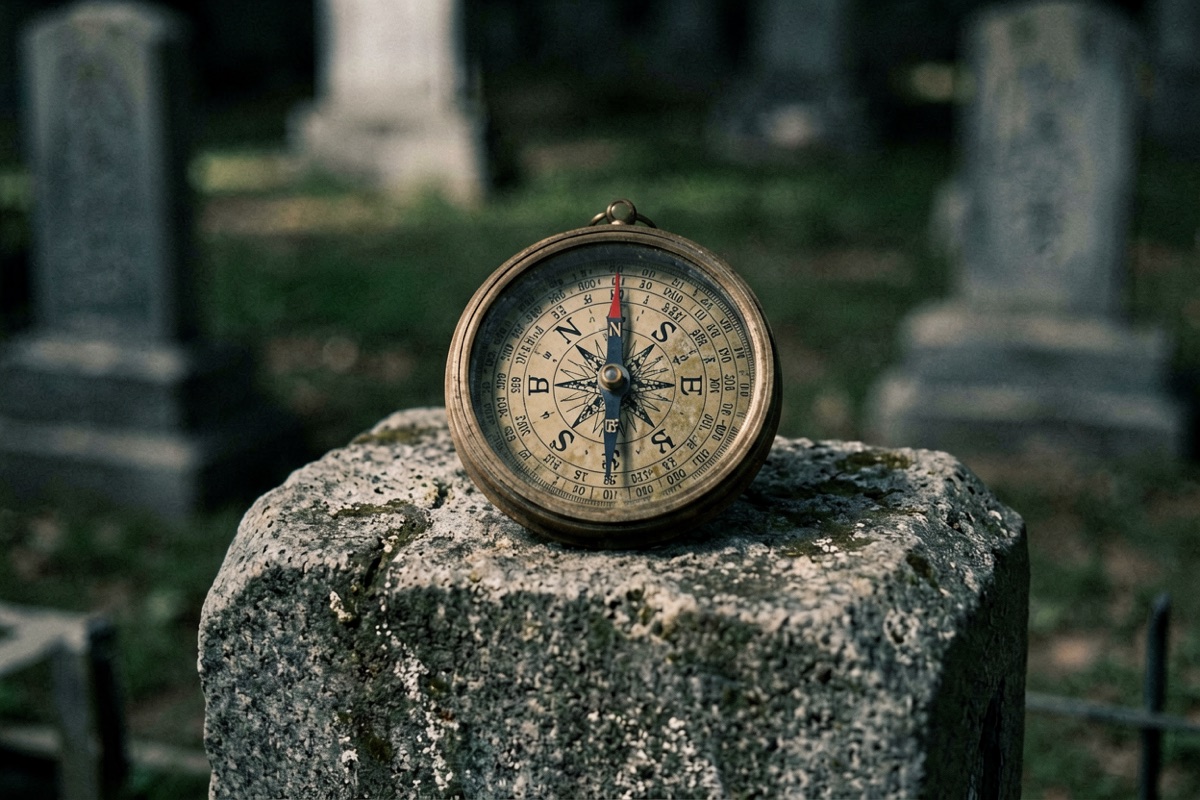
The luopan
The Chinese geomantic compass is a magnetic needle at the centre of a disc carrying anywhere from a handful to more than thirty concentric rings. The rings encode the eight trigrams, the twenty-four directional divisions, the sixty stem-branch combinations, the five elements, the twenty-eight lunar mansions and other systems, all indexed to bearing. A practitioner takes a reading by levelling the plate, aligning the needle to its marked position, and then reading outward through the rings that matter for the job in hand. It is a genuine instrument with a real history — the Chinese magnetic compass is attested for geomantic use before it is attested for navigation.
What the classical criteria want
Behind the grave, support: a rise, a slope, higher ground — 'the mountain' at the back. In front, openness: a level area, the 'bright hall' (明堂), and ideally water or a view at a distance. On both sides, flanking ground, the 'green dragon' and 'white tiger'. Beneath, dry firm stratum. These criteria are consistent across schools and centuries, and they describe, in ordinary terms, a sheltered dry spot on a slope with drainage away and an open aspect. The correspondence between what geomancy asks for and what a soil engineer would ask for is close enough that it is more useful to notice it than to argue about it.
Why a few degrees matter
The twenty-four-direction ring divides the compass into fifteen-degree sectors, and the sixty-division ring is finer still. A grave set a few degrees off can fall into a neighbouring sector with a different elemental assignment, and in the tradition's terms that is a different siting altogether. Practitioners therefore take the reading two or three times, at different moments, and note it. Whether the distinction carries the consequences claimed is not testable; that the tradition is internally precise about it is simply a fact about how the system is built. It is worth knowing that a practitioner reporting 'three degrees out' is making a statement inside a defined system, not waving a hand.
The stone that moves
Headstones shift. Frost heave, differential settlement, tree roots, the freeze-thaw cycle, water moving through the fill, cattle, and simple gravity on a slope will all rotate or tilt a stone over years. The family checking the facing at Qingming and finding it a few degrees off is observing something real, and the traditional response — reset it, check the reading, note the date — is the correct maintenance response as well as the ritually correct one. What the tradition adds is a reason to keep records, and families that have kept them for generations have, without intending to, accumulated genuinely interesting long-run data about ground movement on a particular hillside.
Fiction · Tales of the Hidden Path
The Facing
When they moved the grave and set the new stone, they had a practitioner fix the sitting and facing. Backing north, facing south. He levelled the compass and took the reading three times, and called the numbers out, and the son wrote them in a notebook.
At Qingming the next year the stone was off. He measured roughly with the compass app on his phone: three degrees. He reset it.
The third year, five. The fourth year, eight. The fifth, thirteen.
Always the same way round.
He bought a proper luopan, the kind the practitioner had used, two hundred and forty yuan, and started measuring properly once a year and writing it down.
The rate crept up a little each year but the direction never changed. He worked out how long a full revolution would take.
A hundred and twenty years.
He looked it up in the clan register. The grave was first marked with a stone a hundred and twenty years ago.
Which meant it had come the whole way round and was back where it started.
He set the luopan on top of the stone and waited for the needle to settle.
The reading matched the three the practitioner had called out, exactly.
An original short story written for our folklore film series. It is fiction — invented, not a recorded case, not a claim about how any of the customs above actually work. The belief it is built on is real; everything that happens in it is not. See our honesty policy。
The same compass logic governs houses. What front-door orientation means in yangzhai practice, and the practical sense underneath it.
Facing, for the Living →FAQ
What is a luopan?
The Chinese geomantic compass: a magnetic needle at the centre of a plate carrying concentric rings encoding trigrams, the twenty-four directions, stem-branch combinations, elements and lunar mansions, all indexed to bearing.
What does 坐向 mean?
Sitting and facing — the direction a grave backs onto and the direction it looks out toward. It is the central decision in siting a burial.
Why does the headstone move?
Frost heave, settlement, root growth, water in the fill and gravity on a slope will all shift a stone over years. Finding it a few degrees off at Qingming is an observation of something real.
How much deviation matters?
The compass's twenty-four-direction ring divides the circle into fifteen-degree sectors, so a few degrees can cross a boundary into a different assignment. Whether that carries the claimed consequences is untestable; the system's internal precision about it is simply how it is built.
Related: Encoffining: The Cord, the Coins and the Rules of Laying Out · Moving a Grave: The Rules of Qian Fen · Free BaZi Calculator · Free I Ching Reading