Moving a Grave: The Rules of Qian Fen
Chinese graves are moved more often than outsiders expect — for construction, for land reallocation, because a geomancer has judged the site unsound, or because a family has decided to gather its dead in one place. Qian fen (迁坟), grave relocation, is a substantial undertaking with its own body of rule, and one of its stranger requirements concerns what is left behind in the hole.
Why graves get moved
The commonest reason today is administrative. Land consolidation, road building, cemetery reform and the extension of towns have moved an enormous number of Chinese graves in the last several decades, and families faced with a notice have to organise a relocation on someone else's timetable. Traditional reasons persist alongside: a geomancer finds the site has gone bad — water in the chamber, tree roots in the coffin, subsidence — or a family that has scattered decides to bring several generations into one plot. Whichever the reason, the procedure is treated as a serious ritual event rather than an earthmoving job, and a date is chosen for it.
The day itself
Work usually starts very early, often before first light, on the reasoning that the remains should not be exposed to full sun. Offerings and incense are made at the old site first, addressed to the deceased and to the earth, explaining what is about to happen and asking pardon — the explanation is a real component and is spoken aloud. The remains are lifted in order and wrapped, commonly in red cloth. Descendants may be required to hold an umbrella over the opened grave. The old coffin is burned rather than moved. At the new site the same offerings are repeated in reverse, and the relocation is not considered complete until the first grave-sweeping at the new plot.
The radish in the pit
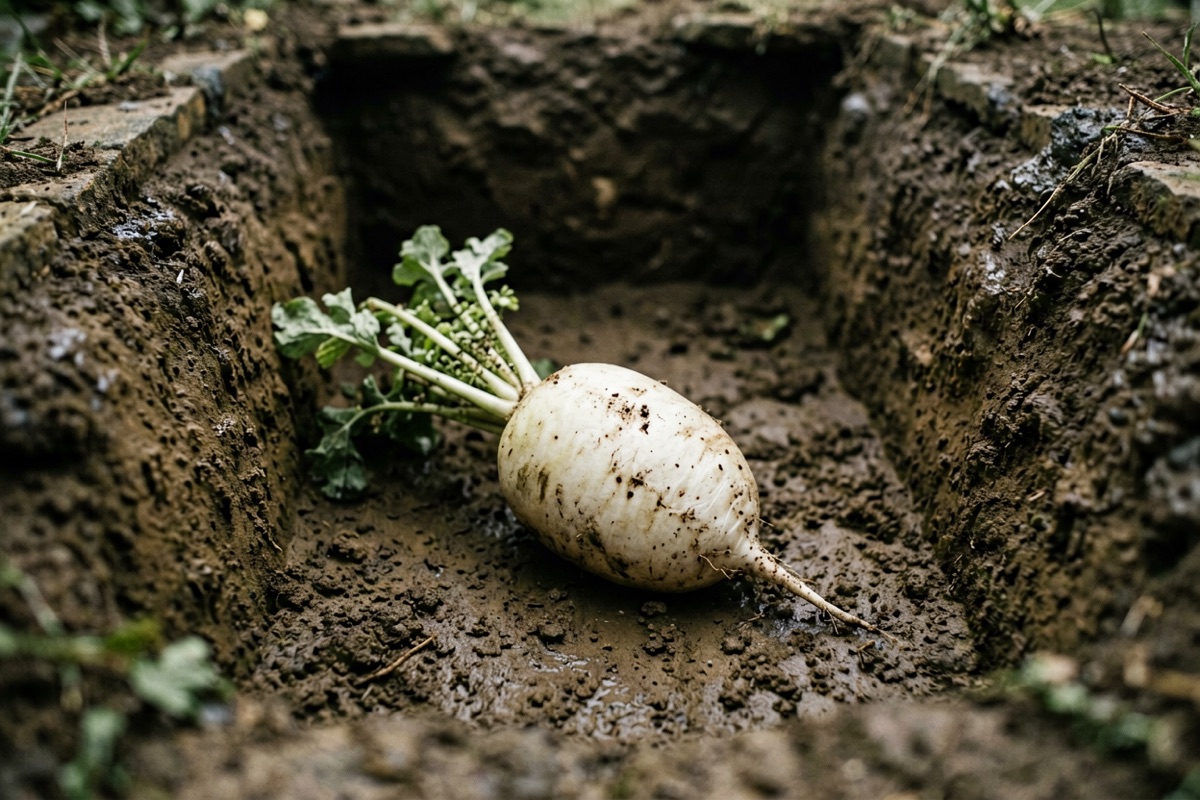
The instruction that surprises everyone is that the old pit must not be left empty. A white radish, sometimes a turnip or another root vegetable, is placed in the bottom before the hole is filled. Regional explanations vary and none is authoritative: that an empty hole in the ground is an invitation; that the earth was given something and must be left something; that the radish stands in for what was taken away. The gesture belongs to the same family of Chinese ritual thinking as the straw substitute and the paper effigy — when something must be removed, put something in its place. What is consistent across the accounts is the negative form of the rule: the danger is not in the taking, it is in the emptiness.
What relocation costs a family
It is worth stating the unromantic part. A relocation obliges a family to open a grave, look at what is in it, and handle it. People who have done it describe it as the hardest day in the whole span of mourning, harder than the funeral, because a funeral is about a person and an exhumation is about what is left. Chinese practice surrounds the day with an unusual density of procedure — the early start, the umbrella, the red cloth, the spoken explanation, the radish — and it is difficult not to read that density as designed. A family with thirty things to do correctly is a family that gets through the morning.
Fiction · Tales of the Hidden Path
The Radish in the Pit
It drizzled the day they moved the grave. The coffin came up and the old pit stood open.
An old man took a radish out of a fertiliser sack — white, a kilo or so, roots still on and dirty — dropped it in, and started shovelling.
He asked why. The old man said the hole cannot be left empty. He asked what happens if it is. The old man handed him the spade.
At Qingming the next year there was a stand of radish tops growing over the old pit. He dug one up. It was about the size of last year's.
The third year that patch was solid with them, growing better than anything else on the hillside. People came to dig them and he did not stop them.
In the fifth year a corner of the new grave subsided. He went to repair it, and the spade struck the coffin lid, and the sound it made was hollow.
He cleared the earth off and levered up a gap.
There was nothing in the coffin. On the base boards lay a radish, white, not rotted, still carrying its dirt.
An original short story written for our folklore film series. It is fiction — invented, not a recorded case, not a claim about how any of the customs above actually work. The belief it is built on is real; everything that happens in it is not. See our honesty policy。
A relocation needs a date, and the date comes from the almanac. How the Tung Shing's auspicious and inauspicious entries are actually read.
Choosing the Date →FAQ
Why is a radish left in the emptied grave?
Custom holds the pit must not be left empty. Explanations differ by region — a substitute for what was taken, or something given back to the earth. It belongs to the same logic as the straw effigy and the paper offering.
When is a relocation done?
On a chosen date, usually beginning before dawn so that the remains are not exposed to full sun. Spring, around Qingming, is common; the specific day is selected from the almanac.
What happens to the old coffin?
It is normally burned at the old site rather than moved or reused. Only the remains go to the new plot.
Is grave relocation considered unlucky?
It is considered serious rather than unlucky. Done for good reason, on a chosen date, with the proper offerings and explanation, it is a normal part of Chinese family duty toward the dead.
Related: Encoffining: The Cord, the Coins and the Rules of Laying Out · Trees on Graves: What Chinese Tradition Reads Into Them · Free BaZi Calculator · Free I Ching Reading