The Eight Directions of a Grave and the Family Members They Answer To
One of the more elaborate parts of yinzhai practice assigns each of the eight compass positions around a grave to a specific member of the family: qian to the father, kun to the mother, zhen to the eldest son, xun to the eldest daughter, and so on through the trigrams. Damage or disturbance at a position is read as bearing on the person it answers to. It is a striking system and one that deserves both explanation and caution.
The assignment
The mapping comes from the Later Heaven arrangement of the eight trigrams and the family roles the Book of Changes assigns them: qian is the father, kun the mother, and the six remaining trigrams are the three sons and three daughters in order. Applied to a grave, the trigrams are laid over the compass around the mound, and each sector of ground then has a person attached to it. Practitioners will walk the perimeter with a compass, note the condition of each sector, and report accordingly. The scheme is systematic, internally consistent, and old, and it is applied with considerable seriousness at family graves across the Chinese world.
What is actually being looked at
Strip the assignment away and the practitioner is doing an inspection: subsidence at any point of the perimeter, water standing anywhere, perimeter stones displaced or cracked, roots entering, animal burrows, erosion on the downhill side, encroachment from neighbouring plots. These are the things that damage a grave, and they are worth catching. The eight-position frame turns the inspection into something a family will actually commission and act on, which is not nothing — an abstract recommendation to check drainage annually gets ignored, and a report that the northwest sector has subsided does not.
Reading it honestly
The claim that damage at a sector causes misfortune to a particular relative cannot be evaluated and should not be presented as though it could. Two things are worth saying plainly. First, every extended family contains, at any moment, several members having a difficult year; a system with eight sectors and a large family will find matches. Second, the direction of causation in the tradition's own accounts is often reversed on inspection — families notice the grave after the trouble, not before. None of this makes the practice worthless, but it does mean a reading should be received as a tradition's way of framing concern for the family, not as information about what is going to happen to your brother.
The stone that was always down
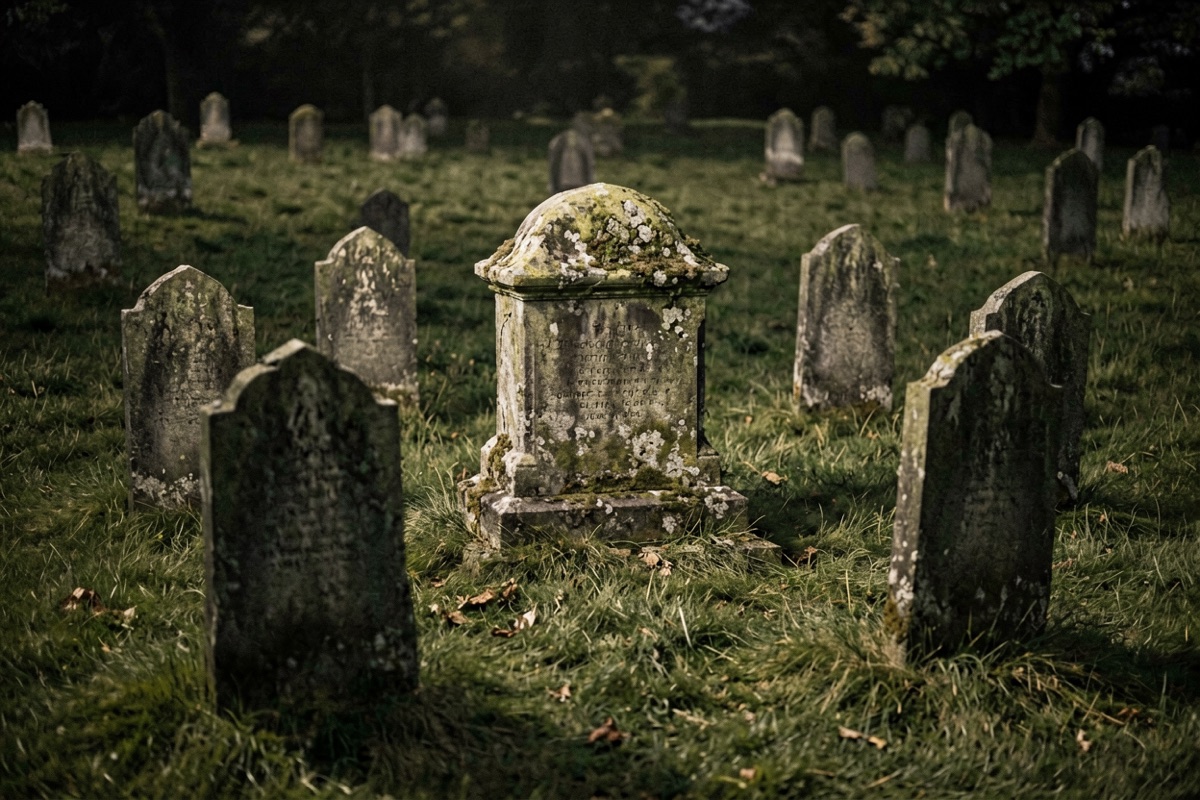
Perimeter markers — eight stones, or four, set at the compass points — are common at older family plots, and the folklore around them is dense. They are set upright, they are checked at Qingming, and a fallen stone is righted with a small offering. Practitioners note something that anyone who has managed an old grave will confirm: it is easy to be certain a marker is standing because it has always been standing, and to have last actually looked at it a long time ago. Grass grows, angles deceive, and a family can walk past the same stone for thirty years. This is a good argument for the annual inspection and a poor one for confidence in memory.
Fiction · Tales of the Hidden Path
The Eight Stones
Eight stones are set around the ancestral grave, one to each direction, standing a hand's height out of the ground. The old rule is that the eight positions answer to the eight branches of the family, and when a stone goes over, that branch has trouble.
He had looked after that grave for thirty years and righted stones a dozen or more times.
Each time he did, that branch of the family did have something — an illness, a divorce, a business gone under. He did not take it very seriously. Nobody goes thirty years without something.
One stone had never gone over. The southwest.
In the thirty-first year, at Qingming, he finished righting another one and crouched down to rest, and happened to look properly at the southwest stone.
It was not standing.
It was lying flat, long face up, half sunk into the soil with the grass grown over most of it. For thirty years he had taken it for upright — from the front of the grave, at that angle, it looked it.
He scraped the earth back with his hands and turned it over.
The underside had been dressed flat and cut with characters. A name. It was his. The strokes were deep, and the dirt packed into them had set hard enough that he had to get it out with a fingernail.
An original short story written for our folklore film series. It is fiction — invented, not a recorded case, not a claim about how any of the customs above actually work. The belief it is built on is real; everything that happens in it is not. See our honesty policy。
The annual visit is also an inspection. What the tradition tells you to look at, and what each finding is held to mean.
Reading a Grave at Qingming →FAQ
What is the eight-position assignment?
Qian (NW) father, kun (SW) mother, zhen (E) eldest son, xun (SE) eldest daughter, kan (N) middle son, li (S) middle daughter, gen (NE) youngest son, dui (W) youngest daughter — the trigram family roles from the Book of Changes laid over the compass around a grave.
Does damage at a position really affect that relative?
That is the traditional claim and it cannot be tested. Large families always contain someone having a hard year, and families usually inspect the grave after trouble rather than before. Treat a reading as a framing of concern, not as prediction.
What is the practice actually good for?
As an annual inspection checklist it is genuinely useful — it catches subsidence, standing water, displaced stones, root intrusion and erosion, which are the things that destroy graves.
What are the perimeter stones for?
They mark the compass positions and the plot boundary. They are checked at Qingming and a fallen one is righted, usually with a small offering.
Related: Encoffining: The Cord, the Coins and the Rules of Laying Out · Moving a Grave: The Rules of Qian Fen · Free BaZi Calculator · Free I Ching Reading