Trees on Graves: What Chinese Tradition Reads Into Them
Among the things a Chinese family checks when they visit the ancestral graves at Qingming, a tree growing out of the mound itself is the one that stops the conversation. Trees planted around a grave are normal and in some cases prescribed. A tree growing on it is read as a warning, and dealing with it is not as simple as fetching a saw.
Pine and cypress, and what is not planted
Chinese graves are conventionally planted, and the standard species are pine and cypress — evergreen, long-lived, and associated in Chinese literature with constancy since the Analects. Imperial tombs are planted with them; so are village family plots. Alongside this runs a body of folk preference about what should not be planted: species that fruit heavily, that sucker aggressively, that are short-lived, or whose names carry unfortunate homophones. The reasoning offered is a mixture of the symbolic and the entirely practical, and the practical half is sound — a heavy-fruiting tree brings animals and people onto the grave, and an aggressive rooter damages the chamber.
The tree on the mound
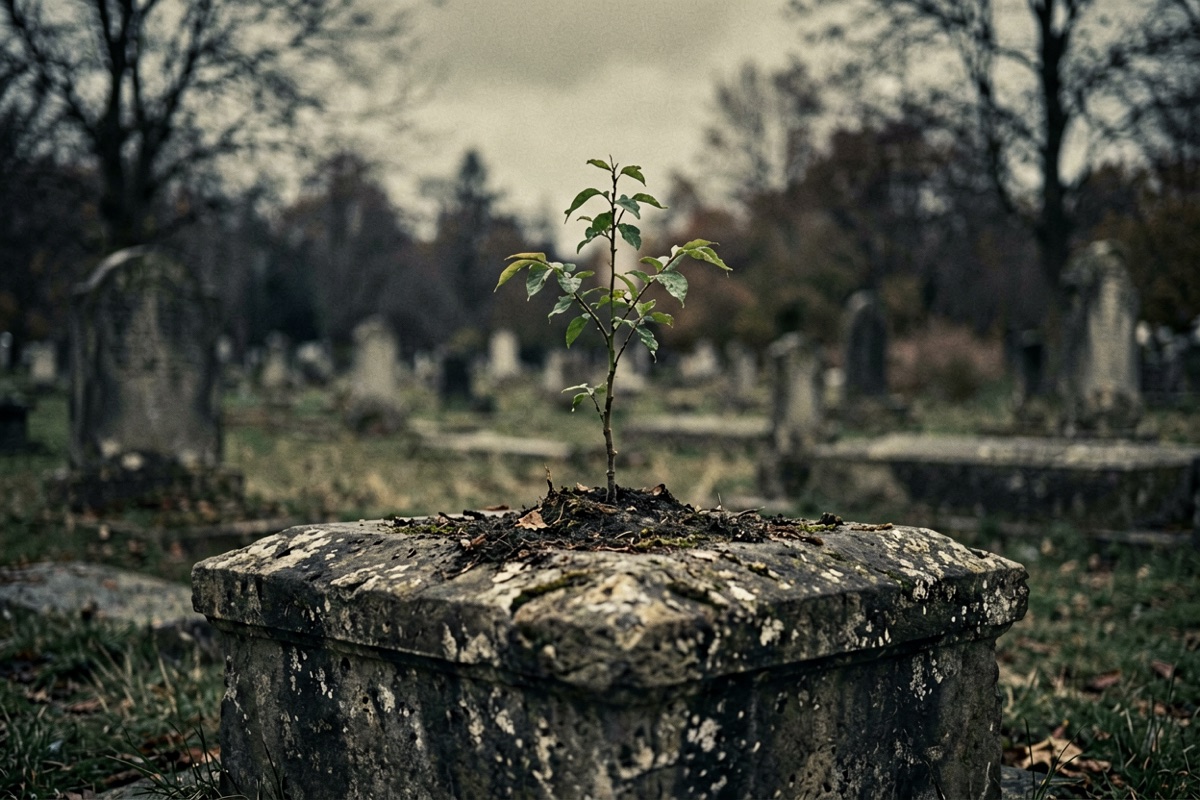
What is planted at the foot or around the perimeter is one thing; what seeds itself on the mound is another. Yinzhai practice reads a tree rooted in the mound as an active problem, and the stated mechanism is direct rather than mystical: roots follow moisture and voids, a grave chamber offers both, and a mature tree will put roots into a coffin. Practitioners describe the consequences in the language of the tradition — that the ancestor is disturbed, that the family will show it — and excavators describe the same situation in the language of archaeology, which is that root intrusion wrecks a burial. The two accounts agree on the facts and differ on what follows from them.
Why it is not simply cut down
The procedure is deliberate. A date is chosen. Offerings and incense are made at the grave and an explanation is spoken aloud — the same practice as at a relocation, addressed to the ancestor, stating what is about to be done and why. In many regions a specialist is called rather than a family member doing it. Some accounts require that the stump be treated rather than left, and some that the wood not be taken home for any purpose. The gravity is not really about the tree. Anything done to an ancestral grave is done in public, in front of the whole lineage, and the procedure exists partly so that the family can be seen to have done it properly.
Reading a grave at Qingming
The annual visit is also an inspection, and the tradition supplies a checklist. Is the mound settling. Is there water standing. Are the perimeter stones in place. Is the grass thick, thin, or absent. Is anything growing on the mound. Practitioners will offer a reading for each of these, and the readings should be treated as what they are — a traditional interpretive frame, not a diagnosis. What is not in dispute is the underlying function: once a year, somebody walks up the hill and looks carefully at a thing the family is responsible for. Most of what the checklist catches is subsidence, drainage and encroachment, which is exactly what wants catching.
Fiction · Tales of the Hidden Path
The Tree on the Grave
A sapling had come up on top of the ancestral grave. Bowl-thick at the base, leaves something like a locust, but nobody could name the species.
The clan met and decided it had to go.
They stopped halfway through cutting it. The heartwood was hollow and dry, without a trace of moisture. He looked for growth rings and there were none — the wood was layered, wound, the way rolled paper is wound.
One of the old men said it had not come up from above. It had come up from below.
He dug down half a metre and found the roots. They did not run downward. They ran up — twisted strands climbing, spreading out only when they reached the surface. He filled the hole back in.
The next year it had doubled in height. The year after it fruited: small, green, about the size of a plum. It was the only tree in the village that bore anything that year.
He picked one and cut it open.
There was something in the stone, hard and flat.
A brass button, gone green at the edges. His grandfather had been buried in a Chinese-collar jacket with buttons like that. He had seen the photograph.
An original short story written for our folklore film series. It is fiction — invented, not a recorded case, not a claim about how any of the customs above actually work. The belief it is built on is real; everything that happens in it is not. See our honesty policy。
Yinzhai governs graves, yangzhai governs the houses of the living. The siting logic behind feng shui's oldest division.
The Other Half: Homes →FAQ
Is a tree growing on a grave really bad?
Chinese geomancy treats it as a serious problem, and the stated mechanism — roots reaching the coffin — is straightforwardly true. Archaeologists describe root intrusion as one of the main destroyers of burials.
What trees are planted at Chinese graves?
Pine and cypress are standard: evergreen, long-lived, and associated with constancy since the classics. Heavy-fruiting and aggressively suckering species are avoided.
Can I just cut it down?
Custom says not casually. A date is chosen, offerings are made, an explanation is spoken at the grave, and in many regions a specialist does the work. Cutting a tree at someone's ancestral grave without agreement is a grave offence in village terms.
What else is checked at Qingming?
Subsidence of the mound, standing water, the perimeter stones, and the state of the grass. The tradition supplies a reading for each; the practical function is an annual inspection of something the family is responsible for.
Related: Encoffining: The Cord, the Coins and the Rules of Laying Out · Moving a Grave: The Rules of Qian Fen · Free BaZi Calculator · Free I Ching Reading