Ghost Month and the Water: Why Nobody Swims in the Seventh Moon
For one lunar month a year, large parts of the Chinese world stay out of the water. The seventh month is Ghost Month; its fifteenth day is the Zhongyuan Festival, the Hungry Ghost Festival, when the gates of the underworld are held to stand open and the dead move among the living. Of all the month's prohibitions, the water taboo is the one people still keep — including many who keep no others.
What the month is
Zhongyuan Jie is the Taoist name — the middle of the three Yuan festivals, the birthday of the Officer of Earth who pardons sins — and Yulanpen is the Buddhist one, from the sutra in which Mulian rescues his mother from hungry-ghost rebirth by making offerings to the monastic assembly. The two merged in popular practice into a month in which the underworld's gates stand open and the dead, particularly the neglected and unremembered dead, come out. Households make offerings at the roadside; temples hold universal-deliverance rites; food is set out for the ones with no descendants to feed them. The framing is worth noticing: the month's ghosts are hungry rather than malevolent, and the response to them is a meal.
The substitute in the water
The water taboo rests on one of the harshest ideas in Chinese folk belief. A person who drowns is said to be unable to be reborn until they find a ti shen (替身) — someone to take their place in the water. The drowned therefore wait, and pull. This is the same substitution logic that governs straw effigies and well spirits, applied to the specific and observable fact that people drown in summer. During the seventh month, when the dead are abroad in general, the water is considered at its most crowded and least safe. The prohibition is total: no swimming, no boating for pleasure, no letting children near the river.
The other prohibitions
The month's remaining taboos have the shape of a list assembled by many hands over many centuries, and they mostly concern not attracting attention. Do not marry, move house, sign contracts, launch a business or start construction — the month is unlucky for anything begun. Do not whistle or call names after dark, do not hang washing out overnight, do not sit in the front row at a street opera performance (that row is for the guests you cannot see), do not pick up money found on the road. Compliance in Taiwan, Hong Kong, Malaysia and Singapore remains high enough to be commercially measurable: property transactions, weddings and car purchases all visibly dip.
Lanterns on the water
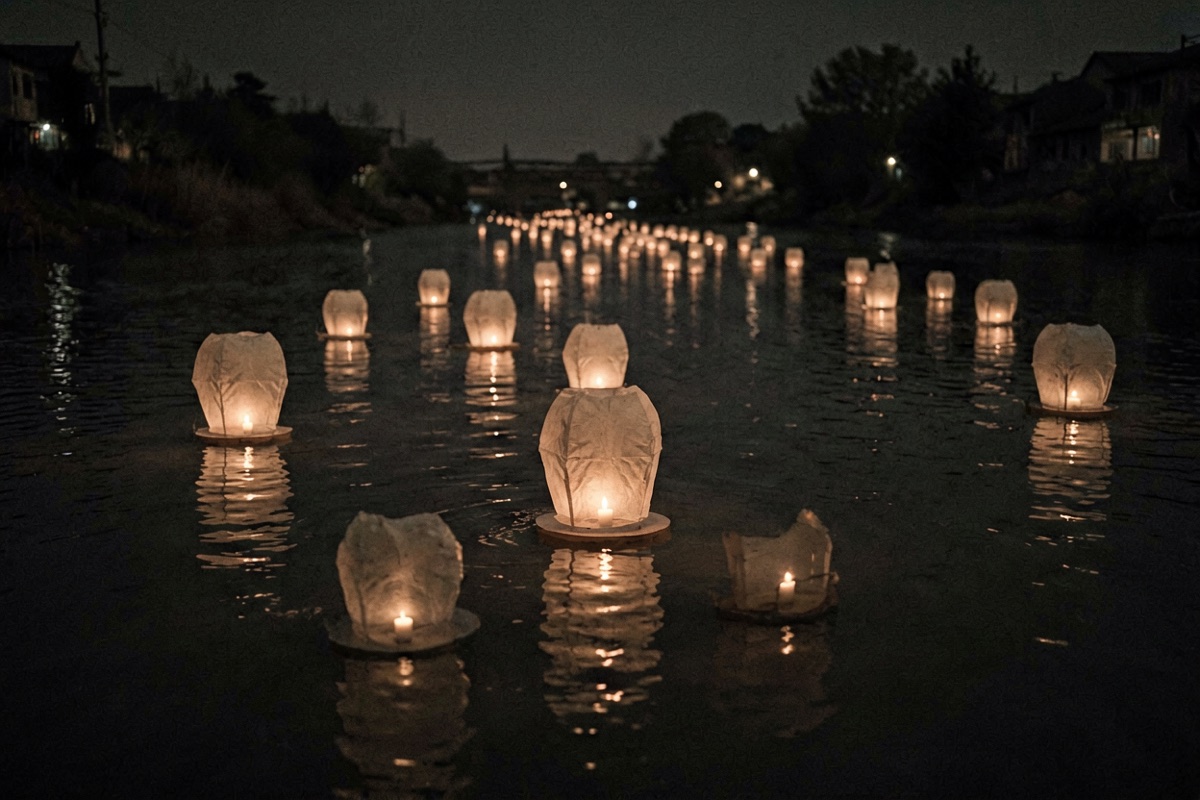
The festival's most photographed rite is fang he deng (放河灯), the floating of paper lanterns on rivers and at the seashore on the fifteenth night. Each carries a candle, sometimes a name, and is pushed out into the current. The stated purpose is guidance — the lanterns light the way for the drowned and the lost, who are held to have the worst of it among the dead, and drifting downstream marks a road for them out. It is the one moment in Ghost Month when the water is approached deliberately, and the gesture it makes is exactly the reverse of the month's other rules: for one night, instead of staying away from the drowned, you go down to the edge and put out a light for them.
Fiction · Tales of the Hidden Path
The Seventh Month Boat
In the seventh month the river carries lanterns — one for every name anybody still remembers. The ferryman worked that night the way he worked every night, because a river does not stop needing crossing just because the month is bad.
Halfway over, the boat began to sit lower in the water. He was alone in it.
He watched the waterline come up the side: two fingers below the gunwale, then one, then level with it. The oar started dragging as though he were pulling it through mud, and the oarlock complained on every stroke, longer each time.
He stopped rowing and looked back at the stern. Nothing there. A little water rocking in the bottom boards, and that was all.
But the surface alongside the boat was very still, and the boat's shadow lay on it, and beside the shadow the water was dimpled in rings — the small pressed circles that people make when they are sitting down.
The rule for that night is that you row and you do not look behind you and you do not count. He had broken two of the three.
When the bow touched the stone landing the boat came up as if a hand had been taken off it, and the waterline dropped two fingers all at once, and five sets of rings went out from the hull toward the bank together.
He sat there a long while before he could let go of the oar. When he finally looked at the steps, the wet prints were going up out of the river onto dry stone, and he counted them, because by then it was too late not to. One. Two. Three. Four. Five.
The sixth was still climbing.
An original short story written for our folklore film series. It is fiction — invented, not a recorded case, not a claim about how any of the customs above actually work. The belief it is built on is real; everything that happens in it is not. See our honesty policy。
The almanac is where these date rules live. How to read the Tung Shing's daily auspicious and inauspicious entries — and what they are actually based on.
Reading the Chinese Almanac →FAQ
When is Ghost Month in the Western calendar?
It moves. The seventh lunar month usually falls across August and early September; the Hungry Ghost Festival is its fifteenth day. Check a lunar calendar for the exact dates in any given year.
Why is swimming forbidden?
Because of the belief that a drowned spirit must find a substitute before it can be reborn, and that the seventh month is when the dead are most active. The taboo is one of the most widely observed in the Chinese world.
Do people really postpone weddings and house moves?
Yes, measurably. In Taiwan, Hong Kong, Malaysia and Singapore, property transactions, weddings and major purchases all show a visible dip during the seventh month.
What is the difference between Zhongyuan and Yulanpen?
Zhongyuan Jie is the Taoist festival — the Earth Officer's day of pardon. Yulanpen is the Buddhist observance from the Mulian story. They fall on the same day and merged in popular practice into a single festival.
Related: Paper Offerings: Why the Chinese Burn Houses, Servants and Money · The Soul-Guiding Lantern: Light at the Head of a Chinese Funeral · Free BaZi Calculator · Free I Ching Reading