The Ever-Burning Lamp: Tomb Lights and Lamp Offerings
In a Chinese temple, before a memorial tablet, and — according to a very persistent body of report — inside sealed tombs, there burns a lamp that is not supposed to go out. The chang ming deng (长明灯), the 'ever-bright lamp', is one of the simplest objects in Chinese practice and one of the most freighted. Its job is to mark a place in the dark and keep marking it.
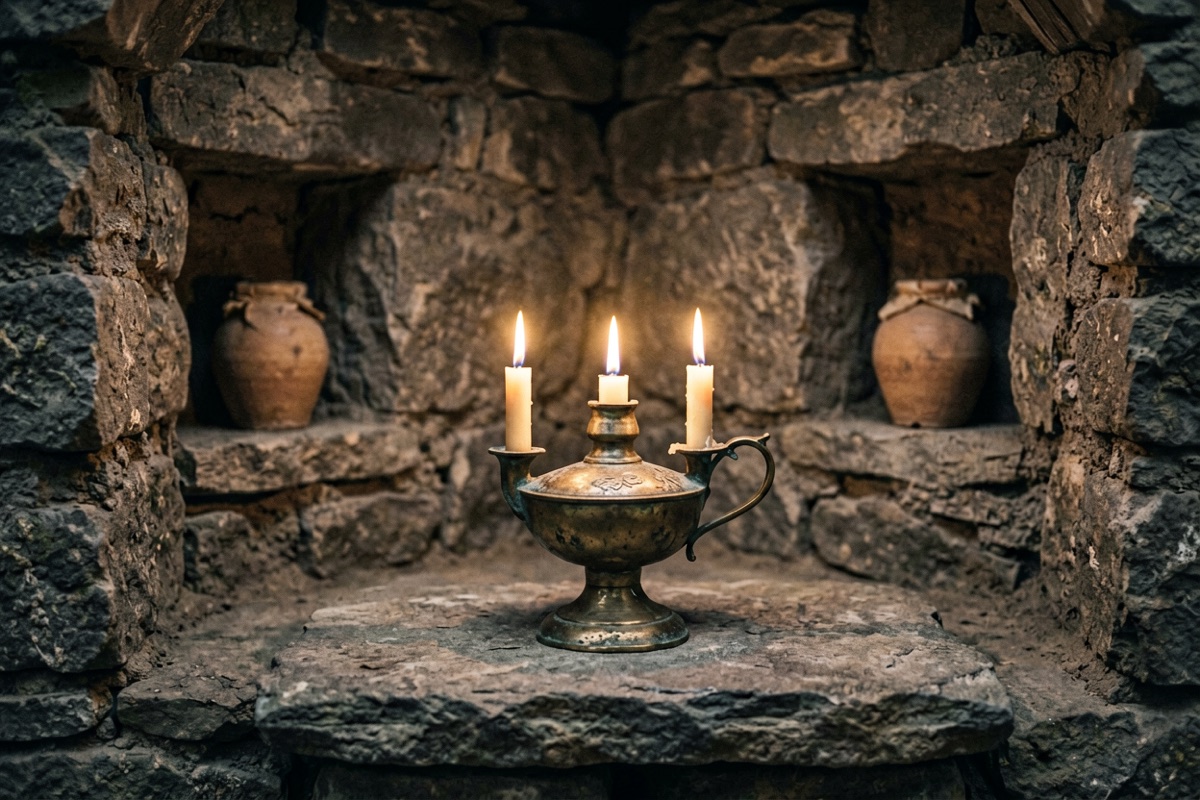
The lamp at the head of the coffin
The most common use is domestic and immediate. From death to burial a lamp burns at the head of the coffin, and in fuller observance a light is kept before the memorial tablet for the whole forty-nine days. Whoever keeps vigil is responsible for it: oil added, wick trimmed, flame not permitted to fail. The reasoning given is that the newly dead do not know the road and the lamp shows where they are and which way out lies. The practical effect on a household is worth stating plainly — it converts the first unbearable nights into a task that must be attended to hourly, and grief takes to a task the way it takes to nothing else.
Lamps in sealed tombs
Chinese texts report perpetual lamps in tombs from an early date, and archaeology has recovered lamps positioned as though intended to burn indefinitely. Excavators occasionally report a lamp that appears to have been lit at sealing. What the evidence does not support is literal eternity: a sealed chamber exhausts its oxygen within hours, and the flame dies while the tomb is still fresh. The most likely account of the recurring 'lamp still burning when the tomb was opened' story is that oil residues and disturbed materials can flare on contact with inrushing air. This is a good example of a tradition that is entirely real in intent — the lamps were placed, and placed to burn forever — and mistaken in fact.
Offering light as merit
In Chinese Buddhism, lamp offering (燃灯, 供灯) is a standard meritorious act, and any large temple will offer lamp dedications — a light lit and maintained in the name of a living person for health or a dead one for their passage, recorded in a register, renewed annually. The symbolism is explicit and does not require any supernatural claim: light is what allows seeing, the lamp is offered so that others may see, and offering it is an act of intention that shapes the person who offers. Taoist liturgy has its own elaborated form in the Dipper lamp rites, where a prescribed number of lamps is lit and tended in a fixed arrangement on behalf of a named person.
The keeper
Any lamp that is not permitted to go out implies somebody who does not permit it, and the figure of the lamp-keeper recurs across Chinese practice — the monk who tends the hall lamps, the family member who takes the night watch, the villager responsible for the light at a mountain shrine or a pass. Mountain roads in old China were dotted with small lamp niches maintained by subscription, lit as a charitable act for travellers and, explicitly, for the lost dead. It is a modest institution and an unusually decent one: somebody walks up a hill in the dark, every night, so that the road exists for whoever is on it. That is worth a great deal of the folklore it attracted.
Fiction · Tales of the Hidden Path
The Last Lamp
There is a mountain with a lamp on it. There used to be a hundred and eight, one at every niche along the stone steps. Now there is one, at the top, in a stone hut the size of a cart: a bronze lamp with three wicks, and a wall of shallow niches each holding a small sealed jar with a date written on it.
The old keeper walked that path every night for fifty years. He was told what to do and never why. Fill it before it burns low. Never let all three wicks go out at once.
The winter he handed over, he put the oil jug into the young man's hands and said: when the lights down in the village start going out one by one, don't go down. The young man asked what he should do instead. There was a long pause, and the old man said: fill it.
Then he went down the steps and did not come back up.
The village had been empty for thirty years. That night its lights came on, one after another, a whole grid of them in the dark below. Then the lights began to climb — and the first dead lamp niche on the path lit itself, and the second, and the third, coming up the mountain in order.
The three wicks shook. He poured oil until they steadied. Footsteps came up the last of the steps, a great many of them, and stopped outside the door, and a shadow reached in across the floor and came no further.
It was still there when the sky began to go grey. Then it thinned out and was gone, and the wicks were burning, and his hands would not stop shaking.
He got up and went to the wall of niches and read along it — jar after jar, each with a date. The last full one was yesterday's.
The next niche was empty. Cut into the stone at the back of it, already, was today's.
An original short story written for our folklore film series. It is fiction — invented, not a recorded case, not a claim about how any of the customs above actually work. The belief it is built on is real; everything that happens in it is not. See our honesty policy。
Lamp and incense are the paired offerings of every Chinese rite. What the three sticks mean, and how an offering is properly made.
Incense and Offering →FAQ
Do tomb lamps really burn forever?
No. A sealed chamber exhausts its oxygen within hours. The intent behind the placement was genuine, and reports of lamps 'still burning' at opening are best explained by residues flaring as air rushes in.
What is the lamp beside a coffin for?
To light the road for the newly dead, who are held to be disoriented. It is kept burning by whoever keeps vigil and is not permitted to go out until burial.
Can I have a lamp lit for someone?
Yes — lamp dedication is a standard temple service in Chinese Buddhism, usually recorded in a register and renewed annually. It is offered as an act of merit and remembrance, not as a promise of any outcome.
What are the Dipper lamps?
In Taoist liturgy, an arrangement of lamps lit and tended in a fixed pattern during Dipper rites (拜斗), petitioning on behalf of a named person for wellbeing and extended life.
Related: Mirrors in Chinese Belief: Covered at Death, Never Facing the Bed · Shoes for the Dead: Burial Footwear and the Rules Around It · Free BaZi Calculator · Free I Ching Reading