Shoes for the Dead: Burial Footwear and the Rules Around It
Chinese burial dress is a complete outfit assembled to rules, and its most rule-bound component is the shoes. Shou xie (寿鞋) — 'longevity shoes', the euphemism being obligatory — are made specifically for the dead, and everything about them, from the sole to the direction they are placed, is prescribed. The living, meanwhile, are told a number of things about shoes that come from the same place.
The burial outfit
Shou yi (寿衣), the 'longevity clothes', is the full set in which a person is dressed for burial, and Chinese families have traditionally prepared it well before it is needed — commissioning it in a person's later years is considered auspicious rather than morbid, and the euphemism is used strictly. The rules are specific: an odd number of layers, typically five, seven or nine; no fur or leather, on the Buddhist-influenced reasoning that one should not be reborn as an animal; traditionally no buttons, since the word for button suggests binding descendants. The shoes complete the set, and are made new. Nobody is buried in shoes they wore.
The unworn sole
Burial shoes are soft-soled and made light, and the sole is often worked with a lotus, a cloud pattern or a ladder motif — imagery of the road ahead. Because they are made for one wearing, their soles are unmarked, and this is one of the ways a specialist distinguishes surviving burial footwear from ordinary period shoes. It is also, incidentally, the thing that makes them slightly uncanny to handle: a shoe is an object that records its wearer, and a shoe with nothing recorded on it is a shoe with something conspicuously missing. Chinese folk story is fully alive to this, and the number of ghost tales that turn on the state of a sole is not small.
What the living are told about shoes
The taboos for the living run in two directions. First, do not wear a dead person's shoes, and do not pass shoes down from the dead to the living — clothing may sometimes be redistributed, shoes almost never. The reasoning offered is that shoes carry the road a person walked, which makes them the item most attached to their owner's movement. Second, shoe placement: do not leave shoes pointing under the bed, do not leave them facing the door overnight in some regions, do not leave one shoe on its side. These are minor household rules of the kind every culture generates, but their Chinese form is unusually consistent about direction. A shoe is understood to be pointing somewhere.
The bride's shoes in the chest
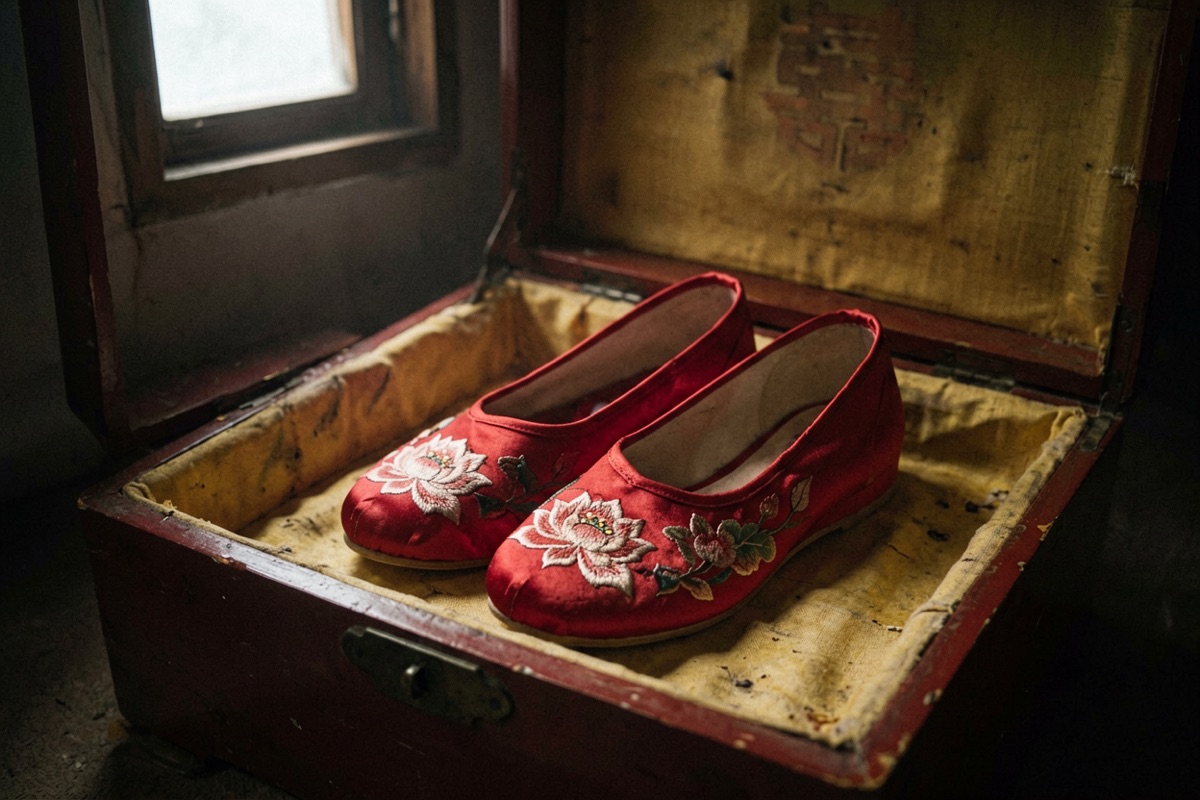
One reason so many pristine embroidered shoes survive in Chinese family collections has nothing to do with burial. Under the old dowry system a bride's shoes were part of the trousseau, made or commissioned for the wedding, and frequently packed into the red lacquer marriage chest and never worn again — sometimes never worn at all. Households that kept a chest for sixty years kept, inside it, a pair of red silk shoes with untouched soles and a pair of newlyweds' names attached to them. Both traditions therefore converge on the same object: beautiful footwear with no wear on the bottom, sitting in a box, waiting. It is not surprising that stories accumulated around them.
Fiction · Tales of the Hidden Path
The Embroidered Shoes
They cleared the old house after the funeral, and in the attic, under the small window, was the red lacquer marriage chest with the brass catch gone green.
The shoes were in a cloth bundle on top of the folded clothes. Red silk, twin lotuses on the toe, stitching so fine you could not find where a thread began. Her grandmother had married at seventeen and been widowed at nineteen and kept them in that box for sixty years.
She turned them over. The soles were clean. Not a scuff, not a shine, nothing. Sixty years in a chest and they had never been on a floor.
She took them home because they were beautiful, and set them beside the bed that first night, toes toward the bed, the way you leave shoes.
In the morning they were facing the door.
She turned them back. Every morning they had turned again, and by the fourth they were facing the door and half a metre further from the bed than she had left them. On the fourth morning she picked one up and turned it over.
There was wear on the sole. At the ball of the foot and at the heel — the two places a sole wears — the silk was rubbed grey and flattened, the way it goes when somebody walks.
She put them in the wardrobe that night and shut the door on them.
Later, in the dark, if you had been lying on that floor with your cheek against the boards, looking under the bed: the red shoes, side by side, toes out. And beside them, neatly, a pair of her own slippers.
She had put them on once. Only once, to see if they fitted.
An original short story written for our folklore film series. It is fiction — invented, not a recorded case, not a claim about how any of the customs above actually work. The belief it is built on is real; everything that happens in it is not. See our honesty policy。
Red thread runs through every Chinese rite of passage — marriage, protection, mourning. What the cord traditionally signifies and how it is worn.
Red Cords and What They Mean →FAQ
Why are Chinese burial shoes never worn?
Because they are made specifically for the burial and form part of the shou yi outfit. Their soles are typically soft and decorated with a lotus, cloud or ladder motif rather than made for walking.
Can I wear or keep shoes belonging to someone who died?
Chinese custom advises against it more strongly for shoes than for any other garment, on the reasoning that shoes are the item most bound to their owner's movement. Whether you observe it is your call; it is one of the most widely held Chinese clothing taboos.
Why prepare burial clothes in advance?
It is considered auspicious — commissioning shou yi for an elderly parent is traditionally read as a wish for long life, which is why the clothes are called 'longevity clothes' and never called anything else.
Why no buttons or leather?
Leather and fur are avoided on the reasoning that they risk an animal rebirth. Buttons are avoided because the word for fastening suggests binding or entangling one's descendants; ties are used instead.
Related: Mirrors in Chinese Belief: Covered at Death, Never Facing the Bed · The Figure in the Painting: Chinese Beliefs About Painted People · Free BaZi Calculator · Free I Ching Reading