Mirrors in Chinese Belief: Covered at Death, Never Facing the Bed
The mirror is the most heavily regulated object in the Chinese home. It must not face the bed. It must not face the front door. It is covered or turned to the wall when there is a death in the house. And in the older layer of belief it is not a passive surface at all, but an instrument that shows what something actually is. All of this is more coherent than it first appears.
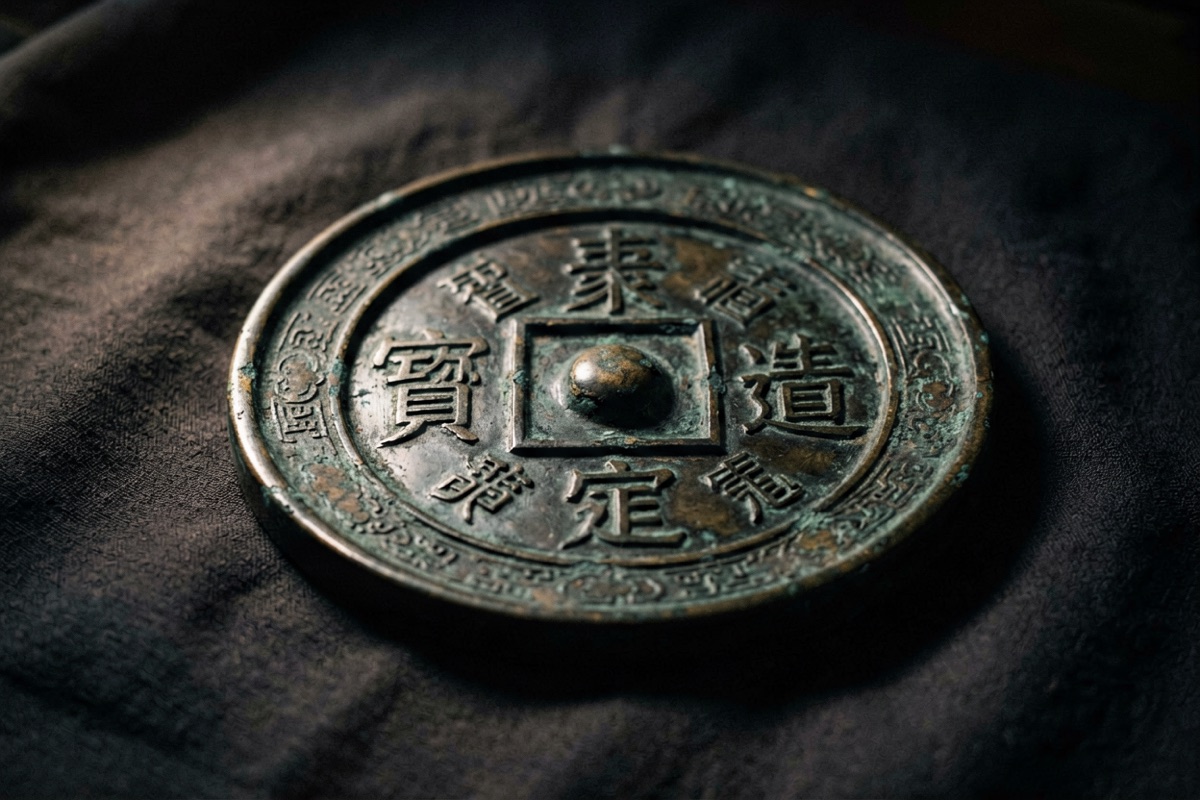
The mirror that shows what a thing is
Before feng shui rules, before bedroom placement, the Chinese mirror is an instrument of exposure. The zhao yao jing (照妖镜) of classical fiction reveals the true shape of anything that stands before it: the beautiful woman shows as a fox, the scholar as a corpse, the honest merchant as something with too many joints. The image is ancient and recurs from the Six Dynasties tales onward. It gives the mirror a moral character no other household object has — a mirror is the thing that cannot be lied to, and by extension the thing that will show you what you would rather not see. Every later Chinese mirror rule inherits some of this.
Covering mirrors at a death
When someone dies in a Chinese household, the mirrors are covered with cloth or turned to face the wall for the duration of the funeral. Explanations vary by region: that the newly dead may see their own reflection and be distressed or trapped; that a mirror can catch a passing soul and hold it; that a mourner who sees the coffin reflected invites misfortune. The custom is shared with a striking number of unrelated cultures — Jewish, Irish, Appalachian and Slavic households all cover mirrors in mourning — which suggests the underlying intuition is not specifically Chinese but something close to universal. A reflective surface in a house with a body in it makes people uneasy, and always has.
Why not facing the bed
The most frequently asked feng shui question about mirrors has both a metaphysical and a practical answer, and they agree. The traditional reasoning is that sleep is the time the hun soul is held to travel, and that a sleeper who wakes and sees themselves may be startled in the specific way that matters — the same fright that soul-calling rites exist to treat. The practical reasoning needs no cosmology: a mirror opposite a bed catches every light in the room, doubles every movement, and produces exactly the sort of half-waking disturbance that ruins sleep. Feng shui also keeps mirrors out of the direct line from the front door, since a mirror there is treated as reflecting arriving energy straight back out.
Mirrors in the ground
Chinese archaeology has recovered bronze mirrors from tombs continuously from the Warring States period to the Tang, often placed on or near the body, sometimes face-down on the chest. Their inscriptions ask for long life, for sons, for the preservation of the family. The clearest reading is protective — a polished bronze surface in the dark of a tomb, positioned to face whatever comes. It is the same instinct as the octagonal bagua mirror still hung over doorways in Chinese neighbourhoods today, and the same instinct as covering the mirror when there is a coffin in the front room. In all three cases the mirror is understood to be doing something rather than merely reflecting.
Fiction · Tales of the Hidden Path
Behind the Mirror
The mirror came with the house — a heavy old thing, foxed at the edges, screwed to the wall of the back bedroom so firmly that the previous owner had evidently given up on moving it.
He noticed the marks a week after he moved in. On the reverse, where the backing board had come away from the frame, somebody had written dates in pencil. A column of them, in a small careful hand, going back decades.
There were three columns by the time he had cleaned the dust off. He copied them into a notebook and looked them up, which took an afternoon at the county office and produced a result he sat with for a long time. Every date was a death. All of them in that house.
The last one in the column was eight months ago. The previous owner.
He took the mirror off the wall that night, which required a screwdriver and most of an hour, and carried it out to the yard and broke it against the well-head, and swept up the pieces in the morning feeling, on the whole, foolish.
The replacement he bought in town: cheap, light, four screws. He hung it on the same hook because the hook was there.
It was a fortnight before he had any reason to take it down again, and when he did — because it hung slightly crooked, and he had finally got tired of it — he turned it over in his hands and found three lines of pencil on the backing board.
The same small careful hand. The first two dates he already knew. The third was tomorrow.
An original short story written for our folklore film series. It is fiction — invented, not a recorded case, not a claim about how any of the customs above actually work. The belief it is built on is real; everything that happens in it is not. See our honesty policy。
Mirrors are one of the standard cures in feng shui practice — and one of the most misused. What sha qi is and how it is properly addressed.
Sha Qi and Its Cures →FAQ
Why do Chinese families cover mirrors when someone dies?
To prevent a soul being caught or startled by its reflection, and to spare mourners the sight of the coffin doubled. The custom appears in many unrelated cultures, which suggests the discomfort is broadly human rather than specifically Chinese.
Is a mirror facing the bed really bad feng shui?
It is the most consistently repeated rule in residential feng shui. The traditional reason concerns the travelling soul during sleep; the practical reason — that a bedroom mirror catches light and movement and disturbs rest — arrives at the same instruction.
What is a bagua mirror?
An octagonal mirror framed by the eight trigrams, hung outside a door or window to deflect sha qi from an unfavourable feature opposite. It is an exterior device — traditional practice does not hang one facing into a home, or facing a neighbour's door.
What is a 照妖镜?
The 'demon-revealing mirror' of Chinese fiction, which shows the true form of whatever stands before it. It is the oldest layer of Chinese mirror belief and underlies most of the later rules.
Related: Shoes for the Dead: Burial Footwear and the Rules Around It · The Figure in the Painting: Chinese Beliefs About Painted People · Free BaZi Calculator · Free I Ching Reading