The Long-Life Cord: Five Colours Tied at the Dragon Boat Festival
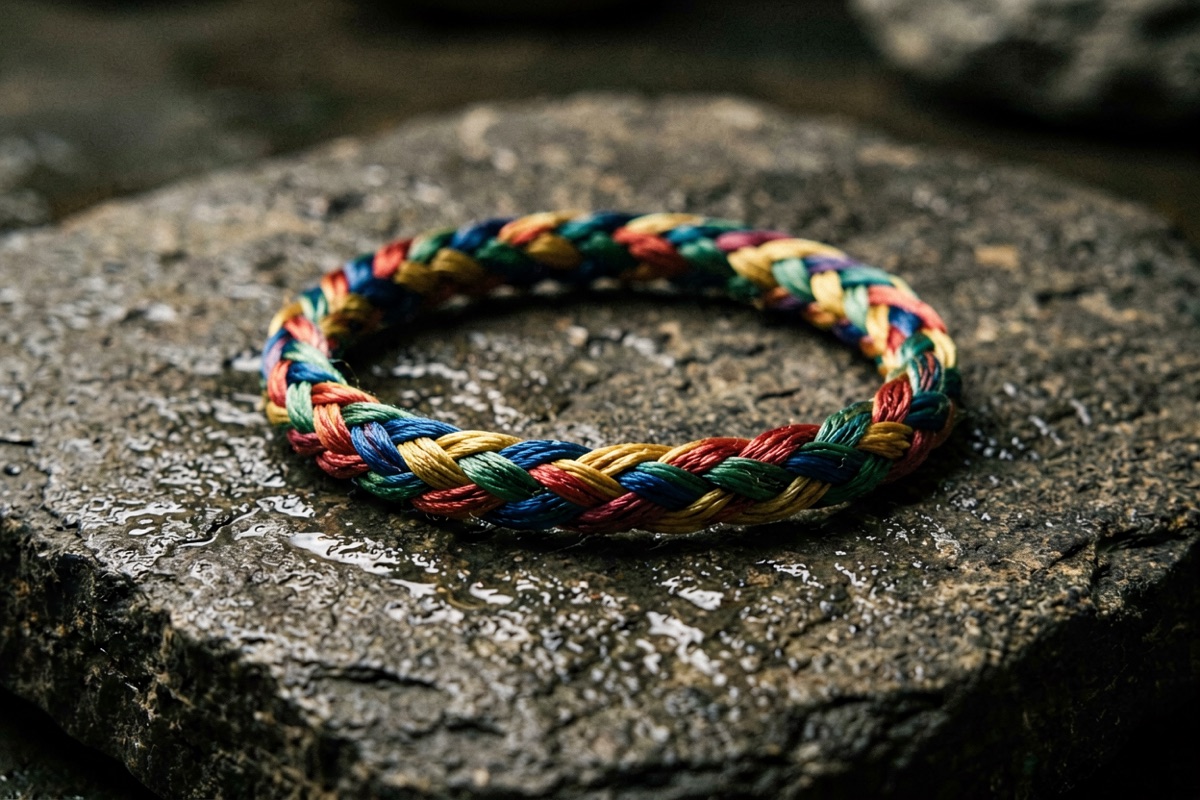
On the fifth day of the fifth lunar month, Chinese children have a braided thread of five colours tied around a wrist or an ankle. It is called wu cai sheng (五彩绳) or chang ming lü (长命缕) — the long-life cord — and its rules are exact: it goes on at Duanwu, it is not cut off, and it is thrown into moving water at the first rain.
Why the fifth of the fifth
Duanwu is popularly known abroad for dragon boats and for Qu Yuan, but its older character is protective. The fifth month was regarded as the noxious month — the onset of real summer heat in central China, and with it insects, snakes, spoiled food and epidemic disease. The festival's traditional practices are almost all prophylactic: hanging mugwort and calamus at the door, drinking realgar wine, making scented sachets, and tying the five-colour cord. Read that way the festival is a public health observance with a very long history, timed to the moment in the year when the danger begins.
Five colours, five elements
The colours are the elemental five: green for wood, red for fire, yellow for earth, white for metal, black for water. Braiding all five is understood as putting the complete set on the wearer, and the completeness is the point — nothing is left out and therefore nothing is unguarded. The same five-colour logic appears across Chinese practice, in ritual banners, in offerings and in protective sachets. On a child's wrist it is the most compressed possible statement of the idea, made of thread.
The rules of removal
The cord is not cut. It is worn until the first rainfall after the festival, then untied and thrown into a river, stream or any moving water. The stated function is transfer: whatever illness or misfortune the wearer would have had is carried into the cord and then carried away by the water. Some regions specify the first heavy rain, some the first thunderstorm, some allow the whole month. The underlying gesture is the same substitution logic that runs through Chinese practice — the straw effigy, the paper offering, the radish in the grave pit. Something must go in your place, and then it must be sent away.
How old it is
The five-colour thread is attested in Han-period sources under names including the long-life cord and the continuing-life thread, described as tied on at the fifth month to ward off illness. That gives it roughly two thousand years of continuous documented practice, which places it among the oldest Chinese customs still performed in an unbroken form. It is still done. Anyone in a Chinese city around Duanwu will see the cords on sale in the days before, and on children's wrists for a week or two afterwards, until it rains.
Fiction · Tales of the Hidden Path
The Long-Life Cord
His mother tied one on every Duanwu. Five strands — green, red, yellow, white, black — on the left wrist.
The rule is that it goes on at the festival and comes off at the first rain, and you throw it in the river and the water takes it.
He wore one for more than thirty years. After she died he braided them himself, and never as well as she did: at the start of hers there is a knot that runs backwards, and he spent twenty years failing to learn it. He ties a plain one and makes do.
The year before last, the first rain after Duanwu came in the afternoon and came down hard. He untied the cord as usual, walked to the river and threw it in.
It was heavy enough on the way back that he could not see, and he got under a bridge to wait it out.
The water came up and brought things down with it. Plastic bags, branches, a single shoe.
A five-colour cord caught on a stone by his foot.
Green, red, yellow, white, black. Five strands.
At the start of it there is a knot that runs backwards.
The cord is dry.
An original short story written for our folklore film series. It is fiction — invented, not a recorded case, not a claim about how any of the customs above actually work. The belief it is built on is real; everything that happens in it is not. See our honesty policy。
The other Chinese thread worn on the wrist — different colour, different rules, and a different reason it must not be cut.
The Red Cord →FAQ
What is the five-colour cord?
A braided thread of five colours tied on at the Duanwu festival, most often on children, to protect against illness. Also called the long-life cord.
Which five colours?
The elemental five — commonly green, red, yellow, white and black, for wood, fire, earth, metal and water. Braiding all five puts the complete set on the wearer.
When and how is it taken off?
Not cut. It is worn until the first rain after the festival, then untied and thrown into moving water, which is said to carry away whatever illness it absorbed.
How old is the custom?
It is attested in Han-period sources under names including the long-life cord, giving it about two thousand years of continuous documented practice. It is still widely done.
Related: Peng Zu's Hundred Prohibitions: One Rule for Every Day · Waking at the Same Hour Every Night: The Meridian Clock Reading · Free BaZi Calculator · Free I Ching Reading