The Door Gods: Who Is on Your Door and Why They Face Outward
Two armoured figures, one on each leaf of a double door, glaring outward with weapons drawn: the men shen (门神) are the most recognisable piece of Chinese domestic religion, and among the oldest. They are pasted up at New Year, they are not taken down until the year is out, and there are two entirely different stories about who they are — both of which are correct.
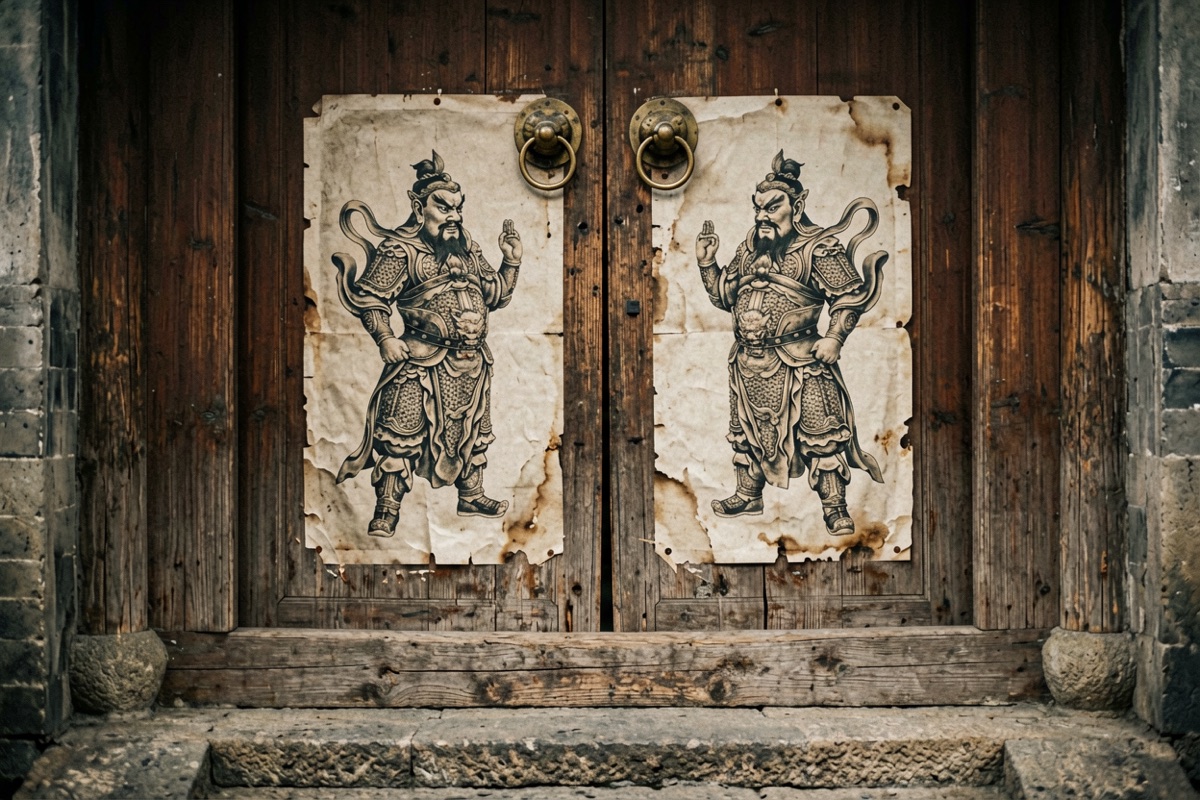
Peach wood and the two gatekeepers
The oldest layer of the tradition is recorded in Han-era sources drawing on earlier material: on a great peach tree grows a gate through which all spirits pass, and beside it stand two brothers, Shen Tu and Yu Lei, who inspect what comes through, bind the malicious ones with reed rope and give them to the tigers. Households accordingly hung peach-wood boards bearing the two names beside their doors at the turn of the year. Those boards, taohu (桃符), are the direct ancestor of both the door-god print and the red New Year couplet — Wang Anshi's famous poem describes the whole village replacing its old peach boards with new ones on the first day of the year.
The two generals
The pair most people actually have on their doors come from a much later and more charming legend, popularised by the Ming novel Journey to the West. Emperor Taizong of Tang, tormented at night by something outside his chamber, is guarded by two of his generals — Qin Qiong (Qin Shubao) and Yuchi Gong — who stand in full armour at the door until the disturbance stops. Unwilling to keep two senior officers awake indefinitely, the emperor has their portraits painted and pasted to the door instead, and the portraits work. It is a story about images doing a job that a body was doing, which is exactly the premise the whole practice rests on.
The rules of hanging
Door gods come in pairs and the pair must be handed correctly: each figure is painted looking slightly to one side, and they go up so that the two face each other across the gap between the door leaves. Reversed, so that they look away from each other, is considered a mistake worth fixing. They belong on the outermost door of the household, facing out. They go up before the New Year, traditionally with the couplets and the upside-down fu character, and — this is the part every household knows — they are not taken down early. New prints go over or replace old ones at the next New Year; a torn or weathered pair is left to weather. The year is the unit, and the year is not interrupted.
What the figures actually mean
The door is the boundary of the household, and Chinese practice treats boundaries as the places where attention is required: the threshold that is stepped over rather than on, the screen wall inside the gate, the mirror above the lintel. Door gods are the boundary's staff. Read plainly, pasting them up is an annual act by which a family states where its edge is and asserts that the edge is watched. Whether one believes anything is being kept out, the gesture is legible and it is public — everyone who walks past sees that the household has done it, and sees how recently. In a village street of a hundred doors, the paper is a message to the neighbours as much as to anything else.
Fiction · Tales of the Hidden Path
The Door Gods
The old man had pasted new door gods every New Year for forty years and would never let anybody else do it. One rule, which he said often enough that it stopped registering: never take them down before the year is out.
He died in February. In March his son, clearing up, found the pair on the outer doors curled at the edges and stained through where the rain had got at them, and said out loud to nobody that they were a disgrace, and put a finger under the lifted corner, and pulled.
The paper came away in one long tearing sound and left a clean dark rectangle on the wood underneath. He did the other one too. Both of them went into the yard in a ball.
The knocking started that night. Three, always three, always light, always on the outer door. He stood in the dark passage with the line of light under the door broken by something on the other side of it and watched the bar, and the bar did not move.
Seven nights. Never the handle. Only ever three.
On the eighth day he went into town and bought a new pair and pasted them up himself, badly, with too much paste, and that night nothing knocked at all.
He was standing in the passage with his hand flat on the door, letting his breath out, when three knocks came from the other end of the passage — from inside, from the archway to the courtyard.
He turned around slowly, and then he looked at the inner face of the door under his hand, which he had never once looked at in his life.
There was a pair of door gods pasted on that side too. Faded to exactly the same age as the pair he had torn off the front.
Forty years, and the old man had always insisted on doing it alone, so that nobody would notice which way they were facing.
An original short story written for our folklore film series. It is fiction — invented, not a recorded case, not a claim about how any of the customs above actually work. The belief it is built on is real; everything that happens in it is not. See our honesty policy。
Door gods are the household version. What tradition considers protective at the personal scale — and what it honestly claims for it.
Protective Objects in Chinese Practice →FAQ
Who are the two figures on Chinese doors?
Most commonly the Tang generals Qin Qiong and Yuchi Gong. The older tradition names Shen Tu and Yu Lei, the peach-tree gatekeepers. Regional variants use civil officials, Zhong Kui, or other guardians.
Which one goes on which side?
The pair are painted turned slightly inward and should be hung so they face each other across the doors. Hanging them so they look away from each other is considered incorrect.
When are they replaced?
At New Year, when the old prints are covered or replaced along with the couplets. Custom holds that they should not be removed before the year is out, even if they weather badly.
What is the connection to New Year couplets?
Both descend from the taohu, the peach-wood boards bearing the gatekeepers' names hung beside doors at the turn of the year. The boards split into two traditions: the printed door-god image, and the red paper couplet.
Related: Mirrors in Chinese Belief: Covered at Death, Never Facing the Bed · Shoes for the Dead: Burial Footwear and the Rules Around It · Free BaZi Calculator · Free I Ching Reading