The Figure in the Painting: Chinese Beliefs About Painted People
Chinese tradition is unusually cautious about images of people. Portraits of unknown persons are not hung casually; ancestral halls use tablets bearing names rather than faces; painters' lore treats the eyes as a separate and final act. Behind these scattered habits sits a single old idea — that a likeness is not merely a picture of somebody, and that under some conditions it may not stay put.
Dotting the eyes
The founding anecdote is told of the painter Zhang Sengyou of the Liang dynasty, who painted four dragons on a temple wall and left them without pupils, explaining that if he added the eyes they would fly away. Pressed by sceptics, he dotted two of them; thunder broke the wall and those two dragons left, and the two without eyes remained. The story gave Chinese the idiom hua long dian jing — the finishing stroke that brings a work alive. It also gave craft traditions across several media a shared rule of thumb: eyes last, or eyes never. Paper effigy makers, statue carvers and puppet makers all observe some version of it, and all give the same reason.
The painted wall
The single most influential Chinese story about pictures is Pu Songling's Hua Bi (画壁), from the seventeenth-century Liaozhai Zhiyi. A traveller admires a mural of celestial maidens in a temple, is drawn into it, lives an interval inside the painting, and is called back out. The story's genius is its ending: the figure he had been with is still on the wall, but her hair is now dressed as a married woman's. The painting has changed to record what happened. This is the exact register of Chinese image-folklore — not a picture that attacks anybody, but a picture that turns out to have been keeping its own account of events.
What households actually do
Contemporary Chinese practice retains a set of soft rules about images. Portraits of people the family does not know — antique photographs, second-hand paintings of unidentified sitters — are widely considered unsuitable for living areas. Photographs of the deceased belong on the memorial altar, not scattered through the house. Some households avoid hanging any portrait in a bedroom. Feng shui practitioners add their own layer, generally advising against images of solitary figures, of decline or of violence in rooms where the family gathers. Whether one reads any of this cosmologically or not, it describes something real: a face on a wall is looked at every day for years, and what people live with shapes them.
Names instead of faces
The most telling piece of evidence is what Chinese ancestral practice uses instead of portraits. The classical instrument of ancestral veneration is the shen zhu (神主) — a wooden tablet bearing the deceased's name, titles and dates, installed on the family altar and treated as the seat of the ancestor during rites. Portraits exist and were commissioned, but the tablet is the ritually operative object. Chinese practice locates a person in their name, not their likeness. That single fact explains an enormous amount: why names are written on effigies, why petitions require a name and birth date, and why a tradition so cautious about images was never much interested in making the image the point.
Fiction · Tales of the Hidden Path
The Painted Guest
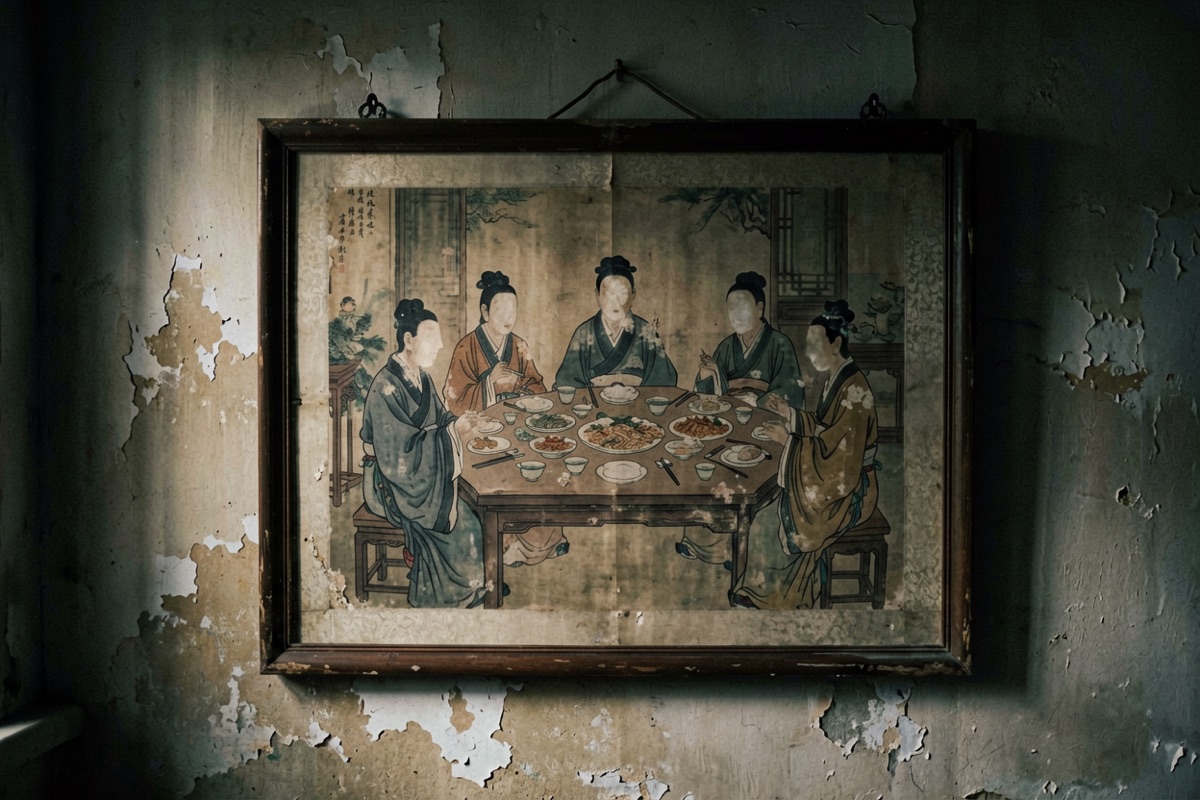
The house came with the painting: an old thing in a wooden frame on the back wall, folk workmanship, dark colours, a banquet table with people sitting around it and their faces worn to nothing.
He counted the figures on his second day, the way you do. Seven.
The next morning there were eight.
He started keeping a tally on the wall in pencil. Nine. Ten. On the fourth day he took the painting down, rolled it, put it in the cupboard and shut the door on it, and in the morning the cupboard door stood open a hand's width and the painting was back on its nail.
Eleven.
On the seventh day he stood in front of it for a long while before he raised his hand and went along the row with his finger. Nine. Ten. Eleven. Twelve. His finger stopped on the last one.
It was sitting at the foot of the table with its back to the room, and the clothes it was painted in were the clothes he had on.
He took a step back. On the wall beside him the pencil column read eight, nine, ten, eleven, twelve, all in the same hand, evenly spaced, the way a person writes when they are keeping a careful record.
He remembered stopping at ten.
An original short story written for our folklore film series. It is fiction — invented, not a recorded case, not a claim about how any of the customs above actually work. The belief it is built on is real; everything that happens in it is not. See our honesty policy。
What tradition says should and should not be on your bedroom walls — and the practical logic underneath the rules.
Bedroom Feng Shui →FAQ
Is it bad luck to hang a portrait of someone you don't know?
It is widely avoided in Chinese households, on the reasoning that a likeness carries something of its subject and that you do not know whose it is. This is folk caution rather than a formal doctrine.
What is the story of the painted wall?
Pu Songling's Hua Bi, from Liaozhai Zhiyi: a man enters a temple mural, spends an interval inside it, and returns to find the painted figure's hairstyle has changed to a married woman's — the painting has recorded what happened.
Where should photographs of the deceased be kept?
Traditionally on the memorial altar or in a dedicated place, rather than distributed through living areas and bedrooms. The practice is about keeping remembrance in its proper setting.
Why does Chinese ancestral worship use tablets instead of portraits?
Because the tradition locates a person in their name rather than their face. The inscribed tablet, the shen zhu, is the ritually operative object at the altar; portraits are supplementary.
Related: Mirrors in Chinese Belief: Covered at Death, Never Facing the Bed · Shoes for the Dead: Burial Footwear and the Rules Around It · Free BaZi Calculator · Free I Ching Reading