A Bed Without Backing: The Wall Behind Your Head
Feng shui wants something solid behind your head while you sleep. Chuang tou wu kao (床头无靠) — 'the bed head has no support' — covers a bed floating in the middle of a room, a bed head against a window, or a bed head against a partition with a gap behind it. It is one of the tradition's most consistently repeated bedroom rules, and it is very easy to justify.
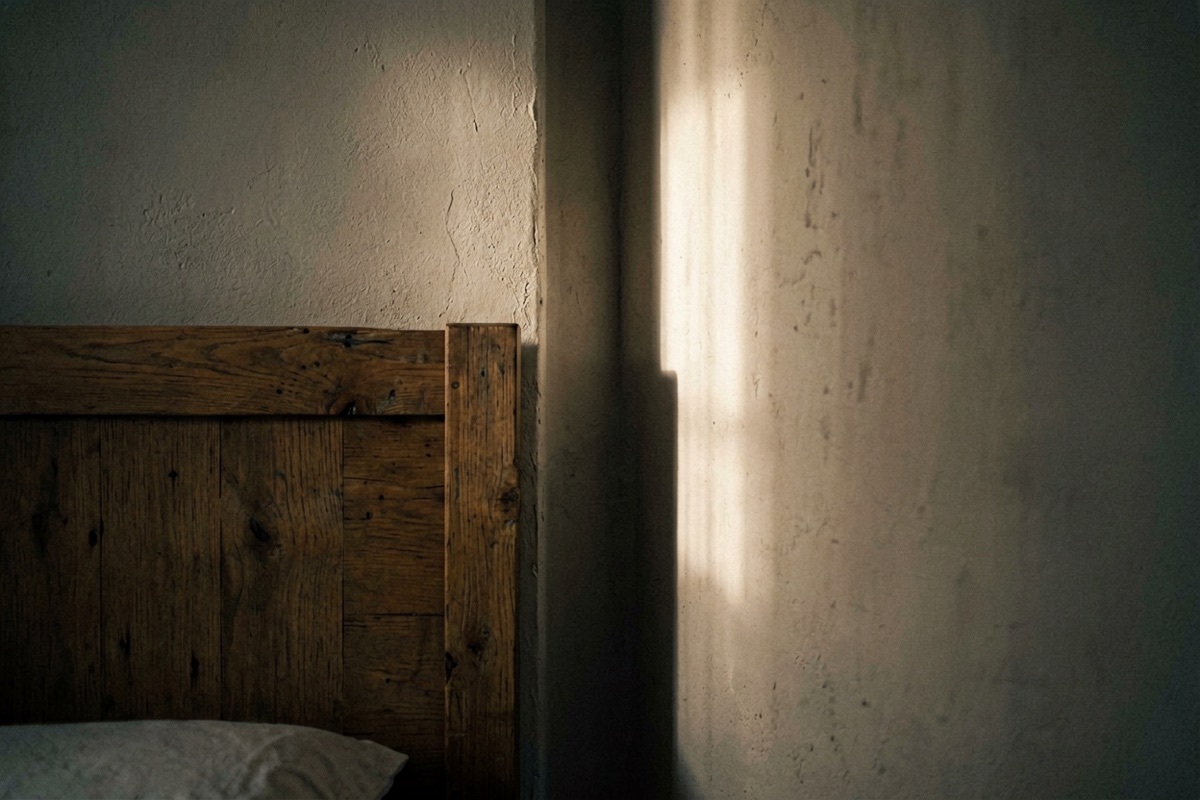
The mountain at your back
The idea of solid support behind is one of the load-bearing principles of the whole system, and it appears everywhere: a burial wants a rise behind it, a house wants higher ground at the rear, a desk wants a wall behind the chair, a bed wants a wall behind the head. The Chinese term is the 'mountain' or 'backing', and its absence is described as leaving the occupant unsupported in a way that shows up in confidence, health and standing. The consistency of the principle across scales is one of the reasons feng shui feels coherent to people who use it — it is not a list of rules but one rule applied repeatedly.
Why a window behind the head is the worst version
Sleeping with your head under a window puts you next to the coldest surface in the room, in the draught path, in the noise path and in the light path. Glass radiates heat away from a body beside it; downdraught from cold glazing produces a low-level flow across exactly head height; street light and vehicle headlights sweep the wall above; and glazing transmits far more sound than a wall does. The tradition says a bed head under a window means broken sleep and poor health. A building physicist would say cold radiant asymmetry, draught, light intrusion and reduced acoustic performance, and would recommend moving the bed.
The command position
Alongside backing runs the second bedroom rule: the bed should be placed so that the occupant can see the door without being directly in line with it. The traditional reasoning concerns qi arriving through the door; the ordinary reasoning is that a person who cannot see the entrance to the room they sleep in remains subliminally alert, and that lying directly in the doorway's line puts you in the draught and the corridor light. The two rules together — support behind, sight of the door, not in its line — describe a placement most people, asked to arrange a bedroom well, arrive at anyway.
Partitions, and what is behind the wall
Practitioners extend the rule to what lies on the far side of the wall, and the extensions are all practical. Avoid a bed head against a wall shared with a bathroom (plumbing noise, damp), a kitchen (heat, noise, cooking smells), a lift shaft or a stairwell (mechanical noise and vibration), or a neighbour's living room. A stud partition with a void behind it is treated as insufficient backing. Where the plan cannot be changed, the standard advice is a substantial solid headboard — which is, again, a physical remedy that addresses the physical complaint.
Fiction · Tales of the Hidden Path
The Gap Behind the Bed
The head of the bed was against the wall. A solid wall, load-bearing, a metre twenty thick at the base.
One morning he reached back and his hand went into air. The bed head was two fingers off the wall.
He shoved it back and heard the legs scrape on the floorboards.
The next day, two fingers again.
He took a marker and drew round all four bed legs on the floor. The next morning the legs were outside the circles by two fingers.
He went to the hardware shop and bought four expansion bolts, drilled, and fixed the bed frame to the floor. He pushed it hard with both hands and it did not give.
The next day the bed had not moved.
The wall had. There were still two fingers between the bed head and the wall face, and a gap had opened between the skirting board and the plaster.
He put a finger into the gap. It went in to the knuckle and did not find a back.
He fetched a torch and shone it in.
Behind the gap was not masonry. It was wallpaper on another wall — pale green, with a small scattered floral print. It was the paper they had in the house when he was a child.
An original short story written for our folklore film series. It is fiction — invented, not a recorded case, not a claim about how any of the customs above actually work. The belief it is built on is real; everything that happens in it is not. See our honesty policy。
Support, command position, mirrors, beams and the door. The five fixes practitioners recommend most often.
The Full Bedroom Layout →FAQ
Does the bed head really need to touch the wall?
Tradition wants solid support behind the head. A small gap for cleaning is not the issue; a bed floating in the room, or backing onto a window or a hollow partition, is.
Why is a bed under a window bad?
Cold radiant surface at head height, downdraught from the glazing, street light and headlights sweeping the wall, and far more transmitted noise than a solid wall. All of it lands on your head.
What is the command position?
Placement that lets you see the bedroom door from the bed without lying directly in line with it. Traditionally about arriving qi; practically about not remaining subliminally alert, and staying out of the draught and corridor light.
What if the layout can't be changed?
A substantial solid headboard is the standard remedy, and it addresses the actual complaint. Also check what is on the far side of the wall — bathroom, kitchen, lift shaft and stairwell are all flagged.
Related: The Beam Overhead: Why Feng Shui Moves Your Bed · Glare Sha: When the Building Opposite Throws Light Into Your Home · Free BaZi Calculator · Free I Ching Reading