Tian Yi: The Heavenly Doctor Star
Tian yi (天医), the heavenly doctor, is the star of medicine. Where the noble helper indicates that someone will turn up when things go badly, the heavenly doctor is more specific: it indicates meeting the right practitioner, aptitude for healing work, and recovery from illness. It is also, unavoidably, the star most likely to be quoted at somebody who is frightened.
What it indicates
Two readings, related. The vocational one: aptitude for medicine, nursing, pharmacy, therapy and the healing trades, and a temperament suited to them — practitioners associate it with patience, an interest in causes, and tolerance for other people's distress. The circumstantial one: encountering effective treatment at the right time, meeting a practitioner who correctly identifies the problem, and recovering from illnesses that might have gone otherwise. As with the noble helper, the star describes something relational — an encounter — rather than a property of the person.
A note on the name
Chinese star nomenclature is crowded and this one is a known source of confusion. Tian yi (天医), the heavenly doctor, is not tian yi gui ren (天乙贵人), the noble helper, despite the near-identical romanisation; the characters differ and so do the derivations and meanings. Tian yi is also used in eight-mansions feng shui as the name of one of the four favourable directions, where it governs health for a given trigram group. Anyone reading English-language material on Chinese metaphysics should expect these to be conflated, and should check which system a source is talking about.
Where the line is
This has to be said directly. A star in a birth chart carries no information about whether you are ill or what to do about it. The Chinese medical tradition's own classics are unambiguous that diagnosis proceeds by looking, listening, asking and taking the pulse — by examination of the patient in front of you — and no serious practitioner of Chinese medicine has ever held that a birth chart substitutes for that. Where astrology and medicine have been mixed commercially, it has been to sell things. If you are unwell, see a doctor; a chart is not a second opinion.
Family prescriptions
A related folk phenomenon worth knowing about: many Chinese families keep an inherited paper prescription, sometimes generations old, for a specific complaint. Some are copies of genuine classical formulas; some are a local practitioner's adaptation; some have been altered over the years by whoever recopied them. Two things follow. Historically they are interesting and worth preserving. Practically they must not be used without a qualified practitioner reading them — formulas are prescribed to a person and a presentation, quantities matter, and a number of substances that appear in old prescriptions are now restricted or banned, in several cases for good toxicological reasons.
Fiction · Tales of the Hidden Path
The Prescription
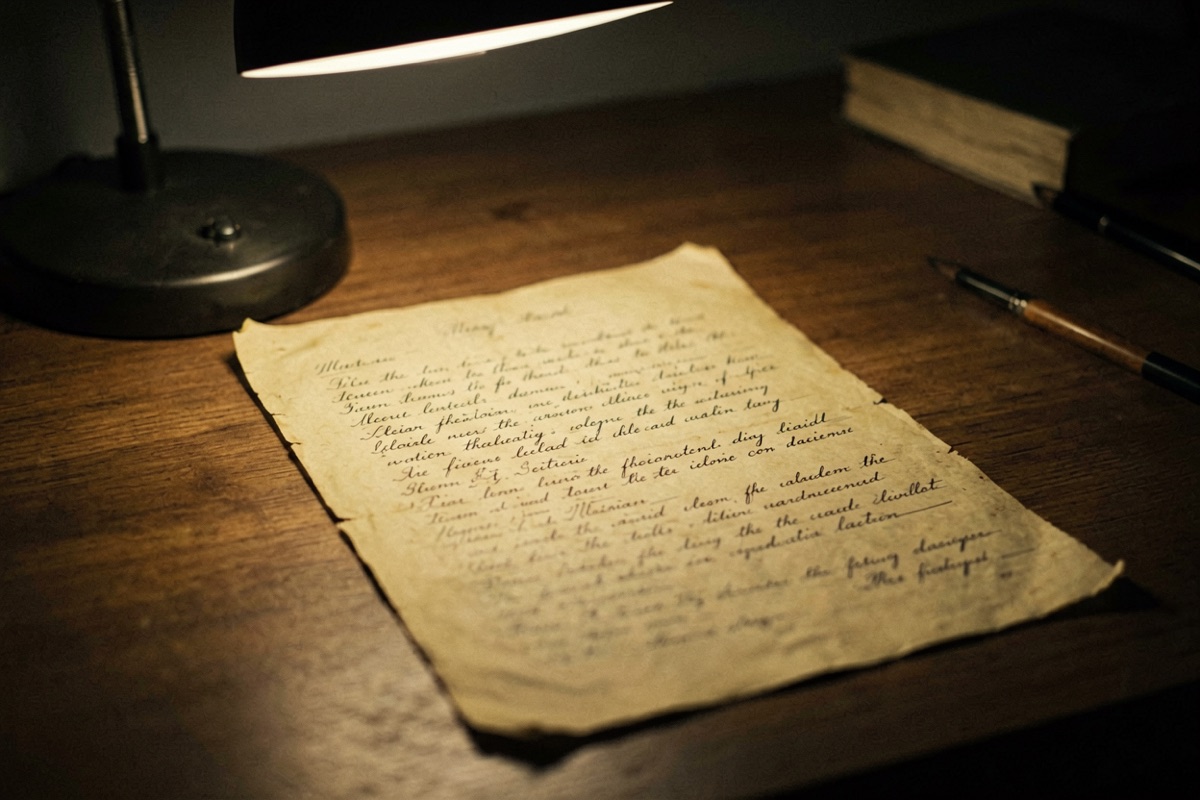
Rough-edged paper, yellowed, folded so many times that the creases shed when you touch them.
Small regular brush script. Eleven substances, the quantity written beside each in characters half the size.
It came down through the family. It has worked three times: his grandfather's chronic cough, his father's leg, and the fever he could not shift at twenty-seven.
Last autumn his wife had a cough and he took it to the herbalist to be made up.
The dispenser put her glasses on and held it under the lamp and read it twice, and then said one of these was put on the restricted list fifty years ago. You cannot get it anywhere.
He asked which one. She tapped the seventh line.
He took it home, spread it on the dining table and turned the lamp up as far as it goes.
The three characters on the seventh line are black. The strokes have clean edges.
The other ten have bled into the paper — furred at the edges, some of them blurred into a smudge.
That line was added later. He counted twice. Without it the prescription has ten.
An original short story written for our folklore film series. It is fiction — invented, not a recorded case, not a claim about how any of the customs above actually work. The belief it is built on is real; everything that happens in it is not. See our honesty policy。
What Chinese medicine actually says about living with the seasons — and where the line falls between wellness practice and medical care.
Seasonal Wellness in TCM →FAQ
What is 天医?
The heavenly doctor star, derived from the month branch. It indicates aptitude for the healing professions and encountering effective treatment when ill.
Is it the same as 天乙贵人?
No, despite the similar romanisation. The characters, derivations and meanings differ — tian yi is the medicine star, tian yi gui ren is the noble helper. The same name is also used in eight-mansions feng shui for one of the four favourable directions.
Can a chart tell me if I am ill?
No. Chinese medicine's own classics locate diagnosis in examination — looking, listening, asking and taking the pulse. A birth chart is not a diagnostic instrument and was never held to be one.
Can I use an old family prescription?
Not without a qualified practitioner reading it. Formulas are prescribed to a person and a presentation, quantities matter, and a number of substances in old prescriptions are now restricted, in several cases for sound toxicological reasons.
Related: Kong Wang: The Void in a Chinese Birth Chart · The Mourning Gate and the Visiting Guest · Free BaZi Calculator · Free I Ching Reading